In heavy industry, the “right” water is not simply the “cleanest” water—it is water that stays consistent, measurable, and engineered for a specific process. A beverage line, a boiler house, a pharmaceutical utility loop, and a microelectronics cleanroom can all start with water that looks identical, yet each reacts very differently to dissolved salts, silica, organics, particles, oxidants, and microbes. That is why Industrial Reverse Osmosis Systems are treated as production infrastructure: they turn variable feedwater into stable process water with repeatable targets for conductivity (or TDS), TOC, and particle control. When water quality drifts, boilers scale, heat-transfer efficiency drops, corrosion risk increases, and final rinses can leave spots or residues.
By making water quality stable and auditable, Industrial Reverse Osmosis Systems shift water from an uncertainty to a controlled input that supports product consistency, protects capital equipment, and reduces unplanned downtime. This guide focuses on how to specify and operate Industrial Reverse Osmosis Systems so they stay reliable after commissioning, not just on the first day they run.
Reverse osmosis (RO) is often explained in one sentence—pressure pushes water through a semi‑permeable membrane while most dissolved ions are rejected—but industrial success depends on protecting the membrane and finishing purity to specification. In high‑purity applications, RO is valued because it removes the bulk of ionic contamination and a large share of organics and particulates; a pharmaceutical water guide notes that RO typically removes about 90% to 99% of ionic contamination, most organic contamination, and nearly all particulate contamination. That same guidance also notes a key limitation: dissolved gases are not removed, so degassing or downstream polishing may be needed for demanding targets.
In practice, Industrial Reverse Osmosis Systems are not “just membranes”; they are engineered trains that combine pretreatment, pumps, instrumentation, and (when required) polishing steps such as UV, ultrafiltration, or deionization. If you want stable water quality month after month, treat Industrial Reverse Osmosis Systems as a process you control—not a filter you react to.
Industries Requiring High-Purity Water and Solutions
Why High-Purity Water Is a Strategic Utility
High‑purity water is demanded when even small impurities can create outsized losses: product defects, unstable reactions, microbial contamination, or conductivity‑driven corrosion. In regulated environments, water quality must also be proven—not assumed—because water can be present as an excipient and used throughout manufacturing and cleaning. Pharmaceutical guidance describes water as a major utility used across synthesis, production of finished product, and as a cleaning agent, and it emphasizes that microbiological quality is a major concern that drives investment in purification systems.
For the highest grades (such as when there is concern for pyrogens), regulatory inspection guidance notes that distillation and reverse osmosis are the acceptable methods listed for producing Water for Injection. In that context, Industrial Reverse Osmosis Systems are not “optional utilities”; they are part of the quality system. Well‑specified Industrial Reverse Osmosis Systems combine repeatable separation performance with monitoring and distribution controls so water quality stays stable at the use points.
Sector Snapshot: Where High Purity Pays Off
Some sectors use RO for improvement; others use RO because “good enough” water is not acceptable. In pharmaceutical water systems, Water for Injection and similar high‑grade waters are tied to strict specifications for conductivity and total organic carbon (TOC), alongside microbial and endotoxin expectations; published examples cite conductivity below about 1.3 μS/cm at 25°C and TOC below about 500 ppb.
For these utilities, Industrial Reverse Osmosis Systems are commonly combined with polishing and a controlled loop so the produced water stays compliant from generation to point of use. In microelectronics, water is a high‑volume cleaning and rinsing medium where ionic impurities, organic residues, and particles can translate into defects; a representative high‑purity chain describes conductivity approaching 18.2 MΩ·cm (about 0.055 μS/cm). In power and steam systems, treating feedwater to remove organics, particles, dissolved minerals, and dissolved gases protects boilers and turbines. Across these use cases, Industrial Reverse Osmosis Systems add value by removing bulk dissolved solids efficiently, while tailored pretreatment and finishing steps address the remaining risks.
| Industry / Process | Primary water-quality risk | Typical treatment approach |
|---|---|---|
| Pharma / Biopharma utilities | Defined limits on conductivity, TOC, microbes/endotoxin depending on grade | Industrial Reverse Osmosis Systems (single- or double-pass) + polishing (e.g., EDI or IX) + final barrier (e.g., UF) + controlled distribution loop |
| Semiconductor & precision rinse | Trace ions, particles, and TOC driving defects | Industrial Reverse Osmosis Systems + UV oxidation + degassing + polishing + microfiltration/UF in a continuously circulated loop |
| Boiler makeup / high-pressure steam | Scale/corrosion risk from dissolved solids; steam purity sensitivity | Pretreatment filtration + Industrial Reverse Osmosis Systems for bulk mineral reduction + polishing (IX/EDI) + optional degassing |
| Food & beverage ingredient water | Flavor stability, scaling, odor/organics affecting product profile | Carbon pretreatment + Industrial Reverse Osmosis Systems + blending/remineralization aligned with recipe needs |
| Surface finishing & coating lines | Spotting, bath instability, deposition on parts | Tailored pretreatment + Industrial Reverse Osmosis Systems; add polishing where final rinses are critical |
Membrane Technology and Filtration Stages
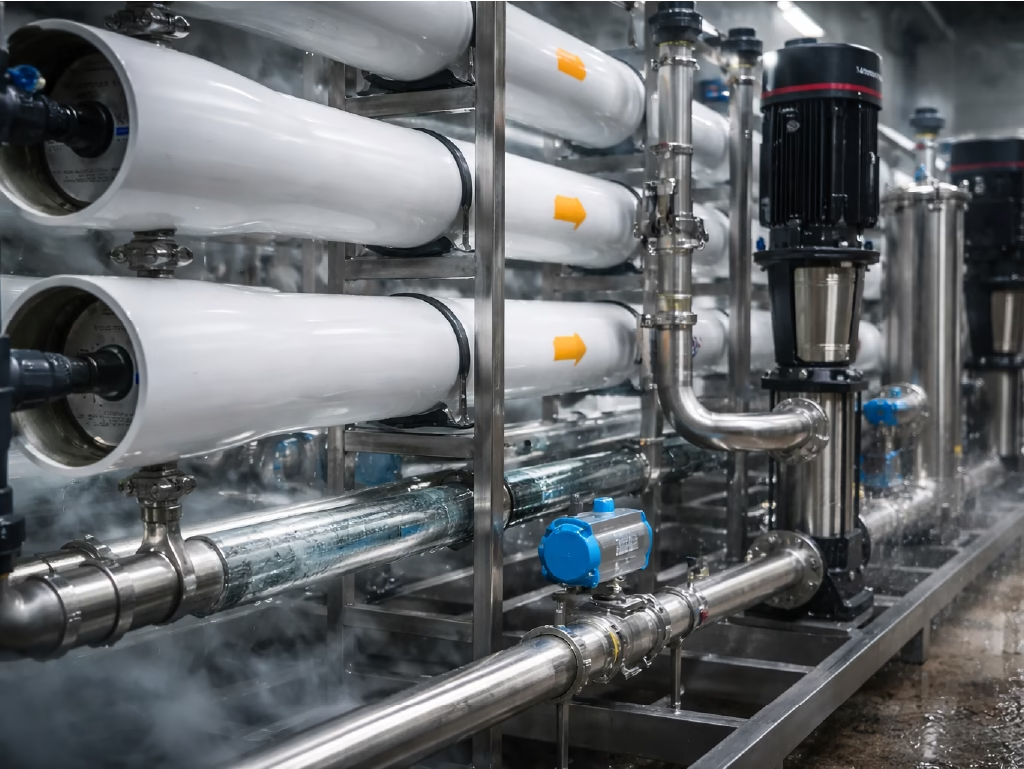
Think of Industrial Reverse Osmosis Systems as staged risk reduction. Stage one is feedwater conditioning, matched to source variability. RO pretreatment guidance shows that surface water generally needs more elaborate pretreatment than consistent well water, and it lists common steps for variable surface water: chlorination, coagulation/flocculation, clarification, multimedia filtration, dechlorination, and acidification and/or antiscalant dosing. Stage two is particulate control.
Practical guidance states that turbidity of feedwater to RO/NF should be less than 1 NTU as a minimum requirement and uses SDI as a routinely applied fouling index. Stage three is a final safety filter: guidance recommends a cartridge filter with absolute pore size below 10 µm as the minimum pretreatment for every RO system, with 5 µm absolute recommended. Stage four is membrane separation, followed—when needed—by finishing. Double-pass Industrial Reverse Osmosis Systems and polishing steps (for example UV oxidation, ultrafiltration, or deionization) are added when conductivity, TOC, or particles must be pushed lower than a single RO pass can reliably deliver.
Detail work is where most projects win or lose. Specifications for Industrial Reverse Osmosis Systems should define permeate targets and the feedwater “protection” targets that keep membranes healthy—especially turbidity, SDI, oxidant residuals, and cartridge filter differential pressure. Use absolute prefiltration as recommended so the RO stage behaves like separation equipment, not emergency filtration. Also clarify maintainability up front: which stages can be isolated, whether the system has CIP connections, and how baselines will be documented. When these points are addressed early, Industrial Reverse Osmosis Systems are easier to operate, and troubleshooting Industrial Reverse Osmosis Systems becomes faster.
Designing RO Trains for Different Purity Targets
The “best” Industrial Reverse Osmosis Systems design is the one that meets specification at the lowest lifetime risk, not the one that maximizes theoretical rejection on day one. Single‑pass Industrial Reverse Osmosis Systems are often sufficient for bulk desalting where the target is stable conductivity/TDS reduction and lower scaling potential. When targets tighten—particularly for regulated utilities—designers add double‑pass RO and/or continuous polishing.
Pharmaceutical guidance describes Water for Injections production by reverse osmosis that may be single‑pass or double‑pass, coupled with techniques such as electro‑deionisation, ultrafiltration, or nanofiltration. Regulatory inspection guidance also recognizes reverse osmosis (alongside distillation) as an acceptable method listed for producing Water for Injection. In regulated applications, that end‑to‑end thinking is what separates commodity skids from Industrial Reverse Osmosis Systems that perform consistently.
Monitoring, Sanitization, and Membrane Protection
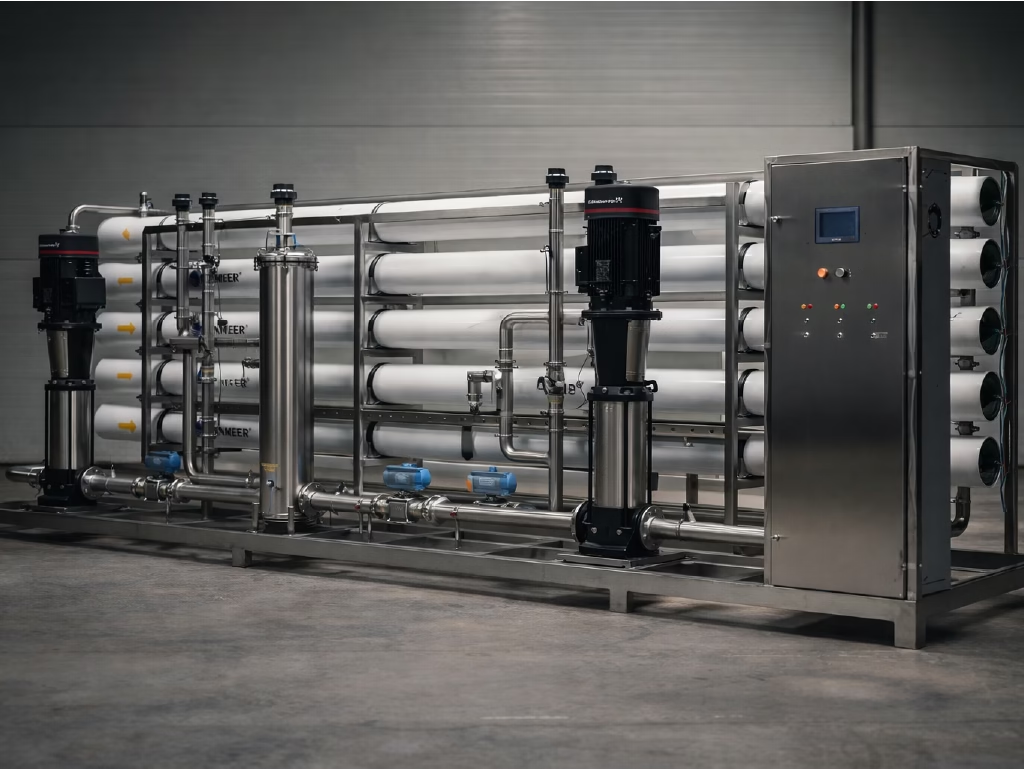
Monitoring is what turns Industrial Reverse Osmosis Systems from “installed equipment” into “controlled quality.” Practical design guidance recommends instrumenting each stage using conductivity/TDS, pressure, temperature, and flow on the feed, concentrate, and permeate streams. It provides a sampling roadmap from intake to after filtration units, after dechlorination (normally after cartridge filtration), and finally to concentrate and permeate streams.
Oxidant control is critical: dechlorination guidance explains that RO/NF feed must be dechlorinated to prevent oxidation and describes activated carbon and sodium metabisulfite as effective tools; it even notes typical dosing logic (about 3.0 mg SMBS used in practice to remove 1.0 mg free chlorine). Well‑planned Industrial Reverse Osmosis Systems also include maintainability features such as provisions to clean stages individually and clean‑in‑place (CIP) capability. Teams that run Industrial Reverse Osmosis Systems well treat monitoring data as a daily operating control, not a quarterly report.
Common Challenges and How to Prevent Them
The most common performance killers in Industrial Reverse Osmosis Systems map to fouling, scaling, organic loading, and biofouling. Design guidance explains that SDI correlates with fouling material in pretreated feedwater and that increasing flux and element recovery tends to increase fouling rates, driving more frequent chemical cleaning. Exceeding operating limits can mean more cleanings, reduced capacity, increased feed pressure, and reduced membrane life. The practical response is simple: keep feedwater turbidity/SDI stable, keep oxidants off the membranes, and act on trends early. A disciplined operating window is what keeps Industrial Reverse Osmosis Systems profitable.
- Fast checklist for stable operation
- Trend turbidity/SDI, validate dechlorination, monitor differential pressures, and verify permeate conductivity by stage so Industrial Reverse Osmosis Systems stay inside their design window.
When designed and operated well, Industrial Reverse Osmosis Systems do more than “make clean water.” They create a predictable utility that supports yield, protects equipment, and reduces the downstream work required to stay in specification. Treat pretreatment as the foundation, choose single‑pass or double‑pass Industrial Reverse Osmosis Systems based on the real purity target, and add finishing steps only where they reduce risk. That is how Industrial Reverse Osmosis Systems become a stable process—not a constant maintenance project. With clear documentation for every shift, every day.
Ready to make water quality a controllable part of production rather than a daily firefight? Start with three inputs: a current feedwater analysis, a clear purity target at the point of use, and an uptime plan (monitoring frequency, spares, and clean‑in‑place strategy). With that foundation, an experienced engineering partner can tailor pretreatment to your fouling and oxidant risks, size Industrial Reverse Osmosis Systems for stable flux and recovery, and recommend polishing only where it truly protects quality or compliance. If you want a solution that is engineered—not guessed—explore project support at https://atmosfermakina.com/.
You will get more value from Industrial Reverse Osmosis Systems when the design includes the details that keep performance steady: correct pretreatment, clear instrumentation, sensible CIP provisions, and a commissioning plan that sets operating baselines. Whether your goal is protecting boilers, meeting strict utility standards, or building a high‑purity rinse loop, the right partner helps you translate specs into Industrial Reverse Osmosis Systems that run reliably, are easy to maintain, and keep your team focused on production. Ask for a transparent scope: instrumentation list, performance documentation at startup, operator training, and a service plan for consumables and membrane cleaning. Those details often determine lifetime cost. Long-term reliability.
