
AdBlue® production energy consumption is one of the most important cost factors for companies that produce DEF, supply fleet operators, serve fuel stations or invest in private-label AdBlue® manufacturing. A plant may have high daily capacity, but real profitability depends on how much energy is required to dissolve urea, mix the solution, transfer the product and run the filling line. When AdBlue® production energy consumption is not controlled, every batch carries hidden operating losses.
Reducing AdBlue® production energy consumption requires a complete process view. Heating demand, water temperature, urea feeding, batch timing, pump selection, automation level, filling speed and operator workflow all affect the final energy cost. A low energy AdBlue® plant should be engineered according to production capacity, site conditions and long-term business goals. AdBlue® production energy consumption should remain measurable from the first design stage.
Atmosfer Makina designs automated DEF production solutions that help businesses manage AdBlue® production energy consumption with controlled batch processes, efficient equipment selection and integrated filling systems. With the right project-based approach, producers can reduce waste, improve consistency and build a more competitive AdBlue® production operation.
Where Energy Is Consumed in DEF Manufacturing
Understanding AdBlue® production energy consumption starts with identifying where energy is used inside the plant. DEF manufacturing includes thermal loads, mechanical loads and automation-related electrical loads. The most visible energy demand usually comes from urea dissolution and possible heating requirements, while mixing, pumping, filtration, water treatment and filling equipment create repeated electrical consumption.
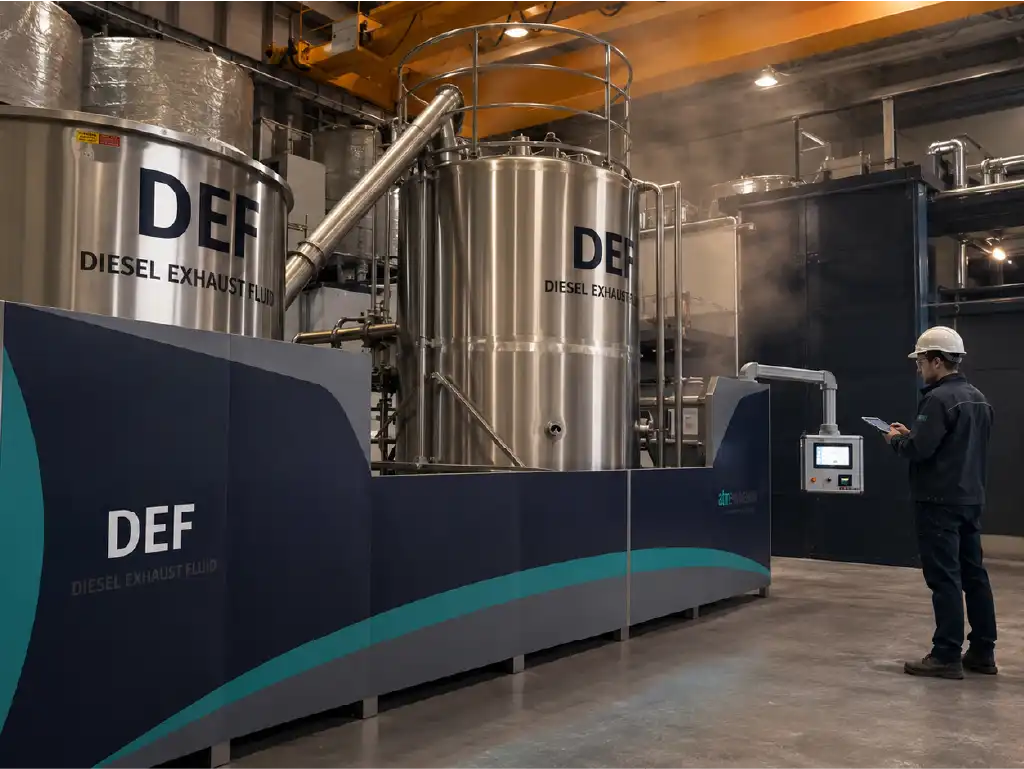
Energy use is strongly affected by working conditions. A facility operating with cold process water may require more thermal support than a facility where water and urea are stored at stable temperatures. A plant with long transfer distances may require more pump energy. A filling line that stops frequently may force equipment to wait in standby. These small inefficiencies can increase AdBlue® production energy consumption over time. AdBlue® production energy consumption also changes when batch frequency increases.
Industrial energy guidance from the U.S. Department of Energy process heating resources emphasizes that best operating practices and advanced control technologies can reduce manufacturing energy use. In DEF manufacturing, the same principle applies: AdBlue® production energy consumption should be controlled through correct heating, optimized process timing and reliable automation.
Urea dissolution and heating requirements
Urea dissolution is a critical stage because AdBlue® is produced by dissolving high-purity urea in demineralized water at the correct concentration. During this stage, AdBlue® production energy consumption can increase if the system depends on excessive heating or if dissolution takes longer than necessary. The plant should balance heat input, mixing performance, water quality and batch speed.
Heating is not always required at the same level in every project. Climate, raw material temperature, storage conditions, tank geometry and daily production targets all influence real demand. A professional plant design should calculate these variables instead of using oversized heating power. Oversizing may seem safe, but it can raise AdBlue® production energy consumption and reduce long-term efficiency.
Atmosfer Makina focuses on controlled dissolution, accurate dosing and reliable batch completion. In a well-designed automated DEF production system, AdBlue® production energy consumption can be reduced by preventing unnecessary heating time and by ensuring that the process moves to the next stage only when the correct condition is reached.
Mixing, pumping and filling line electricity usage
Mixers, pumps and filling lines also play a major role in AdBlue® production energy consumption. These systems may not draw as much power as heating equipment at a single moment, but they operate repeatedly throughout the production day. If mixers run after the solution reaches the required condition, or if pumps continue during idle stages, energy is wasted without improving product quality.
Mixing efficiency depends on tank volume, mixer design and operating duration. Pumping efficiency depends on pipe diameter, valve losses, filtration resistance and the selected pump curve. Filling line energy depends on packaging format, conveyor operation, filling accuracy, capping, labeling and stop-start frequency. Each factor can raise or lower AdBlue® production energy consumption. AdBlue® production energy consumption becomes easier to control when equipment works in sequence.
For producers filling IBCs, drums, jerrycans or bulk storage tanks, the production machine and filling line should work as one integrated system. Atmosfer Makina offers filling, capping and labeling solutions that support automated DEF production, reduce waiting time and improve overall energy use per finished batch.
Energy-Efficient Production Design Strategies for AdBlue® Production Energy Consumption
Reducing AdBlue® production energy consumption requires an engineering strategy, not only individual equipment changes. A plant with efficient components can still waste energy if the process sequence is weak. Likewise, a smaller machine can become expensive to operate if batch control, heating logic and filling coordination are not optimized.
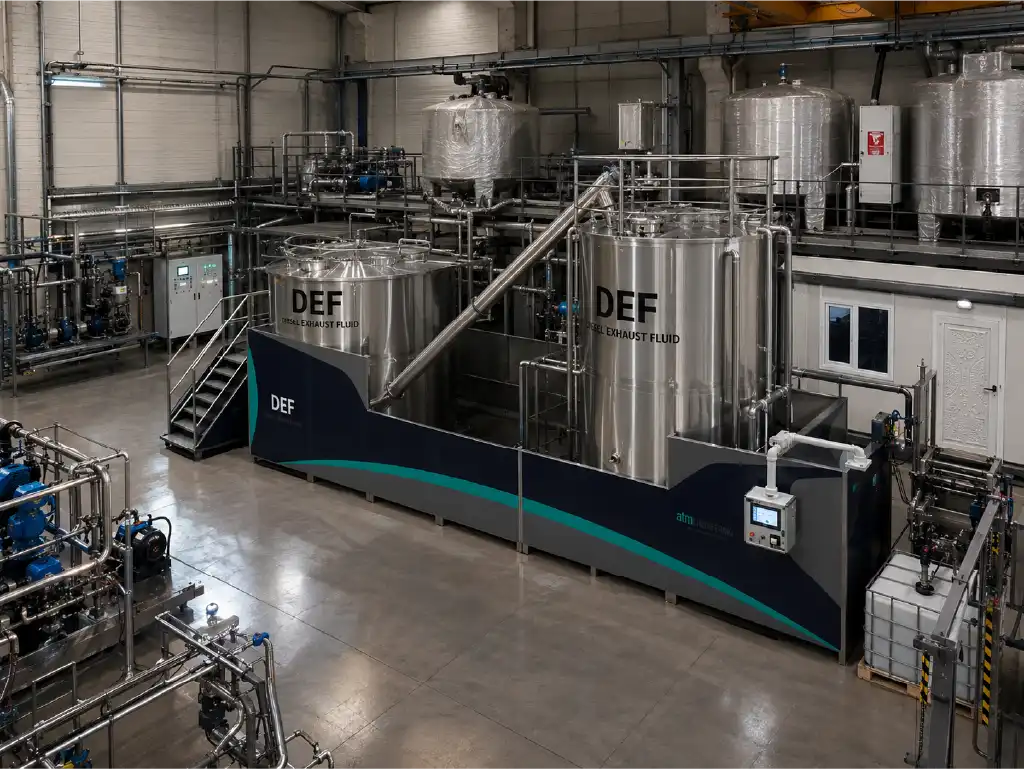
The most effective approach is to evaluate the whole production cycle. Producers should measure energy use per batch, per cubic meter and per operating day. This makes it easier to see whether the main problem is heating, mixing, pumping, water treatment, standby time or filling delays. Once the source of AdBlue® production energy consumption is clear, improvements can be prioritized. AdBlue® production energy consumption should be tracked after every major process adjustment.
Optimized dissolution process and batch control
Batch control is one of the strongest tools for reducing AdBlue® production energy consumption. In manual or semi-automatic plants, operators may depend on fixed timing, visual checks or experience. This can cause overmixing, unnecessary circulation, excessive heating and inconsistent production times. In an automated plant, process steps are controlled by defined parameters and sensor feedback.
Optimized batch control helps the system start and stop equipment at the right moment. Water transfer, urea feeding, dissolution, mixing, circulation and final product transfer can be sequenced to avoid unnecessary overlap. This reduces energy peaks and supports safer operation. More importantly, it reduces AdBlue® production energy consumption without sacrificing product quality.
Atmosfer Makina’s AdBlue® Production Line AUS32 solutions are developed for precise production control, consistent concentration and scalable output. For investors, production capacity can be evaluated together with AdBlue® production energy consumption, labor requirement, maintenance needs and long-term cost performance.
Automation, sensors and process timing
Automation reduces DEF plant energy efficiency problems by turning process data into real-time control. Sensors can monitor liquid levels, flow, temperature, conductivity, pressure, transfer completion and process status. When these values are connected to PLC-based automation, the plant can reduce AdBlue® production energy consumption by avoiding unnecessary operation.
Sensor accuracy is especially important. If a system cannot detect when dissolution is complete, mixing may continue longer than required. If a level sensor is not reliable, pumps may run inefficiently. If process timing is not coordinated, equipment may remain active during waiting periods. These hidden losses increase AdBlue® production energy consumption and maintenance demand.
Automation also supports quality assurance. Energy savings should never compromise DEF purity or concentration requirements. The correct goal is to reduce AdBlue® production energy consumption while maintaining controlled production, filtration, analysis and repeatability. This is why Atmosfer Makina combines automation, user-friendly control panels and process monitoring within turnkey AdBlue® production systems. AdBlue® production energy consumption becomes more predictable when automation replaces guesswork.
Expert note: AdBlue® production energy consumption should be evaluated together with water quality, urea quality, filtration performance, storage conditions and batch analysis. Lower energy settings are useful only when they support consistent DEF quality. The best results come from project-based engineering, commissioning and periodic control.
| Process Area | Energy Risk | Efficiency Strategy | Expected Benefit |
|---|---|---|---|
| Urea dissolution | Excessive heating and slow dissolution | Controlled heat input and optimized batch timing | Lower AdBlue® production energy consumption per batch |
| Mixing | Long mixer operation after process completion | Sensor-based completion and correct mixer sizing | Reduced electricity waste |
| Pumping | Pressure losses and unnecessary circulation | Efficient pump selection and optimized pipe layout | Lower operating load |
| Filling line | Bottlenecks and stop-start operation | Integrated filling, capping and labeling automation | Higher output with less idle time |
| Control system | Manual timing and inconsistent operation | PLC control, sensors and process monitoring | Stable quality and lower AdBlue® production energy consumption |
How Lower Energy Use Affects Production Cost
AdBlue® production energy consumption has a direct effect on AdBlue® production cost, but the financial impact is broader than the electricity bill. Energy efficiency also influences batch time, labor planning, maintenance frequency, equipment life and production reliability. In competitive DEF markets, reducing unnecessary energy use helps producers protect margins without lowering quality.
A plant should be evaluated by cost per liter, not only by installed capacity. A system that completes a batch quickly but consumes excessive energy may not be the best choice. A system that uses low power but takes too long may also reduce daily output. The right design balances AdBlue production energy consumption, production speed, quality stability and investment cost.
Energy cost per batch calculation
The simplest method is to calculate energy cost per batch. Producers can measure electricity used during dissolution, heating, mixing, pumping, water treatment and filling. This value is multiplied by the local electricity tariff and divided by finished production volume. The result gives a practical indicator of AdBlue® production energy consumption per batch and per liter.
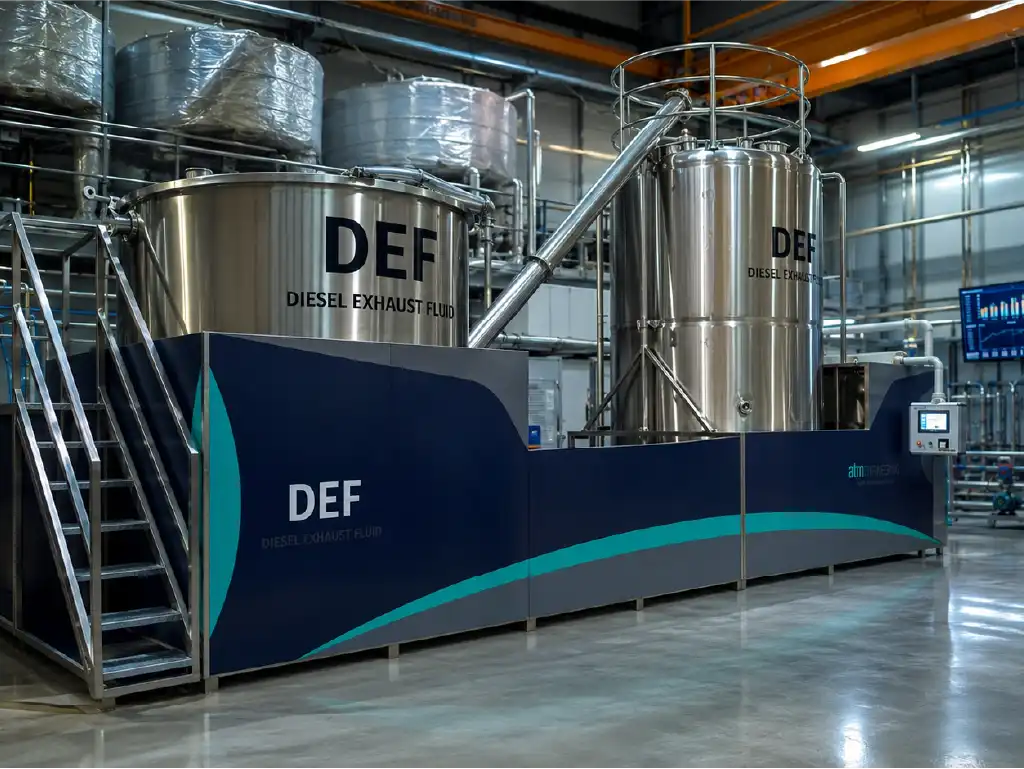
This calculation becomes more useful when compared across different operating conditions. Producers can compare cold water batches with warmer water batches, manual timing with automated timing, full batches with partial batches and direct transfer with extended circulation. These comparisons reveal where AdBlue® production energy consumption can be reduced most effectively.
A professional feasibility study should also include raw material cost, demineralized water cost, labor, maintenance, packaging, storage and target sales volume. AdBlue® production energy consumption should be reviewed with these cost factors. Atmosfer Makina supports customers with project-based evaluation so that machine capacity, automation level and filling configuration match real business needs.
Long-term ROI for automated AdBlue® plants
Long-term ROI is where automated DEF production becomes especially important. A small saving in AdBlue® production energy consumption may look minor in a single batch, but it can become significant across daily, monthly and yearly production. For regional DEF producers, fleet supply companies and fuel distributors, energy savings can directly support stronger profitability.
Automation also reduces dependency on manual decisions. A trained operator is still essential, but the system can standardize production steps, reduce process variation and lower the risk of off-spec batches. This improves productivity and reduces avoidable waste. As a result, AdBlue® production energy consumption becomes part of a wider ROI calculation.
Atmosfer Makina’s AdBlue® Production Skid solutions are developed for efficient, modular and precise production. For investors who want a low energy AdBlue® plant with scalable capacity, a skid-based or turnkey automated system can simplify installation and improve long-term operational control.
Key Factors Before Choosing a Low Energy AdBlue® Plant
Before investing, producers should define expected production volume, batch frequency, available electrical infrastructure, water source, packaging type and future expansion plan. Without this information, it is difficult to estimate AdBlue® production energy consumption accurately. A plant designed for one shift may not be suitable for continuous production, and a plant designed for bulk supply may need different planning than a plant focused on jerrycan filling.
Water preparation is another critical point. AdBlue® production requires high-purity water, and many facilities use reverse osmosis, deionization or additional purification technologies. Atmosfer Makina’s industrial reverse osmosis water purification systems can be integrated into DEF projects to support reliable water supply and stable production.
AdBlue® production energy consumption should also be considered during facility layout planning. Shorter transfer routes, accessible maintenance areas, correct tank placement, good insulation and organized filling zones can reduce losses. These details may seem small during investment planning, but they can affect daily operating cost for years. AdBlue® production energy consumption should be part of every layout decision.
- Analyze daily and monthly DEF demand before choosing plant capacity.
- Calculate expected AdBlue® production energy consumption according to batch size.
- Review local electricity cost and available power infrastructure.
- Evaluate raw water quality and purification requirements.
- Choose automation level according to labor availability and quality control needs.
- Plan filling formats such as IBC, drum, jerrycan or bulk transfer.
FAQ About AdBlue® Production Energy Consumption
What consumes the most energy in AdBlue® production?
In many plants, urea dissolution and process heating create the highest DEF production energy efficiency. However, mixing, pumping, water treatment and filling line operation also contribute to total energy use. The exact result depends on equipment design, batch size, site temperature and automation level.
How can automation reduce DEF production cost?
Automation can reduce DEF production cost by controlling batch timing, dosing, transfer sequences, heating, pumps and process completion. When equipment operates only when needed, DEF production energy efficiency decreases and production repeatability improves.
Is heating always required in urea dissolution?
Heating requirements depend on water temperature, urea temperature, desired batch time, tank design and mixing performance. Heating may be useful, but it should be calculated project by project. Oversized or uncontrolled heating can increase DEF production energy efficiency.
How does batch time affect energy efficiency?
Batch time affects energy efficiency because longer cycles can keep mixers, pumps and control systems active for extended periods. Very fast cycles can also increase AdBlue® production energy consumption if they depend on excessive heating. The best process balances speed, quality and energy input.
How can producers calculate AdBlue® production energy consumption?
Producers can calculate AdBlue® production energy consumption by measuring electricity used during each production stage and dividing the cost by finished batch volume. This method helps identify high-cost stages and supports better process decisions.
Build a More Efficient AdBlue® Production Plant with Atmosfer Makina
Reducing AdBlue® production energy consumption starts with correct engineering, not only lower equipment power. Atmosfer Makina designs and manufactures automated DEF production systems that help businesses control energy use, improve batch consistency and reduce long-term production cost. Whether you are planning a new facility, expanding capacity or improving an existing process, the right configuration can make daily operation more efficient.
With expertise in AdBlue® production plants, water purification, automation, filling lines and turnkey industrial solutions, Atmosfer Makina provides project-based support from technical evaluation to commissioning. The goal is to build a reliable production process aligned with your capacity, quality and ROI expectations. To explore efficient DEF manufacturing solutions, request technical information or discuss your investment needs, visit Atmosfer Makina and connect with an expert team for a tailored consultation focused on AdBlue® production energy consumption.
