
Choosing the right AdBlue® production plant capacity before investment is one of the most important decisions for any distributor, fleet operator, fuel supplier or industrial investor entering the DEF market. Capacity is not only about how many liters a machine can produce per hour. It also affects storage tank volume, filling line speed, labor planning, dispatch rhythm, raw material purchasing, export readiness and long-term profitability.
A plant that is too small may create delivery delays, missed sales opportunities and pressure on operators. A plant that is too large may increase the initial investment, occupy unnecessary space and keep working capital locked in unused storage. For this reason, AdBlue® production capacity planning should begin with real market demand, expected growth, packaging formats and logistics strategy rather than only machine specifications.
Atmosfer Makina designs and manufactures turnkey DEF and AdBlue® production systems for businesses that need controlled, efficient and scalable production. With the right technical evaluation, investors can match their AUS32 production volume with actual sales potential and avoid over-investing or under-sizing the facility.
Why Capacity Planning Matters in AdBlue® Production
Capacity planning is the bridge between market opportunity and operational reality. A business may identify strong local demand for Diesel Exhaust Fluid, but if production, filling, storage and dispatch are not balanced, the plant will not operate efficiently. In DEF manufacturing capacity calculations, the main objective is to define how much finished product can be produced, stored, packaged and shipped within a realistic working period.
AdBlue® is used in Selective Catalytic Reduction systems to help reduce nitrogen oxide emissions in diesel engines. The United States Environmental Protection Agency explains that vehicles using DEF are required to meet specific emissions standards, particularly for NOx control, and SCR systems rely on proper DEF availability and function. You can review the official information on diesel exhaust fluid from the EPA.
This regulatory and operational importance makes reliable supply a serious business matter. If a distributor serves truck fleets, construction machinery, agricultural equipment, fuel stations or export buyers, production delays may directly affect customer confidence. Therefore, AdBlue® production plant capacity should be calculated with a complete view of demand, stock safety, packaging limitations and delivery frequency.
Hourly production vs. daily market demand
Many investors first ask how many liters per hour the plant should produce. This is a useful starting point, but hourly output alone does not define the real DEF plant capacity. A machine may be capable of producing a certain volume per batch or per hour, yet the actual daily output depends on working hours, batch preparation, cleaning procedures, quality checks, operator availability and the speed of transferring finished AdBlue® to storage tanks.
For example, a regional distributor with a daily demand of 20,000 liters does not necessarily need a system that produces 20,000 liters continuously within one hour. If the business works one shift of eight hours and has enough storage capacity, a lower hourly capacity may still meet daily demand. However, if the same distributor receives bulk tanker orders early in the morning and jerrycan orders in the afternoon, the production plan must support both stock replenishment and dispatch deadlines.
A practical way to start is to calculate average daily sales, peak daily demand and expected growth over the next 12 to 24 months. The selected production capacity should cover normal demand comfortably and allow for peak periods without forcing the plant into constant emergency production. In most cases, capacity should be calculated based on realistic operating hours rather than maximum theoretical operation.
Storage, filling and dispatch balance
Production is only one part of the process. If the plant produces faster than the filling line can handle, finished product will accumulate in storage. If filling is faster than production but storage is too limited, operators may still face interruptions. If dispatch is not planned properly, packaged products may occupy too much warehouse space and slow down daily movement.
Storage tanks should be sized according to daily production, delivery cycles, customer order types and safety stock requirements. In many cases, storage capacity should be higher than one day of production, especially for distributors serving multiple customer groups. This allows the business to continue filling and dispatching even if production is temporarily stopped for maintenance, quality control or raw material loading.
The balance between production, filling and dispatch also affects cash flow. Large storage can provide flexibility, but excessive stock may increase working capital requirements. Small storage can reduce initial cost, but it may create pressure during peak demand. A project-based technical analysis helps define the right balance for each investment.
Key Factors That Determine DEF Plant Capacity
DEF plant capacity is shaped by several connected factors. Market demand, production technology, automation level, batch time, working shifts, filling options, storage infrastructure and quality control procedures must be evaluated together. A professional capacity study should not focus only on the machine label. It should answer a more important question: can the entire facility produce and deliver the required volume consistently?
Atmosfer Makina’s AdBlue® production facility solutions are designed around automated production, accurate mixing, smart control and efficient batch management. This type of system helps investors reduce manual dependency and improve production consistency. However, the correct capacity still depends on the investor’s market and operational targets.
Fleet size, distributor demand and export targets
A fleet operator and a regional distributor may require very different capacity levels even if their current consumption looks similar. A fleet operator usually produces for internal use, which makes demand easier to estimate. The calculation can be based on vehicle count, average diesel consumption, DEF consumption ratio, operating days and safety stock. This type of business may prioritize supply security, quality control and predictable operating cost.
A distributor, on the other hand, must calculate demand across many customer types. Fuel stations, logistics companies, agricultural users, wholesalers and industrial buyers may all order in different volumes and packaging formats. Demand may also fluctuate seasonally. Agricultural regions may see higher DEF demand during specific working periods, while logistics corridors may require stable year-round supply.
Export-focused investors should add another layer to DEF manufacturing capacity planning. Export orders often require stronger storage, faster filling, container loading capability, documentation, consistent quality control and reliable production records. If export is a serious target, the selected AdBlue® production plant capacity should not only meet today’s domestic sales. It should also support larger batch dispatches, longer lead times and international order consolidation.
Batch time, automation level and working shifts
Batch time directly affects AUS32 production volume. A system with faster controlled batching can produce more within the same working day, provided that raw material feeding, water treatment, transfer pumps and storage capacity are aligned. Automation level is also critical because manual operations can slow down production and increase the risk of inconsistency.
Advanced automation helps control urea dosing, purified water transfer, mixing, monitoring and product transfer with less manual intervention. Atmosfer Makina states that its automated system controls and mixes urea and water precisely, monitors the process in real time and supports efficient production with reduced waste. Investors can explore related engineering solutions through the AdBlue® production skid page.
Working shifts are another key variable. A plant producing 5,000 liters per hour for one shift may have lower daily output than a smaller system running two or three shifts. However, adding shifts increases labor planning, energy consumption, maintenance scheduling and quality control workload. Before deciding on a larger machine, investors should compare the cost of higher equipment capacity with the cost and practicality of extended working hours.
| Planning Factor | Why It Matters | Capacity Impact |
|---|---|---|
| Daily market demand | Defines the minimum volume needed to serve customers | Sets the baseline production target |
| Peak demand | Shows the highest expected order pressure | Determines safety margin and storage needs |
| Batch time | Affects how many cycles can be completed per day | Improves or limits daily output |
| Automation level | Reduces manual delays and supports consistency | Improves usable capacity |
| Filling line speed | Controls how quickly product can be packaged | May become the real bottleneck |
| Storage tank volume | Protects supply continuity during production pauses | Supports stable dispatch |
Expert note: When calculating AdBlue® production plant capacity, do not evaluate the production unit alone. A professional feasibility study should include water treatment capacity, urea handling, finished product storage, filling equipment, laboratory control, dispatch area and future expansion potential.
How to Match Production Capacity with Filling Options
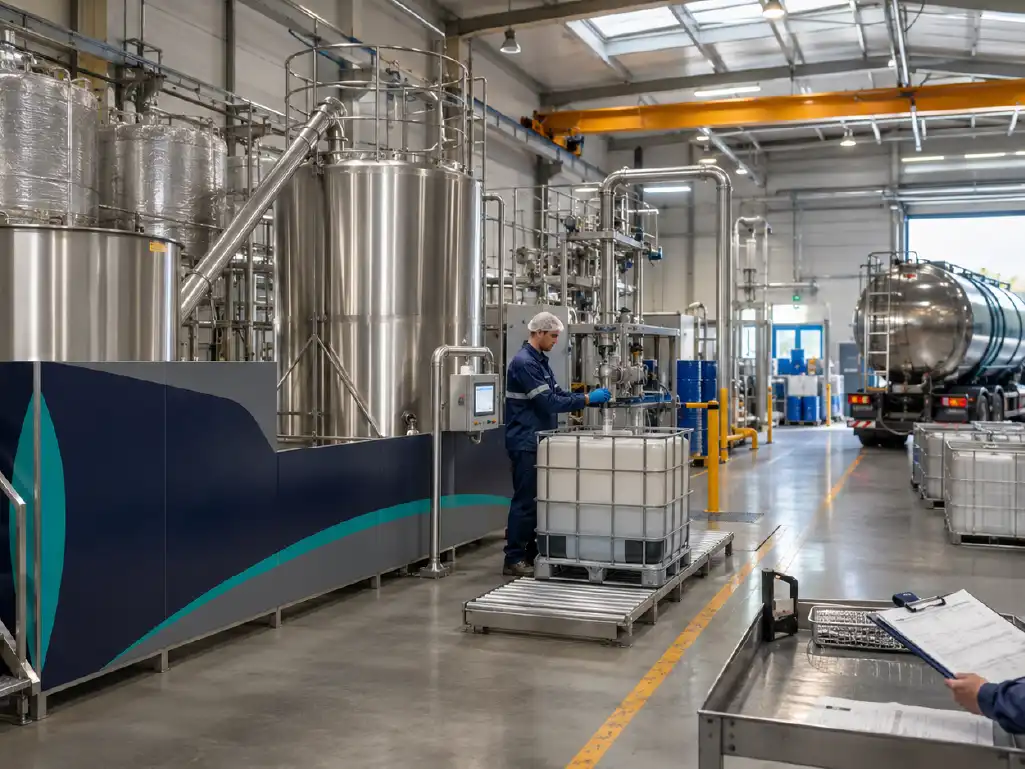
The packaging strategy can change the entire capacity calculation. A plant may produce enough AdBlue® in bulk, but if the filling line cannot package the product fast enough, daily sales will still be limited. This is especially important for companies planning to sell in multiple formats such as 10-liter jerrycans, 20-liter jerrycans, 200-liter drums, 1000-liter IBC tanks and bulk tanker deliveries.
For this reason, production capacity should be matched with filling capacity from the beginning of the project. Investors should define which packaging format will generate the highest sales volume, which format will require the most labor and which format may become a bottleneck during peak periods. Atmosfer Makina’s AdBlue® Production Line AUS32 solutions can be evaluated with different operational scenarios depending on the target market.
Jerrycan, drum, IBC and bulk tanker scenarios
Jerrycan filling is usually more labor and packaging intensive. It may be suitable for retail distribution, fuel station sales and smaller customers, but it requires capping, labeling, packing and palletizing. Even if the production plant can produce high volumes, slow jerrycan filling may reduce the effective daily dispatch capacity. Therefore, investors planning retail sales should pay special attention to filling automation.
Drum filling is generally faster than small jerrycan filling but still requires handling, labeling and storage organization. It is commonly used for workshops, medium fleets and industrial customers. IBC filling can move larger volumes with fewer units, making it attractive for distributors and fleet operators. However, it requires enough floor space, forklift movement, clean transfer connections and organized loading areas.
Bulk tanker supply is the fastest option for high-volume customers, but it requires stronger storage planning and reliable dispatch infrastructure. If most sales will be made in bulk, the plant should prioritize large finished product tanks, transfer pump capacity, loading safety and quality traceability. In this scenario, the filling line may not be the main limitation; storage and tanker dispatch frequency may become more important.
- Retail-focused model: Higher need for jerrycan filling, packaging materials, labeling and pallet preparation.
- Fleet supply model: Balanced need for IBC, drum and sometimes bulk delivery.
- Regional distributor model: Higher storage capacity, mixed packaging and faster dispatch planning.
- Export model: Strong need for documentation, quality control, container planning and scalable storage.
When to scale from compact to modular production
Compact systems can be a smart starting point for investors who want controlled production with manageable initial investment. They are suitable for moderate demand, local distribution, internal fleet consumption or market entry projects. However, if demand grows quickly, the business may need more storage, faster filling or additional production modules.
The decision to scale from compact to modular production should be based on measurable indicators. If the plant regularly operates at near full capacity, if orders are delayed due to limited production time, if filling lines work longer than planned or if storage runs empty before the next production cycle, expansion should be evaluated. Modular production helps investors increase capacity step by step instead of replacing the entire system.
Atmosfer Makina emphasizes capacity flexibility in its production skid solutions, with systems designed for different daily output requirements. This approach allows businesses to match current demand while keeping future growth in mind. Investors who are still at the feasibility stage can also review the guide on how to set up an AdBlue® production line for broader infrastructure planning.
Scaling should also consider utilities and site layout. A modular plant may need additional electrical capacity, water treatment output, tank foundations, warehouse space and loading area. If these requirements are considered during the first investment, future expansion becomes easier and more cost-effective.
Practical Capacity Calculation Method Before Investment
A simple but effective capacity calculation starts with the target sales volume. First, estimate average monthly demand and divide it into working days. Then identify peak demand days and add a realistic safety margin. Next, compare this number with production hours, batch time, storage capacity and filling speed. The result will show not only the required production volume but also the weakest point in the facility plan.
For example, if a distributor expects to sell 300,000 liters per month and works 25 days, the average daily demand is 12,000 liters. If peak demand can reach 18,000 liters per day, the plant should be designed to handle peak pressure without disrupting quality control or dispatch. If the filling line can only package 8,000 liters per day in jerrycans, then filling capacity becomes the limitation, even if production capacity is higher.
Investors should also calculate storage according to demand profile. A facility serving regular customers may operate with moderate safety stock. A regional distributor with mixed customers may need enough finished product storage for several days of dispatch. An export-oriented facility may need larger stock before container loading or bulk shipment.
- Define average daily demand and expected annual growth.
- Calculate peak daily demand and seasonal fluctuations.
- Choose realistic working hours and shift structure.
- Compare production output with filling line speed.
- Size finished product storage according to dispatch cycles.
- Review expansion potential before final investment.
This method gives a practical starting point, but final engineering should be completed through project-based evaluation. Water quality, raw material availability, site layout, local regulations, energy infrastructure and logistics conditions can all influence the correct DEF plant capacity.
Common Mistakes in AdBlue® Production Capacity Planning
One common mistake is selecting equipment only according to the highest possible production number. Maximum capacity is useful, but it does not always represent daily usable capacity. Downtime, cleaning, raw material loading, quality checks, maintenance and operator workflow must be included in the calculation.
Another mistake is ignoring the filling line. A strong production system paired with a slow filling operation can create a bottleneck. Investors should evaluate whether they will mainly sell jerrycans, drums, IBCs or bulk product before choosing the plant configuration. In many real operations, filling and dispatch define the customer experience more than production speed alone.
A third mistake is underestimating storage. Finished AdBlue® storage provides operational flexibility, but it must be designed with proper material compatibility, cleanliness and quality protection in mind. Storage tanks, pipelines and transfer equipment should support product purity and prevent contamination risks.
Finally, some investors plan only for today’s demand. A better approach is to define current capacity, expected growth and the point at which modular expansion will become necessary. This creates a more controlled investment path and supports long-term profitability.
FAQ
How many liters per hour should an AdBlue® plant produce?
The required liters per hour depend on daily demand, working hours, batch time, storage volume and filling speed. A small fleet operator may need a lower hourly output, while a regional distributor or export-focused business may require significantly higher capacity. The best approach is to calculate average daily demand and peak demand first, then match the hourly production rate to a realistic operating schedule.
What capacity is suitable for a regional DEF distributor?
A regional DEF distributor should select capacity according to customer mix, delivery frequency and packaging formats. If the distributor supplies fuel stations, fleets, workshops and wholesale buyers, the plant should support mixed filling options and sufficient finished product storage. In many cases, the correct DEF plant capacity is not the smallest system that meets average demand, but the system that can handle peak orders without delivery delays.
Should storage capacity be higher than production capacity?
In many AdBlue® production projects, storage capacity should be higher than one production cycle or one average production day. This gives the business flexibility during maintenance, quality control, raw material loading and dispatch peaks. However, excessive storage can increase investment and working capital needs, so the final tank volume should be defined through project-based analysis.
How does filling speed affect total plant capacity?
Filling speed can become the real limitation of the facility. If production reaches 20,000 liters per day but the filling line can only package 10,000 liters per day in jerrycans, the practical sales capacity is limited by filling. For this reason, AdBlue® production capacity planning should always compare production output with jerrycan, drum, IBC and bulk tanker filling scenarios.
How is AUS32 production volume calculated for future growth?
AUS32 production volume should be calculated with current demand, expected customer growth, seasonal peaks and export targets. Investors should avoid designing only for the first months of operation. A scalable system with modular expansion potential can help the business increase production capacity as demand grows, while keeping the first investment under control.
Plan Your AdBlue® Production Plant Capacity with Atmosfer Makina
Before investing in an AdBlue® or DEF production system, the most valuable step is a professional capacity evaluation. The right AdBlue® production plant capacity should reflect your market demand, packaging strategy, storage needs, shift plan and future growth targets. Atmosfer Makina supports investors with turnkey production solutions, automation know-how, engineering experience and project-based technical guidance.
Whether you are planning a compact facility for local distribution or a modular production system for regional and export markets, the process should begin with accurate data and a realistic operational plan. To explore suitable production models, filling options and investment planning support, visit Atmosfer Makina and request a project-focused consultation. A well-planned capacity decision can help you protect product quality, improve supply continuity and build a more profitable DEF manufacturing operation.
