
Material selection in an AUS 32 production plant is a product-quality decision, not simply a corrosion-resistance decision. AUS 32, also known as DEF, is a 32.5% high-purity urea solution whose permitted impurity levels are measured in very small concentrations. A tank, valve, pump or hose may remain mechanically sound while still releasing enough metal, additive or elastomer residue to put a batch outside its approved specification.
A reliable design evaluates every wetted surface from purified-water generation and dissolution to storage, filling and final transfer. 316L stainless steel, HDPE and PP are widely used candidates, but grade, fabrication, surface condition and supplier evidence remain decisive. This approach explains how to select and verify DEF compatible materials without treating a material name as an automatic guarantee.
Why Does Material Compatibility Matter in AUS32 Production?
An AUS 32 production plant must protect the purity achieved through automotive-grade urea, properly treated water and controlled blending. The U.S. Environmental Protection Agency’s DEF resource explains that DEF is used by selective catalytic reduction systems to reduce nitrogen oxide emissions. That downstream function makes contamination control commercially important: unsuitable process materials can affect fluid quality, dosing equipment and the SCR system.
Compatibility also affects AUS 32 production plant availability. A swollen seal, shedding hose liner or corroding fitting can cause leaks, downtime and rejected production. Correct selection reduces these risks and supports traceable, ISO 22241-oriented quality management.
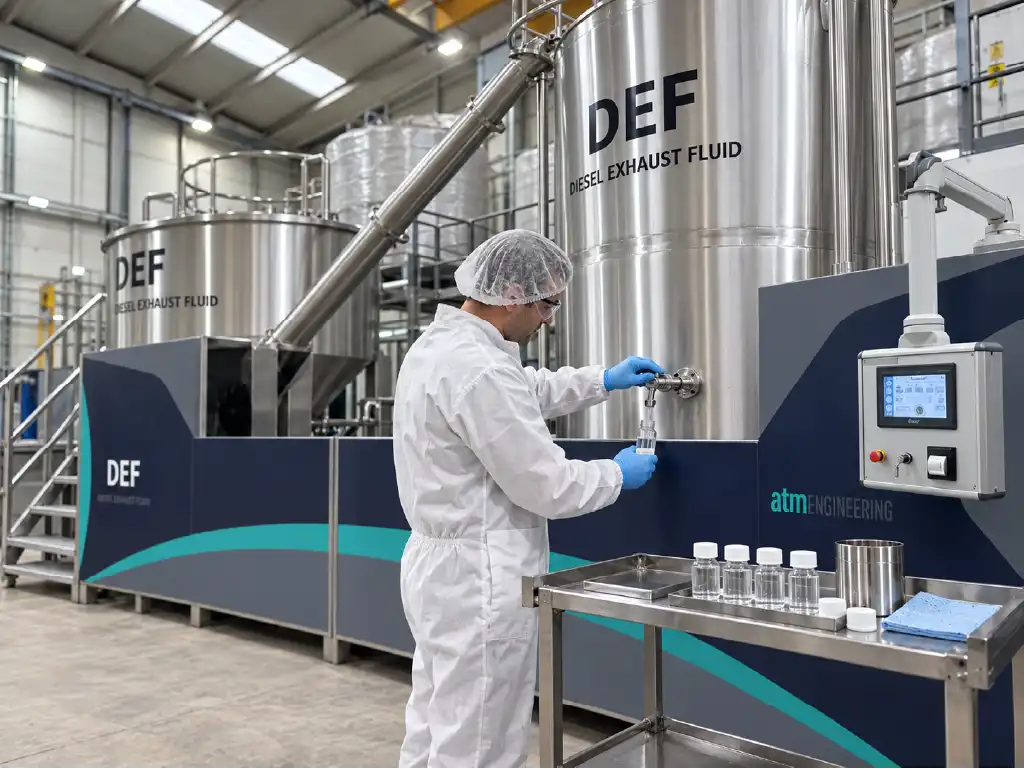
How metallic contamination affects DEF quality
Iron, copper, zinc, chromium, nickel, aluminium and other inorganic contaminants are tightly controlled in quality specifications for AUS 32. They can enter through raw materials, untreated water, fabrication residue, corrosion or contact with unsuitable alloys. Copper-bearing components, zinc-coated surfaces, ordinary carbon steel and unverified aluminium are particularly poor choices for direct product contact because the finished fluid may extract or carry trace contamination even when visible corrosion is absent.
Excess contamination can contribute to deposits, dosing-system wear and adverse interaction with SCR components. It can also cause a finished batch to fail laboratory release. Atmosfer Engineering’s AUS 32 quality information shows how low the declared limits for several metals are, illustrating why an AUS 32 production plant must be engineered as a clean chemical process rather than a general-purpose liquid-mixing line.
How should how metallic contamination affects DEF quality be evaluated in practice?
Begin with a product-contact map linked to the process flow diagram and P&ID. Identify the material grade for every vessel, pipe, weld, valve body, impeller, instrument probe, sample point and filling nozzle. Then evaluate exposure time, temperature, flow velocity, cleaning chemistry and the possibility of stagnant liquid. Long residence times and damaged surfaces can create risks that are not revealed by a short compatibility statement.
Test purified water, urea, the first validated batch and routine product to establish trends for the AUS 32 production plant. After installing a new hose, pump or valve, targeted upstream and downstream sampling provides stronger evidence than visual inspection alone.
Measurement method, documentation and acceptance criteria
Metal analysis is normally performed by a competent laboratory using a validated technique such as ICP-OES or ICP-MS, selected for the required detection limits. Sampling bottles, caps and handling tools must be clean and suitable for trace analysis; poor sampling can create a false failure. Results should be recorded against the batch number, sampling point, date, operator, method, calibration status and applicable specification.
Acceptance criteria must come from the current applicable ISO 22241 edition, the quality plan and customer or certification requirements. Clarity and refractive index alone are insufficient. Retain certificates, laboratory reports and deviation decisions. If a metal exceeds the approved limit, quarantine the batch, confirm the result, investigate the source and document its disposition.
Which plant components come into direct contact with AUS32?
In an AUS 32 production plant, direct contact extends beyond the mixer. The wetted path may include the purified-water tank, dosing lines, dissolver, agitator, pump, filters, valves, flowmeters, probes, gaskets, sample ports, storage tanks, recirculation loop, hoses, filling manifold and closures. Maintenance tools and temporary transfer equipment can also become contact surfaces.
The boundary continues into IBC inner bottles, drums, jerrycans, caps, liners and tanker compartments. They must be approved, clean and dedicated or demonstrably cleaned. A well-built AUS 32 production plant can still deliver nonconforming product if the final hose introduces residue.
How should which plant components come into direct contact with AUS32 be evaluated in practice?
Walk the AUS 32 production plant from water inlet to package outlet, marking every contact item on the P&ID. Compare installed parts with the bill of materials, certificates and drawings. Verify hidden pump shafts, seals, valve seats, sensor housings, hose liners and inserts; the visible body material is insufficient.
Record whether contact is continuous, intermittent or limited to cleaning, plus maximum temperature, pressure, residence time and cleaning agent. The resulting compatibility register guides purchasing, maintenance and change control.
Risk indicators, corrective actions and verification steps
Warning signs include metallic discoloration, cloudiness, particles, rising trace-metal results, seal swelling or cracking, leakage, unstable flow and repeated filter loading. Stop or isolate the affected line, hold exposed batches and compare recent results with the baseline.
Corrective action may require component replacement, stainless repair and passivation, dead-leg removal or a revised cleaning method. Clean and flush by an approved procedure, then verify through rinse inspection, leak testing and representative product analysis. Resume production only after documented quality approval.
Which Materials Should Be Used in an AUS 32 Production Plant?
No single material should be selected by name alone. The engineering team must specify the exact grade, manufacturing standard, additives, surface treatment and connection method. For an AUS 32 production plant, common candidates include properly fabricated austenitic stainless steel and verified grades of HDPE or PP. Final approval should remain project-specific and supported by the current standard, supplier data and validation under expected operating conditions.
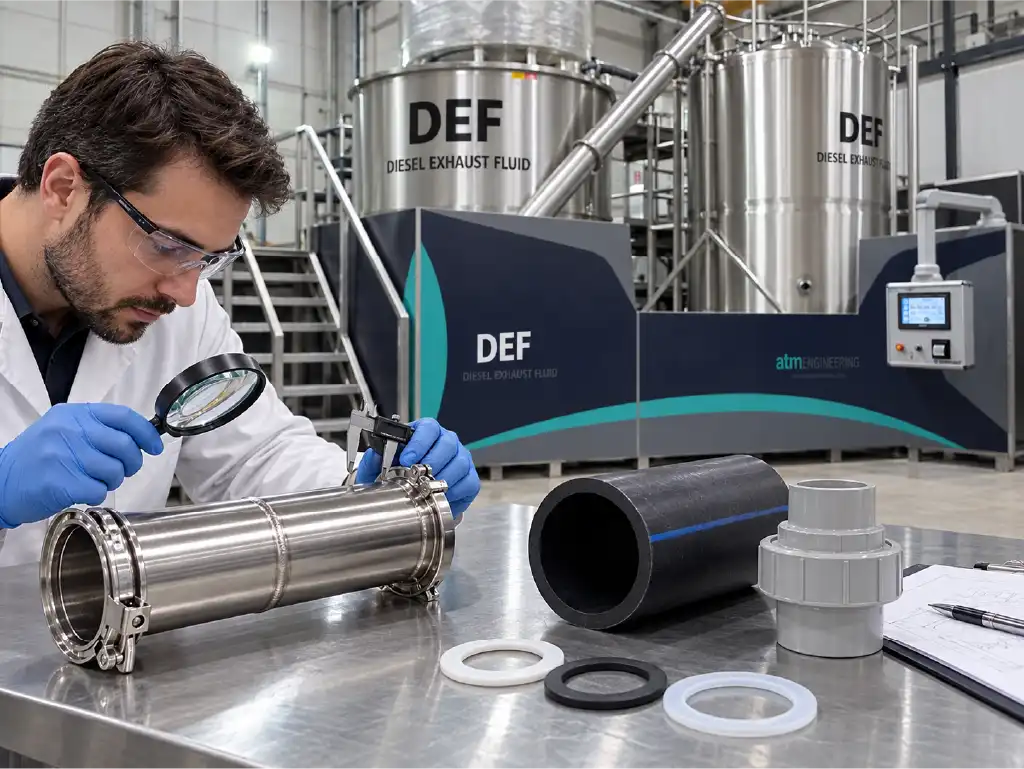
| Material or component | Typical use | Key approval checks |
|---|---|---|
| 316L stainless steel | Mixing vessels, pipework, pump wetted parts and valves | Material certificate, weld quality, surface finish, cleaning and passivation |
| HDPE | Storage tanks, selected pipes and IBC inner bottles | Resin grade, additives, UV exposure, temperature and cleanliness |
| Polypropylene | Pipes, fittings, valve parts and selected housings | Compound declaration, joint quality, pressure and temperature rating |
| Seals and hose liners | Gaskets, O-rings, mechanical seals and transfer connections | Exact compound, supplier compatibility statement, swelling and extraction risk |
316L stainless steel, HDPE and polypropylene applications
316L stainless steel is frequently preferred for critical vessels and sanitary pipework because it offers good corrosion resistance, weldability and cleanability. Its low carbon content helps reduce sensitization risk around correctly executed welds. However, the designation does not correct poor fabrication. Rough welds, embedded carbon-steel particles, unclean tools, heat tint and unsuitable polishing compounds can compromise an otherwise appropriate installation.
HDPE is often used for bulk storage, pipework and container inner bottles. PP can be practical for pipes, fittings and selected valve or instrument parts. Both polymers require grade-specific approval: pigments, fillers, recycled content, processing aids and UV stabilizers may change extraction behavior. Natural or documented compounds intended for the service are preferable to an unspecified commercial plastic.
How should 316L stainless steel, HDPE and polypropylene applications be evaluated in practice?
For stainless assemblies, review applicable material documents, weld maps, welder qualifications, surface finish and passivation records. Inspect contact surfaces and use appropriate tests when fabrication contamination is suspected. Confirm drainability and minimize crevices or dead legs during design review.
For polymers, obtain resin identity, manufacturing method, temperature and pressure limits, and written AUS 32 compatibility data. Evaluate creep, stress cracking, UV exposure and joint integrity. A representative soak test may support approval but does not replace finished-product analysis.
Measurement method, documentation and acceptance criteria
Each critical item needs an approved specification, conformity certificate, lot or heat traceability, supplier statement, incoming inspection and installation record. The finished AUS 32 production plant requires documented cleaning, flushing, leak testing and commissioning before qualification.
Acceptance combines mechanical integrity with chemical evidence. Confirm that welds and joints pass inspection, polymers remain stable and seals show no degradation. Analyze representative water, rinse and product samples. Accept the component only when installation and fluid-quality criteria are met.
Choosing seals, hoses, pumps and fittings for DEF
Small components create disproportionate risk because their exact wetted materials are often overlooked. EPDM and PTFE-based materials are common candidates for DEF service, while other elastomers, including particular FKM or NBR compounds, require grade-specific confirmation. A generic material family is not enough: fillers, plasticizers, curing systems and temperature can change performance.
Pumps should use verified wetted housings, impellers, shafts, mechanical-seal faces and elastomers. Hoses need a compatible inner liner, clean end fittings and caps that prevent workshop contamination. Fittings should avoid unsuitable plated or copper-containing alloys in the product path. Dedicated equipment is strongly preferred to a hose or pump shared with fuel, lubricants or other chemicals.
How should choosing seals, hoses, pumps and fittings for DEF be evaluated in practice?
Request a complete wetted-material declaration and compatibility statement from the supplier, including the exact compound or part number. Check maximum operating temperature, pressure, cleaning exposure and expected service life. For pumps, review all internal parts rather than only the casing. For hoses, confirm the liner and coupling materials separately and control how the hose is stored between transfers.
Before approval, conduct a risk-based trial for the AUS 32 production plant. Where appropriate, inspect mass, dimensions, hardness and surface condition before and after exposure. Monitor leakage, particle shedding and product analysis. Supplier, formulation or manufacturing-location changes require change control and possible requalification.
Risk indicators, corrective actions and verification steps
Flattened gaskets, permanent swelling, tackiness, cracks, discoloration, seal deposits and strainer particles indicate incompatibility or excessive conditions. Repeated tightening is not corrective action. Install an approved part, inspect adjacent surfaces and assess exposed batches.
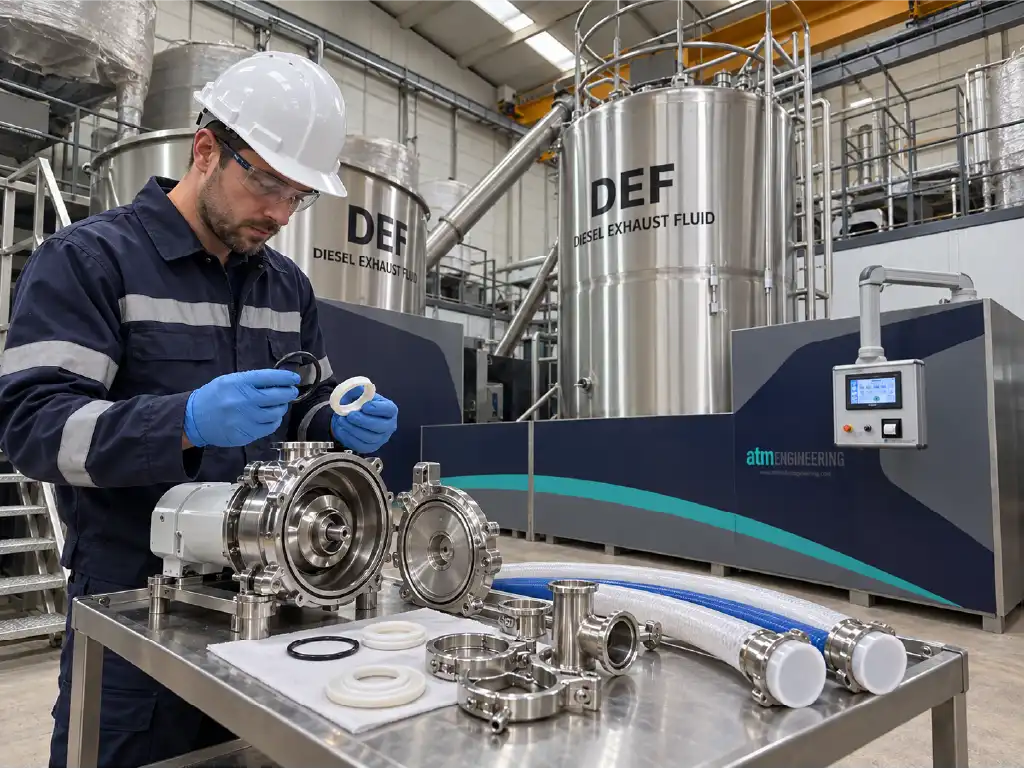
Verification includes pressure or leak testing, documented flushing, visual inspection and laboratory testing of representative product. Update the AUS 32 production plant spare-parts list so a dimensionally similar but chemically unapproved seal cannot be installed.
Expert note: Material compatibility is a system property. A certified 316L tank cannot compensate for a brass sampling valve, an unverified hose liner or contaminated maintenance tools. Atmosfer Engineering evaluates process layout, water treatment, automation and product-contact materials together when configuring AdBlue production equipment for site-specific capacity and operating conditions.
Frequently Asked Questions
Is 304 stainless steel suitable for an AUS 32 production plant?
Some applicable guidance may permit specific austenitic stainless steels, but suitability depends on grade, fabrication, surface condition and the project specification. 316L is often selected for added corrosion resistance and robust fabrication practice. The final choice should be confirmed against the current ISO 22241 requirements, customer criteria and documented engineering assessment.
Can ordinary plastic tanks be used for DEF manufacturing?
No tank should be accepted merely because it is described as polyethylene or polypropylene. Confirm resin grade, additives, previous service, UV resistance, temperature limit and cleanliness. Validate the complete arrangement, including outlet, vent and seal.
Which metals should be avoided in direct contact with AUS 32?
Copper-containing alloys, zinc or galvanized surfaces, ordinary carbon steel and other unapproved metals should not be introduced into the wetted path. Their use can increase contamination risk. A project-specific compatibility review should also cover coatings, plating, brazing material and hidden inserts rather than checking only visible equipment bodies.
How often should seals and hoses be inspected?
Set a risk-based frequency using service hours, transfer cycles, temperature, pressure, supplier guidance and history. Combine pre-use checks with preventive inspection and planned replacement. Leakage, softening, cracking, discoloration or particle release requires immediate assessment.
How is material compatibility confirmed after commissioning?
Confirm it through traceable component records, inspection, cleaning and flushing evidence, leak tests, controlled trial production and analysis of representative samples. Trend critical quality results over subsequent batches. A stable commissioning result is useful, but periodic control and formal management of replacement parts are necessary to preserve compliance.
Plan a Material-Compatible AUS 32 Production Plant with Atmosfer Engineering
Material compatibility should be resolved before procurement, not after a failed batch or recurring seal problem. Atmosfer Engineering can assess raw-water quality, production capacity, automation requirements, product-contact materials, storage and filling interfaces as one integrated project. Its approach connects equipment design with quality-control needs, operator access and maintainability, helping investors build an AUS 32 production plant around documented process requirements rather than isolated component claims.
Explore the company’s turnkey DEF production plant solutions, review suitable automotive-grade urea specifications, or visit Atmosfer Engineering for a broader view of available systems. For a project-specific material review, capacity study, technical consultation or quotation, share your intended output, feed-water data, packaging formats and site conditions through the contact page. The engineering team can then define the appropriate configuration and verification scope.
The images are for illustrative purposes and were created using artificial intelligence.
