
A compact AdBlue® production system is designed for businesses that want to produce high quality DEF in a controlled, efficient and space conscious way without building a large scale industrial facility. As demand for cleaner diesel technology continues to grow, companies in logistics, fuel distribution, automotive supply, agriculture, construction, mining, public transport and industrial fleet operations are looking for smarter ways to secure consistent AdBlue® supply.
A compact production system answers this need by bringing purification, dosing, dissolving, mixing, filtration, storage and automation into a practical plant layout that can fit into limited indoor production areas, containerized units or modular facility sections. The main value of such a system is not only its size. Its true strength comes from the ability to combine efficient engineering, stable product quality, low energy consumption and simplified operation in one integrated solution. When planned correctly, a compact AdBlue® production system can help businesses reduce dependency on external supply, improve cost control, maintain ISO 22241 oriented product consistency and respond faster to market demand.
What Makes an AdBlue® Production System Compact?
A compact AdBlue® production system is not simply a smaller version of a traditional DEF plant. It is a carefully engineered production concept where every component is selected and positioned to save space while maintaining process stability. In conventional facilities, separate tanks, pumps, filters, dosing units, control panels and production zones may require a large installation area. In a compact design, these components are arranged in a more efficient layout so that the production process can be managed with less floor space, fewer unnecessary transitions and a more organized workflow.
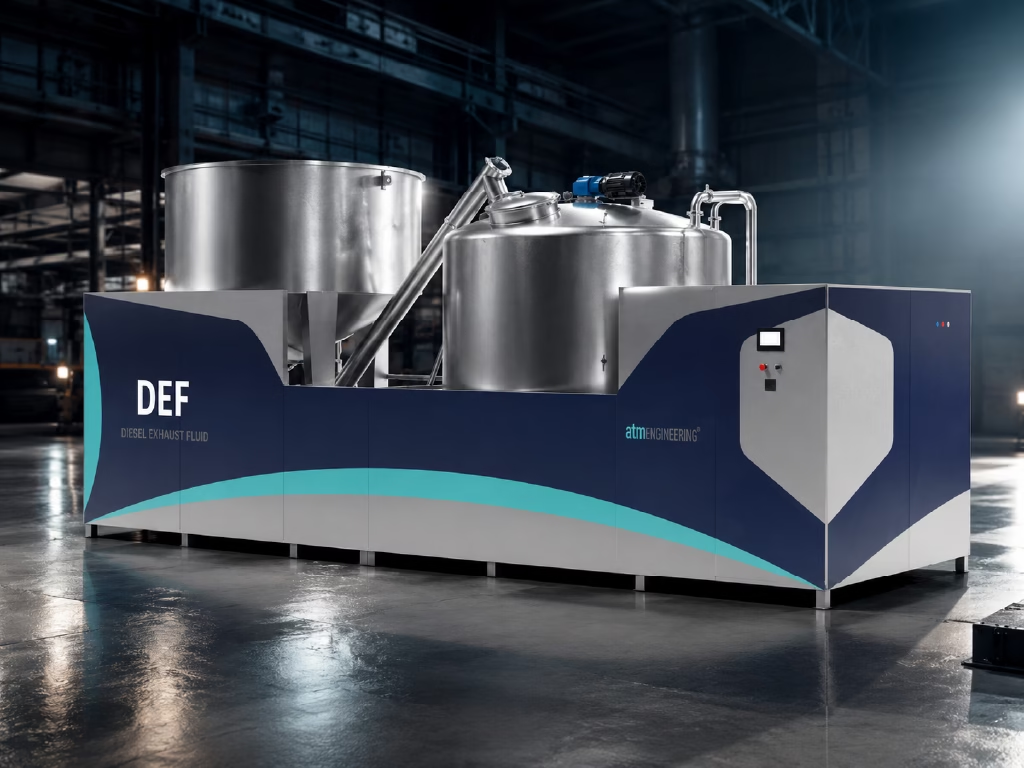
The system may include purified water preparation, urea feeding, dissolving and blending, circulation, transfer, final filtration, storage connection and automatic control in a single coordinated structure. This allows the operator to manage AdBlue® production from a central control point while reducing the need for excessive movement, manual intervention or complex installation planning. Compactness also refers to process intelligence. A system becomes truly compact when it can perform multiple production stages in a simplified arrangement without sacrificing quality, safety or monitoring capability.
Space efficient plant design
Space efficient plant design is one of the most important features of a compact AdBlue® production system. Many businesses do not have large factory halls available for DEF production, and even when space exists, using it efficiently can reduce investment pressure and make future expansion easier. A well designed compact plant considers the complete production flow from raw material input to final product transfer. Urea handling should be positioned close to the dissolving or blending area, purified water should enter the system through a controlled line, process tanks should be located in a practical service position and pumps should be accessible for maintenance.
The control panel should be visible and easy to reach, while pipes, valves and sensors should be organized in a way that supports safe operation. Space efficient design also helps create a cleaner production environment. When components are grouped logically, the facility looks more professional, operators work more comfortably and technical teams can access service points without unnecessary obstacles. For businesses producing AdBlue® in limited space, this design approach is essential because every square meter must support productivity, safety and long term operational value.
Integrated production components
Integrated production components allow a compact AdBlue® system to deliver reliable performance without needing a scattered production layout. In a professional DEF production process, the quality of purified water, the purity of urea, the accuracy of dosing, the efficiency of dissolution and the stability of mixing all affect the final product. If these components are disconnected or poorly coordinated, production can become slow, inconsistent and difficult to control. An integrated compact system brings these critical functions together through engineered connections, automation logic and process monitoring.
Water treatment may be connected directly to the production unit, the urea feeding system can be matched with the required capacity, mixing can be controlled by sensors and the final product can pass through filtration before being transferred to a storage tank or filling line. This integration reduces installation complexity and improves repeatability. It also helps the operator maintain a stable production rhythm because the system is built around a clear process sequence. For companies that want to produce AdBlue® with consistent quality, integrated components are a major advantage because they reduce human error, support traceability and simplify daily operation.
| Compact system element | Main function | Operational benefit |
|---|---|---|
| Purified water supply | Provides controlled water quality for DEF production | Supports stable AdBlue® quality |
| Urea feeding unit | Transfers high purity urea into the process | Improves dosing accuracy and production consistency |
| Mixing and dissolving system | Combines urea and purified water under controlled conditions | Reduces production time and supports homogeneous blending |
| Filtration stage | Helps remove particles before storage or filling | Protects final product cleanliness |
| Automation panel | Monitors process values and controls production steps | Reduces manual workload and operational risk |
Advantages of Compact AdBlue® Production Systems
The advantages of compact AdBlue® production systems go far beyond limited space usage. These systems are preferred because they offer a practical balance between production efficiency, quality control, investment flexibility and operational simplicity. A company that installs a compact system can produce DEF closer to its own market, fleet or distribution network, which may reduce logistics pressure and improve supply security.
Instead of relying only on purchased finished product, businesses can manage production according to demand and maintain better control over stock planning. Compact systems are also useful for businesses entering the AdBlue® market step by step. They allow production to begin with a manageable investment while still using professional process principles. When the system is automated, fewer operators may be needed to manage production, monitor process values and transfer the final product. This makes compact systems especially valuable for businesses that want industrial quality without unnecessary facility complexity. With the right engineering, compact production can be clean, fast, controlled and suitable for long term commercial growth.
Reduced installation area
Reduced installation area is one of the most visible benefits of a compact AdBlue® production system. In many facilities, floor space is expensive, limited or already reserved for storage, packaging, logistics and other production activities. A compact system helps businesses produce DEF without dedicating a large building section to the process. This can be especially important for fuel distributors, regional producers, fleet service companies and industrial suppliers that need efficient production but cannot build a full scale plant.
A smaller installation area also makes project planning easier. Civil works may be reduced, installation time can be shorter and the production unit can be positioned closer to related operations such as raw material storage, finished product tanks or filling lines. However, reduced area should never mean reduced accessibility. A well planned compact AdBlue® plant must still provide enough space for maintenance, safe walking routes, cleaning, inspection and operator movement. The goal is to remove wasted space, not essential service space. When this balance is achieved, businesses gain a professional production environment that is efficient, organized and easier to manage.
Lower operational costs
Lower operational costs are another important reason businesses choose compact AdBlue® production systems. Operational cost is shaped by energy consumption, labor need, maintenance requirements, production loss, water quality management, raw material efficiency and process stability. A compact and well automated system can reduce unnecessary energy use by managing mixing, circulation and transfer more efficiently. It can also reduce labor dependency because one trained operator may be able to supervise the process through a clear control interface. Accurate dosing and controlled blending help limit waste and support consistent concentration values, which is essential for commercial AdBlue® production.
Maintenance costs may also be improved when the system layout is clean, accessible and built with reliable industrial components. Instead of dealing with many separated units and complicated pipe routes, technical teams can inspect the system from a more organized structure. Lower cost does not come from cutting quality. It comes from removing inefficiency. For this reason, businesses should evaluate compact DEF systems not only by purchase price but also by long term energy use, labor efficiency, product loss risk and serviceability.
Faster production cycles
Faster production cycles can create a strong commercial advantage in the AdBlue® market. Demand may change depending on fleet activity, seasonal logistics, agricultural periods, fuel station sales, industrial consumption and regional supply conditions. A compact system with efficient mixing and automation can help producers respond faster by shortening the time between raw material preparation and finished product availability. Faster production does not mean uncontrolled production.
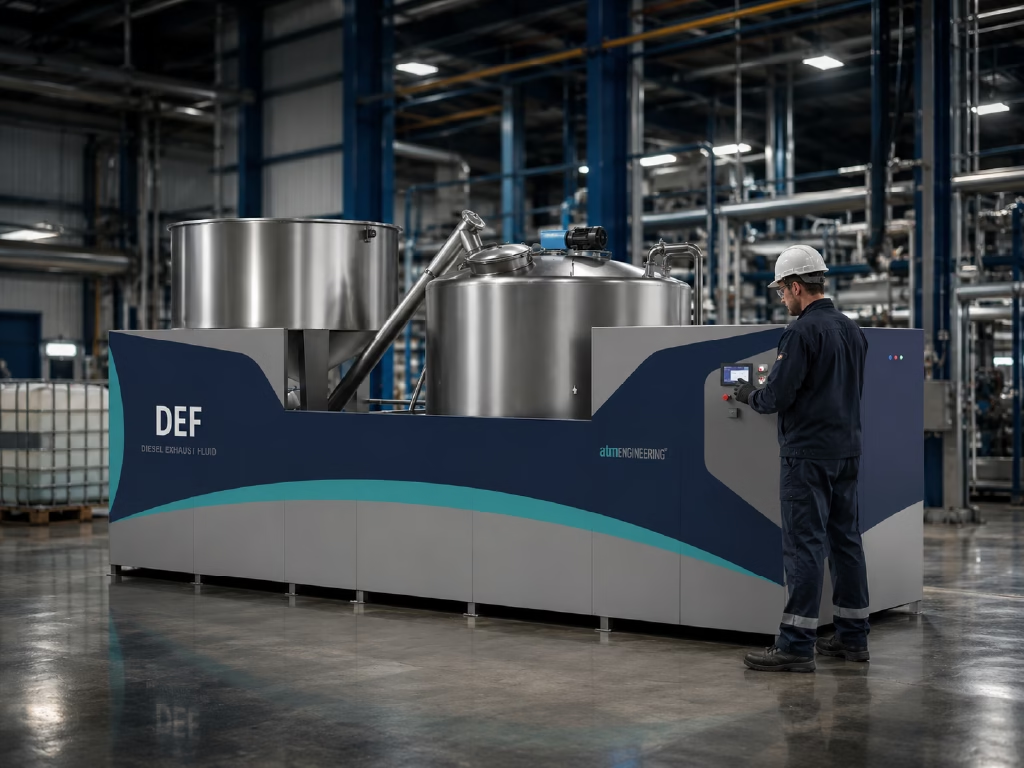
In DEF manufacturing, process speed must always be balanced with quality, concentration stability and product cleanliness. A professional compact system achieves speed through better engineering, not shortcuts. Efficient dissolving, proper circulation, accurate dosing and real time monitoring can help the production batch reach the required quality target in a shorter time. This improves daily output and makes production planning more flexible. For example, a business may produce according to order volume, fill storage tanks more quickly or manage multiple production cycles within the same working day. In a competitive market, the ability to produce AdBlue® quickly and consistently can support customer satisfaction, inventory control and profitability.
| Advantage | Why it matters | Business impact |
|---|---|---|
| Smaller footprint | Uses limited facility space more effectively | Supports easier installation and better area planning |
| Lower labor requirement | Automation reduces manual process control | Improves operational efficiency |
| Controlled production | Process values can be monitored during operation | Supports reliable AdBlue® quality |
| Faster cycles | Efficient mixing and transfer improve production rhythm | Helps respond to demand more quickly |
| Scalable structure | Modular planning can support future capacity growth | Protects long term investment value |
How to Choose the Right Compact System
Choosing the right compact AdBlue® production system requires more than selecting a machine that fits into the available space. The system must match the business model, target production volume, product quality expectations, operator capability, storage plan and future growth strategy. A company producing DEF only for its own fleet may need a different capacity and automation level than a business planning to sell AdBlue® through distributors or fuel stations.
The first step is to define the daily and monthly production target. The second step is to evaluate the available installation area, raw material logistics, water quality, power infrastructure and storage capacity. The third step is to check whether the system supports consistent quality control and compliance oriented production. A compact plant should be easy to operate but it should also be technically strong. It must support accurate mixing, reliable filtration, safe transfer and repeatable results. Buyers should avoid choosing only by the smallest footprint or lowest initial cost. The right system is the one that delivers a balanced combination of capacity, automation, quality, serviceability and long term efficiency.
Production capacity
Production capacity is one of the most important criteria when selecting a compact AdBlue® production system. Capacity should be calculated according to realistic demand, not only ideal sales targets. Businesses should consider current consumption, expected market growth, storage tank size, working hours, number of production cycles per day and seasonal fluctuations. If the system is too small, the producer may struggle to meet demand and may need frequent production cycles that increase operational pressure. If the system is too large, the business may pay for unused capacity, consume more space and face unnecessary investment cost.
A compact system should offer enough capacity to support daily operations while leaving room for future expansion. It is also important to understand the difference between batch capacity and daily production capacity. Batch capacity shows how much product can be produced in one cycle, while daily capacity depends on cycle time, preparation, transfer, cleaning, operator workflow and storage availability. For stable AdBlue® production, the selected capacity must match the full operational plan rather than a single technical number.
Automation level
Automation level directly affects the reliability, speed and ease of operating a compact AdBlue® production system. Manual systems may appear simple at first, but they can create higher dependency on operator experience, increase the risk of dosing mistakes and make quality consistency harder to maintain. Semi automatic systems can support the operator with controlled dosing, mixing and transfer functions, while fully automated systems may provide recipe management, sensor based monitoring, alarm notifications and process data visibility.
The right automation level depends on the business size, production frequency, workforce structure and quality expectations. For commercial AdBlue® production, automation is especially valuable because concentration accuracy, water quality, temperature, mixing time and filtration performance must be managed carefully. A clear human machine interface helps operators follow the process more confidently and reduces the training burden. Automation also supports traceability by making it easier to monitor production conditions and identify deviations. In a compact system, automation is not only a convenience. It is a key factor that helps a smaller plant perform with professional consistency.
Compliance with quality standards
Compliance with quality standards is essential for any business that wants to produce trustworthy AdBlue®. DEF is used in selective catalytic reduction systems to help reduce nitrogen oxide emissions from diesel engines, and poor quality product can create serious performance problems for vehicles and equipment. For this reason, AdBlue® production should be planned with attention to ISO 22241 related requirements, high purity urea, purified water quality, correct concentration, cleanliness, storage conditions and contamination control. A compact system must be capable of supporting these requirements even if the installation area is limited.
Buyers should evaluate whether the system uses suitable materials, accurate dosing technology, proper filtration and reliable monitoring tools. They should also consider how samples will be tested, how production records will be kept and how storage tanks will be protected from contamination. Quality compliance is not achieved only at the end of production. It begins with raw material selection and continues through every process step until the final product is stored or filled. A compact AdBlue® system that supports compliance gives producers confidence, protects customers and strengthens brand reputation.
| Selection criterion | Key question to ask | Recommended focus |
|---|---|---|
| Capacity | How much AdBlue® should be produced per day? | Match system size with real demand and growth plans |
| Automation | How much operator control is required? | Prefer process monitoring and accurate dosing control |
| Water quality | Is purified water consistently available? | Use proper treatment and monitoring before blending |
| Installation area | Can the system fit while remaining serviceable? | Plan access, safety and maintenance space |
| Compliance | Can production support ISO 22241 oriented quality? | Focus on purity, concentration, filtration and storage |
A compact AdBlue® production system is also valuable because it can support different business models. Fuel suppliers can use it to produce DEF near their distribution points. Fleet operators can secure their own supply and reduce purchasing uncertainty. Industrial companies can integrate production into their existing facility. Entrepreneurs can enter the DEF market with a more controlled investment compared to a large plant. In each case, the compact system must be engineered around the same principle: reliable AdBlue® production in a limited area without compromising quality.
This is why system design should include not only the machine itself but also raw material storage, water treatment, product testing, finished product storage, filling options and service planning. A compact plant may occupy less space, but it should still operate as a complete production solution. Businesses that think only about the machine footprint may overlook important details such as tank access, ventilation, drainage, electrical safety, transfer lines, operator ergonomics and quality control workflow. The best compact systems are designed as part of a complete DEF production ecosystem.
Another important point is product consistency. The market does not only need more AdBlue®. It needs reliable AdBlue® that protects diesel engine after treatment systems and meets customer expectations. Consistency depends on controlled inputs and controlled processing. High purity urea must be stored correctly, purified water must meet the required quality level and the mixing process must achieve the right concentration.
The system should help prevent contamination from unsuitable materials, dust, poor storage conditions or uncontrolled transfer equipment. Compact production can be highly reliable when these risks are considered from the beginning. This is why professional engineering is more important than simply reducing equipment size. A compact system must be compact in layout, not limited in capability. When a business chooses a system that combines automation, process control, quality focused design and efficient installation, it can produce AdBlue® with confidence even in a restricted production area.
Operational simplicity is another reason compact systems are becoming popular. A well designed compact AdBlue® plant should be understandable for operators and practical for daily use. The production process should follow a clear logic, alarms should be easy to interpret, valves and service points should be accessible and the control panel should present essential data without confusion.
Simplicity improves safety and reduces training time. It also helps the business maintain consistent production even when staff changes occur. However, simple operation should not mean limited technology. The best compact systems combine advanced automation with a user friendly interface. This allows operators to monitor important process values while the system manages critical production steps with accuracy. For growing DEF producers, this balance is especially important because it allows the operation to remain manageable as production volume increases. In this sense, compact AdBlue® production supports both today’s efficiency and tomorrow’s growth.
When evaluating suppliers, businesses should look for technical experience, customization capability, after sales support and clear communication. A compact AdBlue® production system should be adapted to the customer’s facility, capacity target and market needs. The supplier should be able to explain the production process, component quality, automation features, maintenance requirements and quality control approach.
Documentation, training and service support are also important because DEF production is a long term operation, not a one time equipment purchase. A reliable supplier will help the customer plan the complete installation and avoid common mistakes such as poor tank sizing, weak water preparation, insufficient service access or unclear production workflow. Choosing the right partner can make the difference between a compact system that only fits into the space and a compact system that truly improves production efficiency.
In conclusion, a compact AdBlue® production system offers a practical and efficient path for businesses that want to produce DEF in limited space while maintaining professional quality standards. Its value comes from space efficient design, integrated components, reduced installation requirements, lower operational costs, faster production cycles and automation supported consistency.
The right system should be selected according to production capacity, automation level, quality compliance, facility conditions and long term business goals. As demand for cleaner diesel solutions continues, compact production can help businesses become more flexible, more independent and more competitive. With the correct engineering approach, limited space does not have to limit production potential. A compact AdBlue® plant can deliver strong performance, stable quality and sustainable commercial value in a smaller footprint.
Ready to build a smarter DEF production operation? If your business needs a compact, efficient and professionally engineered AdBlue® production solution, Atmosfer Makina can help you plan a system that matches your capacity goals, facility conditions and quality expectations. From compact plant design and automation to process integration and production efficiency, the right engineering partner makes every stage more reliable.
A well planned system can help you reduce dependency on external supply, improve cost control and produce consistent DEF with confidence. Whether you are entering the AdBlue® market, expanding your existing operation or looking for a space saving production solution, you can explore advanced options through Atmosfer Makina. Visit www.atmosfermakina.com to discover production systems designed for efficient, controlled and scalable DEF manufacturing. Choose a compact AdBlue® production system that supports your business today and prepares your operation for tomorrow.
