
As diesel fleets, logistics networks and industrial distribution channels continue to expand, companies need production solutions that can grow with demand instead of limiting future capacity. A modular AdBlue® Production unit is designed exactly for this purpose. It gives businesses a controlled, scalable and professional way to produce Diesel Exhaust Fluid without committing to an oversized fixed plant from the first day. For growing companies, this model offers a practical balance between investment control, operational flexibility and long term production reliability.
AdBlue® Production has become an important part of modern diesel emission management because DEF is used in Selective Catalytic Reduction systems to help reduce nitrogen oxide emissions. The United States Environmental Protection Agency explains that Diesel Exhaust Fluid is used as part of SCR systems in diesel trucks and nonroad equipment, making DEF supply a critical subject for many commercial sectors. You can review the related government resource here: AdBlue and Diesel Exhaust Fluid information from EPA. For producers, distributors and fleet oriented businesses, the ability to manage AdBlue® Production with a modular system can create a stronger foundation for quality, continuity and market growth.
What Is a Modular AdBlue® Production Unit?
A modular AdBlue® Production unit is a production system built with separate yet integrated process modules that work together to manufacture DEF according to required quality expectations. Instead of being designed as one fixed and difficult to move facility, the modular structure allows key production sections to be planned, installed and expanded according to the real needs of the business. These sections may include purified water preparation, urea dosing, controlled mixing, transfer pumps, storage tanks, filtration, filling equipment, automation panels and quality control connection points.
The main advantage of this approach is that AdBlue® Production can begin with a capacity level that matches today’s demand while still keeping the door open for tomorrow’s expansion. A business does not need to overinvest in a large plant before its market is ready. At the same time, it does not need to choose a small system that may become insufficient within a short period. A modular unit creates a middle path where the production setup remains practical, professional and scalable.
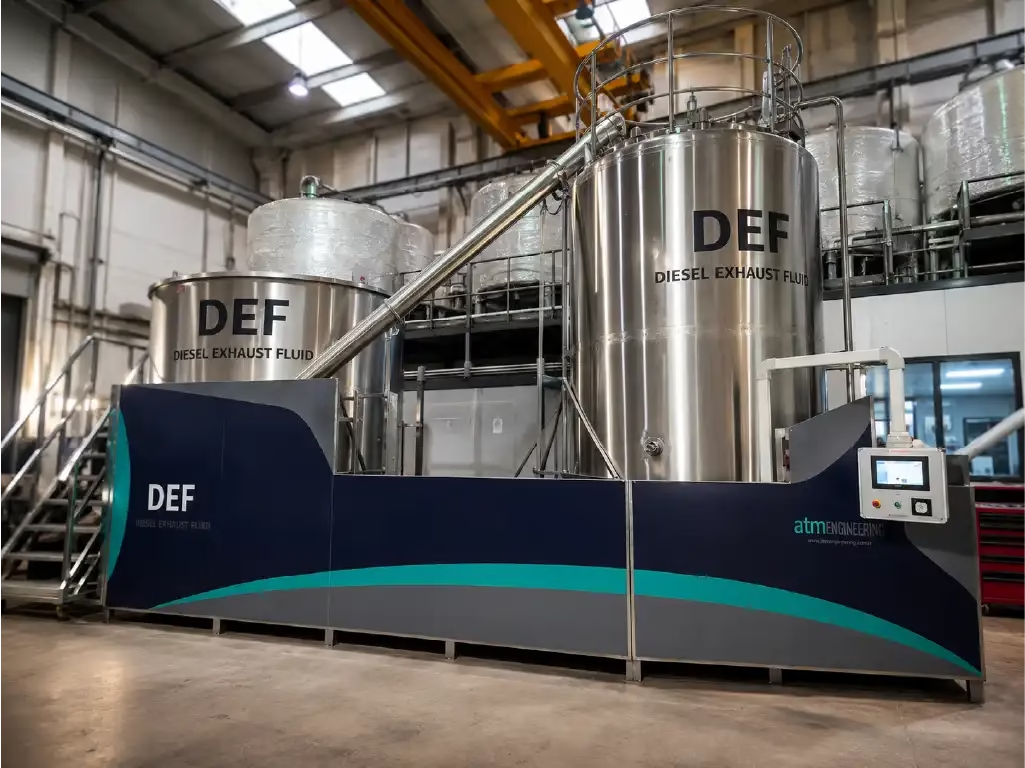
For growing businesses, this structure is especially valuable because DEF demand may change depending on seasonality, fleet contracts, export agreements, regional distributor networks and fuel station partnerships. A modular AdBlue® Production system gives companies the ability to respond to these changes with more confidence. When demand increases, additional tanks, pumps, filling lines or process modules can be added more easily than in a traditional fixed plant layout.
Flexible production system design
Flexible design is one of the most important features of modular AdBlue® Production. Every business has different operational priorities. Some companies focus on bulk DEF supply, some fill IBC containers, some target drums or canisters, and some need a combination of different packaging formats. A modular unit allows the production layout to be configured around these requirements rather than forcing the business into a standard structure that may not fully support its workflow.
In a flexible AdBlue® Production design, equipment placement can be arranged according to available floor space, process direction, operator access and future expansion plans. For example, a company with limited space may choose a compact skid based arrangement, while a larger facility may prefer separated water treatment, mixing, storage and filling sections. This flexibility helps businesses improve process flow, reduce unnecessary handling and create a cleaner production environment.
Another benefit of flexible design is automation compatibility. A modern modular AdBlue® Production unit can be equipped with control panels, sensors and process monitoring systems that help operators manage production more consistently. Accurate dosing, controlled mixing and real time monitoring support better production discipline. For companies that want to build a professional DEF brand, this level of control is a major advantage.
Capacity expansion options
Capacity expansion is a key reason why many businesses choose modular AdBlue® Production. A company may begin with a modest daily production target and later increase capacity as customer demand grows. In a modular system, this growth can be planned from the beginning. The initial installation can be designed with expansion points, suitable utility planning, tank connection options and automation capacity that allow future modules to be integrated more smoothly.
Expansion options may include larger storage tanks, additional mixing capacity, faster transfer pumps, higher output filling systems, more advanced water treatment capacity or extra packaging lines. This means AdBlue® Production can grow step by step instead of requiring a complete replacement of the system. For investors, this creates a more balanced financial strategy because the production infrastructure can develop together with market performance.
Capacity planning should not only focus on liters per hour or liters per day. A strong AdBlue® Production strategy should also consider raw material storage, purified water availability, operator workflow, loading area design, packaging speed, laboratory testing needs and delivery planning. Modular systems make this broader planning easier because they allow the production environment to be shaped around both current and future operational realities.
| Business Need | Modular System Advantage | Operational Result |
|---|---|---|
| Starting with controlled investment | Initial capacity can be selected according to real demand | Lower financial pressure at the beginning |
| Increasing future production volume | Additional modules can be integrated when needed | Scalable AdBlue® Production capacity |
| Serving multiple packaging formats | Filling sections can be customized | More flexible market access |
| Changing facility location | Modular equipment is easier to relocate | Better adaptability for growing businesses |
Benefits of Modular AdBlue® Production
The benefits of modular AdBlue® Production go beyond equipment flexibility. This model supports smarter investment, easier installation, efficient operation and better long term planning. For many growing companies, the biggest challenge is not only producing DEF, but producing it in a way that remains profitable, controllable and adaptable. A modular unit helps solve this challenge by giving the business a production system that can evolve over time.
Traditional production investments may require a large initial budget, complex construction work and fixed infrastructure decisions. In contrast, modular AdBlue® Production allows the company to start with a carefully designed system and expand as business conditions develop. This approach reduces the risk of idle capacity and helps companies avoid building a facility that is too large for their current market.
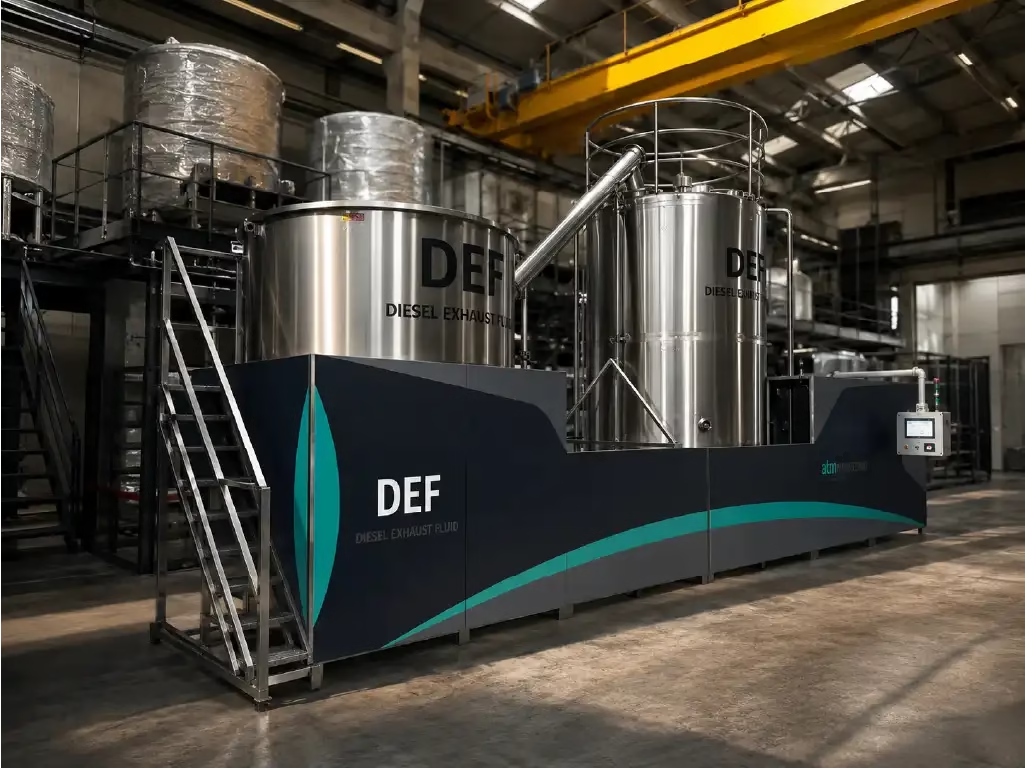
Another benefit is operational simplicity. When modules are designed properly, operators can manage the production process with clear workflow logic. Water purification, urea handling, mixing, storage and filling can be organized in a way that supports consistency. Since DEF quality depends on clean processes, correct raw material handling and controlled formulation, this organized structure is highly important for professional AdBlue® Production.
Scalable investment structure
A scalable investment structure gives businesses more control over their capital. Instead of making one large investment that may take years to fully utilize, companies can build their AdBlue® Production capacity in phases. This is especially useful for new DEF producers, regional distributors or companies entering a new market. The first phase can focus on reliable production and local sales, while later phases can support higher output, wider distribution or export activity.
This phased investment model also helps decision makers measure market response before committing to larger capacity. If customer demand increases faster than expected, the system can be expanded. If the market develops more slowly, the business still owns a functional AdBlue® Production unit that matches its actual needs. This balance makes modular production attractive for companies that want to grow carefully without limiting future opportunities.
Scalability also supports financial planning. With modular AdBlue® Production, companies can align equipment upgrades with revenue growth. This can improve cash flow management and reduce unnecessary pressure on the business. For growing companies, the ability to invest step by step can be just as important as the technical capacity of the machinery itself.
Easy installation and relocation
Installation speed is another major advantage of modular AdBlue® Production. Because the system is built from organized modules, site preparation can be simpler than a fully custom fixed production facility. A well planned modular unit can reduce installation complexity, shorten commissioning time and help the business move from investment decision to operational production more efficiently.
Relocation is also important for companies that may change warehouses, expand into a larger facility or move production closer to target markets. A fixed plant can be difficult and costly to move, while a modular AdBlue® Production unit is generally easier to dismantle, transport and reinstall. This mobility gives businesses more strategic freedom, especially in markets where logistics costs, customer locations or export routes may change over time.
Easy installation does not mean the system should be simple in a low quality sense. Professional AdBlue® Production still requires correct engineering, clean material contact surfaces, suitable pumps, controlled mixing, proper filtration and reliable automation. The benefit of modularity is that these technical requirements can be delivered in a more practical and adaptable package.
Custom configuration for business needs
Every DEF business model is different. A regional producer may need stable bulk supply for local fleets. An export focused company may need filling flexibility for different packaging standards. A fuel distribution company may need consistent production volume and reliable storage integration. Modular AdBlue® Production makes it possible to configure the system according to these business models.
Custom configuration can include tank sizes, filling options, automation level, water treatment design, pipe routing, filtration stages, operator interface preferences and site layout. This is important because a production system should support the company’s sales strategy. If the business sells to large fleets, bulk transfer speed and storage capacity may be priorities. If the business sells packaged DEF, filling accuracy and packaging efficiency may be more important. A modular AdBlue® Production unit can be designed around these priorities.
Customization also improves daily usability. Operators work more efficiently when the system layout makes sense. Maintenance teams can access equipment more easily when service points are planned correctly. Managers can monitor production more confidently when the automation structure provides useful data. These details turn AdBlue® Production from a basic manufacturing process into a more controlled and professional operation.
Who Should Choose a Modular DEF Production Unit?
A modular DEF production unit is suitable for businesses that want to enter or expand in the DEF market with a future oriented mindset. It is not only for small producers. It can also be a smart solution for medium sized companies, regional manufacturers, exporters, fuel suppliers and industrial groups that want to add AdBlue® Production to their existing operations. The key point is growth potential. If a company expects its demand to increase over time, modularity provides a strong advantage.
Companies that operate in dynamic markets often need equipment that can respond to changing demand. A rigid production structure may become a limitation, while a modular AdBlue® Production unit can support gradual expansion. This is useful for businesses that are still building distributor networks, negotiating fleet contracts or exploring export opportunities.
Modular units are also suitable for companies that want to reduce dependency on external DEF suppliers. By establishing their own AdBlue® Production capability, businesses can improve supply security, manage quality more closely and create new revenue opportunities. This can be especially valuable in regions where DEF availability, delivery times or supplier pricing may fluctuate.
Regional DEF producers
Regional DEF producers need reliable production capacity, practical installation and the ability to serve local demand efficiently. For these companies, modular AdBlue® Production can offer the right combination of professional quality and manageable investment. Instead of building a very large facility from the beginning, a regional producer can start with a system sized for its current distribution area and expand as customer volume grows.
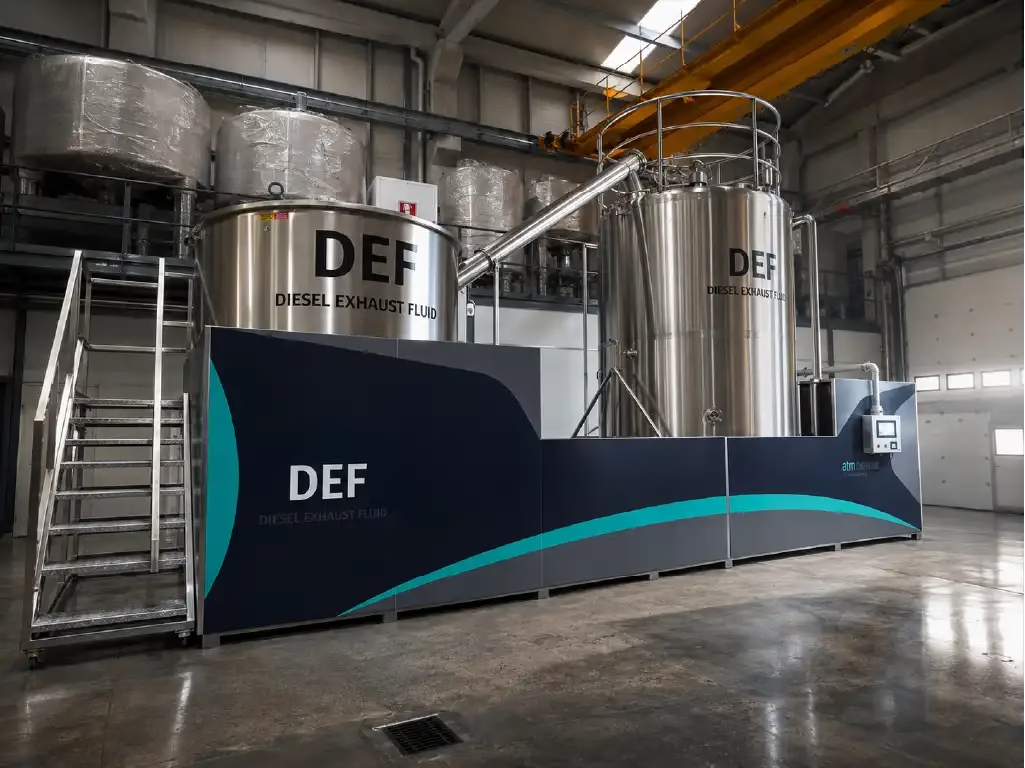
Regional producers often serve transportation companies, agricultural equipment users, construction fleets, fuel stations and industrial diesel users. These customers need dependable DEF supply, consistent product quality and timely delivery. A modular AdBlue® Production unit helps producers build a local supply base while keeping future growth options open.
Another advantage for regional producers is market responsiveness. If demand increases in a nearby city or new distributor agreements are signed, production capacity can be upgraded more easily. This makes modular AdBlue® Production a practical choice for businesses that want to grow geographically without making all expansion investments at once.
Export focused companies
Export focused companies need flexibility, quality consistency and scalable capacity. International customers may request different packaging formats, larger order volumes or specific delivery schedules. A modular AdBlue® Production unit can help exporters adapt to these requirements by combining reliable production with configurable filling and storage options.
For exporters, production planning is closely connected to logistics. Bulk shipments, IBC containers, drums and smaller packages may all require different workflow arrangements. Modular AdBlue® Production supports this by allowing filling systems and storage sections to be planned according to target markets. This can make export operations more efficient and help companies respond to different customer expectations.
Export focused businesses also benefit from future capacity planning. A company may begin with one country or distributor network and later expand to multiple markets. With modular AdBlue® Production, this growth can be supported with additional equipment modules rather than a completely new production investment. This creates a more flexible path for international development.
Businesses planning future capacity growth
Businesses planning future capacity growth are ideal candidates for modular AdBlue® Production. These companies may already have demand today, but they know that larger opportunities may appear in the future. A modular system helps them prepare for that future without overbuilding immediately. This is important because capacity should be a growth tool, not a financial burden.
Future growth may come from fleet agreements, distributor partnerships, new fuel station networks, export contracts or increased regional DEF consumption. A modular AdBlue® Production unit gives businesses the ability to respond when those opportunities appear. Instead of starting from zero again, the company can build on its existing production foundation.
This future ready structure also supports brand credibility. Customers want to work with suppliers that can deliver consistently and grow with their needs. When a company has a scalable AdBlue® Production infrastructure, it can present itself as a more reliable partner for long term supply agreements. This can make a real difference in competitive DEF markets.
| Company Type | Why Modularity Matters | Best Fit |
|---|---|---|
| Regional DEF producer | Can start locally and expand with demand | Local fleet and distributor supply |
| Export focused company | Can adapt packaging and capacity to target markets | International DEF sales |
| Fuel distribution business | Can integrate production with existing logistics | Fuel stations and fleet customers |
| Growing industrial company | Can add capacity in phases | Long term AdBlue® Production growth |
When choosing a modular AdBlue® Production unit, businesses should evaluate more than only machine capacity. The right system should be engineered for process reliability, clean production, accurate dosing, practical maintenance and future expansion. It should also be supported by technical knowledge, installation guidance and after sales service. These factors directly affect long term production performance.
Water quality is one of the most critical points in AdBlue® Production. DEF requires purified water and high purity urea, so the production system must support clean and controlled processing. Poor water quality, contamination risks or unstable mixing can damage product consistency. A professional modular unit should therefore include appropriate water treatment integration and process design that protects the final product quality.
Automation is another important factor. A modular AdBlue® Production unit with smart controls can help operators follow production parameters more easily. This reduces manual errors and supports more repeatable results. For businesses that want to build trust with customers, process repeatability is essential. Customers are not only buying DEF, they are buying reliability, continuity and confidence.
Maintenance planning should also be considered from the beginning. Modular AdBlue® Production units should be designed with accessible components, clear service points and practical spare part planning. Easy maintenance helps reduce downtime and supports uninterrupted supply. In competitive markets, downtime can affect both sales and customer trust, so serviceability should never be ignored.
Another point is space efficiency. Many growing businesses operate in existing warehouses or industrial facilities where floor space is limited. Modular AdBlue® Production can help make better use of available space because the system can be arranged according to site conditions. Compact design, organized piping and logical equipment placement can improve both safety and workflow.
From an investment perspective, modular AdBlue® Production gives companies a more strategic way to enter the DEF market. It allows decision makers to match capacity with real demand, reduce unnecessary initial cost and prepare for future expansion. This is especially valuable in markets where demand growth is expected but timing is not completely predictable.
From an operational perspective, modular AdBlue® Production helps create a cleaner and more manageable production environment. Operators can follow a structured process. Managers can monitor production more effectively. Maintenance teams can access equipment more easily. Customers can receive a more consistent product. These operational benefits can become a competitive advantage over time.
From a commercial perspective, modular AdBlue® Production supports business growth because it gives companies the confidence to accept larger orders and explore new markets. A producer that can expand capacity when needed is better positioned to negotiate with fleets, distributors and export customers. This makes modularity not only a technical feature, but also a business development tool.
For companies entering the DEF industry, the modular model reduces uncertainty. For companies already producing DEF, it can provide a path to modernization and expansion. In both cases, modular AdBlue® Production supports a more flexible, scalable and future ready manufacturing strategy. As demand changes, the production system can adapt rather than becoming a limitation.
In conclusion, a modular DEF production unit is a smart solution for businesses that want scalable manufacturing without sacrificing quality or operational control. It brings together flexible design, phased investment, easier relocation and custom configuration. For regional producers, exporters and growth oriented companies, modular AdBlue® Production offers a practical way to build long term capacity with confidence.
If your business is planning to enter the DEF market or expand an existing production operation, choosing the right modular system can make a major difference in investment efficiency, product consistency and future growth. Atmosfer Makina develops engineering focused solutions for companies that need reliable, scalable and professional AdBlue® Production systems. With a modular approach, your production line can be shaped around your current capacity needs while staying ready for future expansion.
Whether you are targeting regional supply, export opportunities or long term production growth, a properly designed unit can help you improve workflow, reduce operational complexity and build stronger supply confidence. To explore modular production solutions, technical options and turnkey support, visit atmosfermakina.com. A well planned investment today can become the foundation of a more flexible, efficient and competitive DEF production business tomorrow.
