
In any DEF facility, water quality for AdBlue® production is not a secondary utility issue; it is one of the main factors that determines final product purity, batch consistency and SCR system compatibility. AdBlue®, also known as DEF or AUS32, is a high-purity aqueous urea solution. Because water represents the majority of the finished product, every dissolved mineral, metal ion, particle or unstable parameter in the water line can directly affect the reliability of the final solution.
For producers planning a new AdBlue® plant or improving an existing line, the question is not only “Which mixer should we use?” but also “How will we produce and control the right water every day?” A well-designed purification process typically combines reverse osmosis, EDI polishing, online conductivity monitoring and periodic laboratory verification. When these elements work together, the production line can deliver repeatable quality, reduce rejected batches and support compliance-focused manufacturing.
Atmosfer Makina designs turnkey DEF production systems with this complete process approach. From water purification and dosing to mixing, filtration, automation and filling, each stage should be evaluated as part of one integrated quality chain. This guide explains the role of RO, EDI and conductivity control in practical terms for investors, plant managers and technical teams.
Why Water Quality for AdBlue® Production Defines DEF Product Quality
DEF quality depends on two primary inputs: high-purity urea and high-purity water. While urea selection is often discussed first, water is the component that carries the urea into solution and makes the product usable in SCR systems. If the water contains dissolved salts, hardness, silica, iron, copper, sodium, calcium or other contaminants, those impurities may remain in the finished fluid and create long-term performance risks.
In SCR-equipped diesel vehicles and industrial engines, DEF is injected into the exhaust stream where it helps reduce nitrogen oxide emissions. The U.S. Environmental Protection Agency explains that vehicles using DEF are required to meet specific emissions standards, particularly for NOx, and that onboard diagnostics monitor SCR-related performance. For this reason, DEF quality is connected to emissions performance, engine system protection and regulatory expectations. A useful reference is the U.S. EPA diesel exhaust fluid resource.
The role of deionized water in AUS32 stability
Deionized water for DEF is used because it has had most dissolved ions removed. This is essential for AUS32 stability because the product must remain clear, chemically stable and suitable for injection through sensitive SCR dosing systems. The purpose of deionization is not simply to make water “cleaner” in a general sense; it is to reduce the ionic load that can interact with urea, increase conductivity or contribute to deposits.
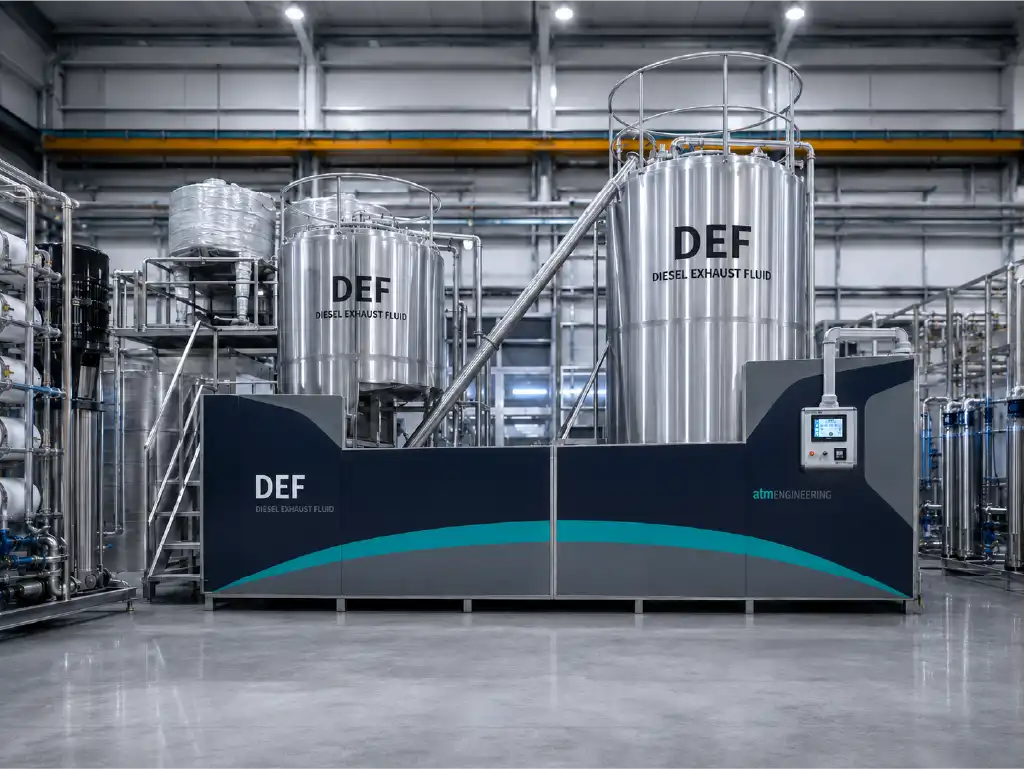
In a controlled AdBlue® production process, deionized water helps maintain predictable concentration, stable conductivity and low contamination risk. It also supports more accurate quality control because variations in the water source are minimized before the blending stage. When producers rely on untreated water or poorly treated water, every seasonal change in the municipal or well water supply can become a production variable.
For plants that produce continuously, stable deionized water becomes even more important. A single off-spec batch may represent wasted urea, lost production time, packaging delays and retesting. This is why water quality for AdBlue® production should be designed as a controlled process, not as a simple utility connection.
How minerals and metals affect SCR systems
Minerals and metals are problematic because SCR systems are designed for a high-purity fluid, not for a mineral-bearing solution. Calcium and magnesium can contribute to scaling. Sodium and potassium can increase ionic content. Iron, copper, zinc and other metallic contaminants can affect catalyst performance, create deposits or indicate that unsuitable contact materials are being used in the production or storage system.
The risk is not always immediate. Contaminated DEF may pass through the supply chain before problems appear in vehicles, storage tanks, pumps or dosing equipment. Deposits, crystallization behavior, injector fouling and sensor issues can create warranty disputes and customer complaints. For this reason, responsible DEF manufacturing must consider not only the water source but also all contact surfaces, including tanks, valves, pumps, pipework and filling nozzles.
Atmosfer Makina’s integrated approach connects water purification, stainless steel process design, automation and quality monitoring. The company’s turnkey DEF production plant concept is built around controlled production, accurate dosing and efficient batch handling. This is the type of process discipline required when the final product must protect sensitive SCR systems.
RO and EDI Technologies in AdBlue® Production
An effective water treatment strategy for AdBlue® production is usually built in stages. The goal is to remove suspended solids, reduce dissolved minerals, control contamination risk where relevant and polish the water to a low-conductivity level suitable for DEF manufacturing. In many industrial setups, reverse osmosis provides the main purification barrier, while EDI water treatment provides the final polishing stage.
Reverse osmosis as the first purification barrier
A reverse osmosis system separates water from a large portion of dissolved salts and other impurities by pushing feed water through semi-permeable membranes. In a RO system for AdBlue® production, this stage is often the first major barrier against conductivity, hardness and total dissolved solids. Pre-treatment may include sediment filtration, activated carbon, softening, antiscalant dosing or other components depending on the feed water profile.
RO performance should be monitored by checking feed water, permeate quality, pressure, flow rate and rejection efficiency. If the RO membranes are overloaded by poor pre-treatment or high scaling tendency, permeate quality can decline and operating cost can rise. For AdBlue® producers, this means that RO should not be treated as a stand-alone machine but as part of a controlled water preparation system.
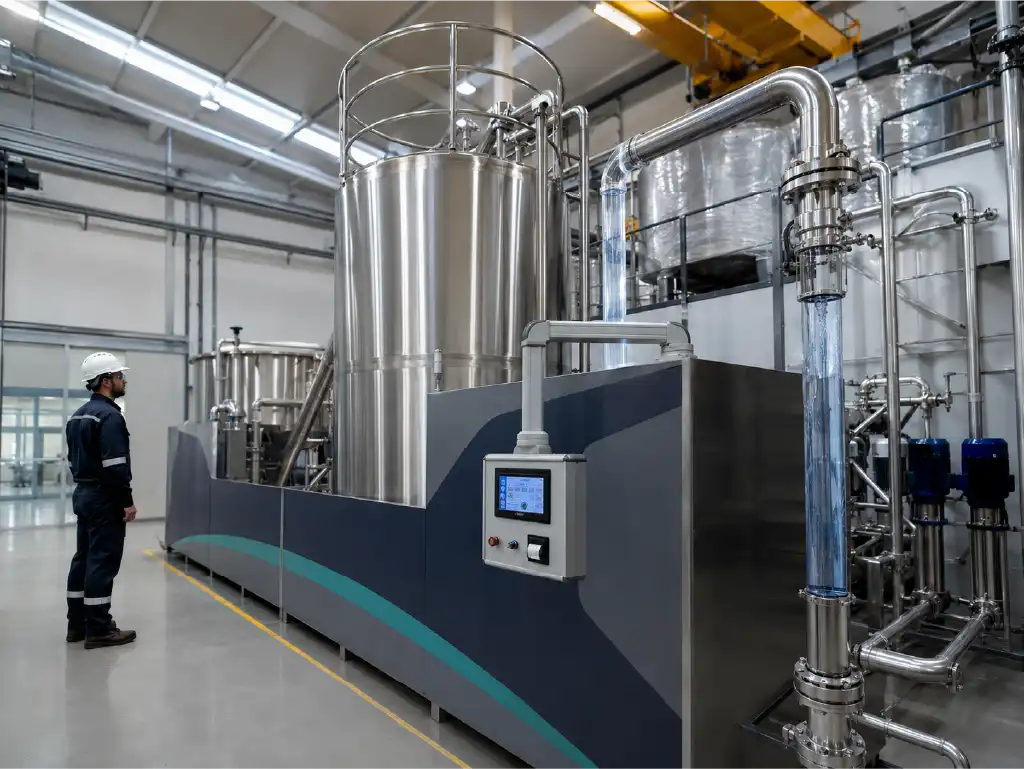
Another key point is sizing. An undersized RO unit may struggle during peak production, while an oversized unit may operate inefficiently if the plant does not use enough water. In a turnkey project, daily DEF capacity, batch cycle time, storage tank volume and filling schedule should all be considered together. Atmosfer Makina’s AdBlue® production line setup guide explains how infrastructure, water availability and process equipment must be evaluated during plant planning.
EDI polishing for consistent low conductivity
EDI, or electrodeionization, is used after RO to further reduce ions and help produce consistently low-conductivity water. Unlike traditional mixed-bed ion exchange systems that require chemical regeneration, EDI combines ion exchange media, membranes and electrical current to continuously remove remaining ions from RO permeate. This makes EDI water treatment attractive for automated DEF plants where stable output and reduced chemical handling are priorities.
In practical production terms, EDI polishing improves consistency. RO water quality can fluctuate depending on feed water conditions, membrane age and operating pressure. EDI helps smooth these variations and delivers a more stable water stream for the blending system. For AdBlue® manufacturing, this stability supports better conductivity control in the final product and reduces the risk of batch deviation.
| Process Stage | Main Purpose | Why It Matters for DEF |
|---|---|---|
| Pre-treatment | Protect RO membranes from particles, chlorine, hardness or scaling risk | Improves system reliability and reduces premature membrane damage |
| Reverse osmosis | Removes dissolved minerals and ionic contaminants | Creates the main purified water stream for AdBlue® production |
| EDI polishing | Further reduces remaining ions after RO | Supports stable low conductivity and repeatable batch quality |
| Online monitoring | Measures conductivity, flow and key process parameters | Helps detect deviations before water reaches the mixer |
| Laboratory testing | Confirms water and final DEF quality | Provides traceability and quality assurance records |
Which Water Parameters Should Be Monitored?
Good water treatment equipment is only one part of quality control. The plant must also monitor the right parameters at the right points. Conductivity in AdBlue® production is one of the most important indicators because it reflects the presence of dissolved ions. However, conductivity alone cannot tell the full story. pH, hardness, silica, metals, temperature and system trend data may also be relevant depending on the plant design and local water source.
A practical monitoring strategy should define sampling points, acceptable ranges, alarm limits, testing frequency and corrective actions. For example, conductivity can be monitored online after RO, after EDI and before the blending tank. Laboratory tests can then verify specific contaminants and confirm that the final AUS32 product is within the required quality expectations.
Conductivity, pH, hardness and silica control
Conductivity is often used as the fastest routine indicator of purified water quality. If conductivity rises unexpectedly, it may indicate membrane leakage, EDI performance loss, resin or membrane contamination, valve failure, mixing with untreated water or a change in feed water quality. In an automated plant, online conductivity sensors can trigger alarms or stop transfer before unsuitable water reaches the process tank.
pH should also be monitored because unusual pH values can indicate contamination, chemical carryover or system imbalance. While pH does not replace conductivity testing, it provides an additional warning signal. In water treatment systems that include chemical dosing or specific pre-treatment steps, pH control can also support membrane protection and stable operation.
Hardness control is important because calcium and magnesium can create scaling in membranes and downstream equipment. Silica is another critical parameter because it can be difficult to remove and may cause deposits under certain conditions. A plant using high-silica feed water should be designed with special attention to recovery rate, antiscalant strategy and polishing performance.
Expert note: For AdBlue® plants, do not evaluate water quality only at commissioning. Seasonal changes, membrane aging, maintenance practices and feed water variations can all affect performance. A professional operation should combine online trend monitoring with scheduled laboratory verification and documented corrective actions.
Online monitoring vs. laboratory testing
Online monitoring gives operators immediate visibility. Conductivity, temperature, tank level, flow rate and pressure data can be integrated into the PLC and HMI so the team can see system performance while production is running. This is especially valuable in automated plants because deviations can be detected before they become finished product problems.
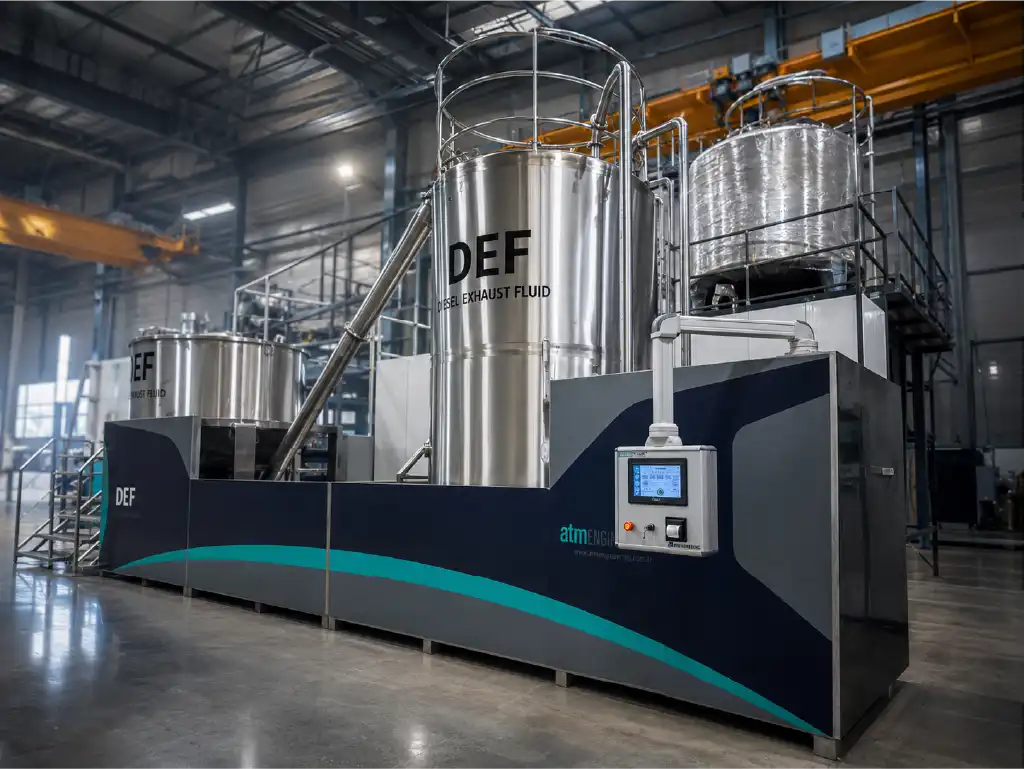
Laboratory testing provides a deeper level of confirmation. While online sensors are excellent for real-time control, they cannot replace periodic analysis for specific impurities, metals or final product verification. A balanced quality program uses online data for process protection and laboratory data for compliance, traceability and customer confidence.
Water Quality for AdBlue® Production Checklist
For investors comparing equipment offers, the water treatment line should be reviewed with the same seriousness as the mixer or filling machine. Feed water analysis should include conductivity, TDS, hardness, alkalinity, silica, iron, manganese, chlorine, pH and any local contaminants that may affect membranes or final product quality. The system must also be sized according to daily production volume, batch frequency, storage tank volume and future expansion.
Material compatibility should not be ignored. Even if water is properly treated, unsuitable materials in tanks or pipelines can reintroduce contaminants. Stainless steel quality, seals, hoses, pump materials and filling components must be selected carefully. This is why a turnkey engineering approach can reduce risk: the system is designed as a complete production chain rather than a collection of separate machines.
Frequently Asked Questions
Can tap water be used for AdBlue® production?
No. Tap water should not be used directly for AdBlue® production because it may contain minerals, hardness, chlorine, metals and other impurities. For consistent DEF quality, the water should be purified through a properly designed treatment system and verified before blending with urea.
Is RO water enough for DEF manufacturing?
RO water may be suitable as an intermediate stage, but it is not always enough on its own. Feed water quality, RO performance, required conductivity level and quality expectations determine whether EDI polishing is needed. Many professional plants use RO followed by EDI to achieve more stable low-conductivity water.
Why is conductivity important in AdBlue® production?
Conductivity indicates the amount of dissolved ionic material in the water or solution. In AdBlue® production, rising conductivity can signal contamination, membrane failure, poor polishing performance or unsuitable water entering the process. Monitoring conductivity helps protect batch quality and SCR compatibility.
What happens if water contains minerals or metals?
Minerals and metals can increase contamination risk in the final DEF product. They may contribute to deposits, injector problems, sensor issues or SCR system performance concerns. They can also cause the product to fail quality checks, resulting in rejected batches and customer complaints.
Build a Quality-Focused AdBlue® Production Line with Atmosfer Makina
Reliable water quality for AdBlue® production starts with the right engineering decisions. A professional plant must control RO performance, EDI polishing, conductivity, material compatibility, automation and laboratory verification as one connected process. This is where an integrated equipment partner can make a measurable difference. Atmosfer Makina designs turnkey DEF production solutions for companies that need consistent quality, efficient operation and scalable capacity. Whether you are planning a new investment, improving your existing water treatment system or comparing plant configurations, the right technical evaluation can prevent costly mistakes before production begins. To discuss your project requirements, capacity targets and quality control expectations, visit Atmosfer Makina and request expert guidance for a production system designed around your real operating conditions.
