
An AdBlue factory budget must cover the cost of producing, approving, storing and delivering saleable fluid, rather than stopping at the mixing machine. Investors need three connected calculations: installed capital expenditure, operating cost per saleable tonne and the working capital required before customer payments arrive. Missing any one of these can make an attractive equipment quotation look misleadingly profitable.
For distributors, chemical manufacturers and fleet suppliers, the practical starting point is a defined production basis: expected monthly sales, packaging formats, feedwater analysis, available utilities and product release requirements. This turns an AdBlue factory cost estimate into a decision supported by measurable assumptions.
What Determines the Initial Cost of an AdBlue Factory?
CAPEX depends on the complete scope delivered and installed. A compact blending package and a commissioned facility with water treatment, storage, filling and laboratory capability are different investments. Compare quotations against the same capacity, operating schedule and contractual boundaries.
Production equipment, storage tanks and water purification
The main process package typically covers urea handling, controlled dosing, dissolution, filtration, transfer pumps and automation. For an AdBlue factory, useful capacity means product available for dispatch after filling and quality release. A nominal mixing rate alone does not establish monthly output: loading, dissolution, transfer, cleaning and waiting time can reduce effective production.
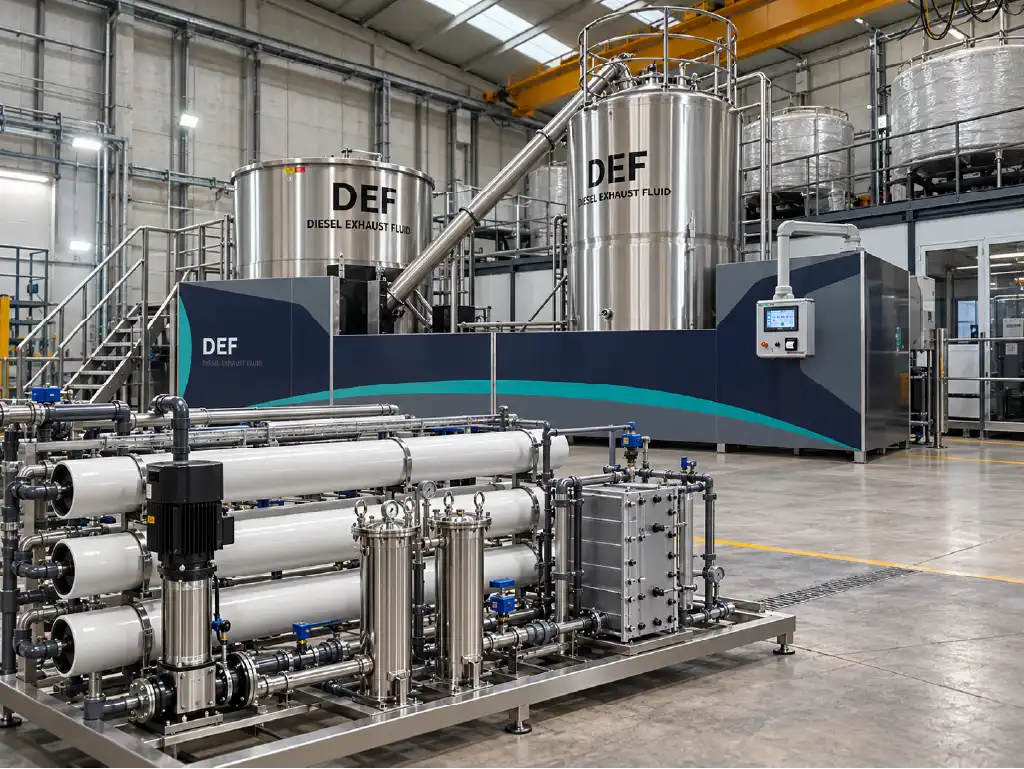
Storage must accommodate incoming materials, purified water, finished product and any batches awaiting approval. Specify compatible wetted materials, protected connections, sampling points and maintainable tank arrangements. The AdBlue production line options provide a starting point for defining this equipment scope.
How should production equipment, storage tanks and water purification be evaluated in practice?
Develop a mass balance and an operating schedule before selecting tank sizes. Calculate purified-water demand during actual production hours, including flushing and cleaning. Size the treatment train using feedwater chemistry and seasonal temperature, not just the daily finished-product target. Pretreatment, reverse osmosis and polishing requirements should follow technical analysis.
An AdBlue factory with inexpensive source water can still face substantial treatment costs if recovery is low or scaling risk is high. Compare electricity, concentrate disposal, membrane replacement and consumables alongside purchase price. The RO, EDI and water-quality guide explains the relationship between water preparation and production control.
Require suppliers to distinguish equipment rating from guaranteed performance at your site. Identify the slowest step across water preparation, dissolution, laboratory release and filling. If approved product cannot leave the storage tanks quickly enough, a larger mixer may add investment without increasing dispatch volume. Schedule changes or additional buffer capacity may offer better value.
Measurement method, documentation and acceptance criteria
Request a process flow diagram, equipment list, material declarations, utility schedule and agreed performance protocol. Define factory acceptance testing and site acceptance testing separately. Verify throughput over an agreed run duration using specified feedwater, raw materials and operating conditions. Record batch time, transferred mass, water consumption and metered electricity.
Product acceptance should reference the applicable ISO 22241-1 quality requirements and relevant test methods. Conductivity and refractive index support process control, but neither independently proves full compliance. Agree laboratory responsibilities, sampling procedures and instrument calibration before ordering equipment.
Building, utilities, filling equipment and laboratory requirements
Building costs extend beyond floor area. An AdBlue factory needs adequate access, floor loading capacity, maintenance clearance, material handling, drainage and suitable environmental protection. Electrical distribution, water connections, compressed air where required and ventilation must be assessed against the actual layout. Climate conditions may also justify insulation or temperature management.
Packaging changes the investment significantly. Bulk dispatch, IBC filling and small-container retail production require different equipment, staffing and warehouse arrangements. Review filling, capping and labeling equipment against the planned container mix. Laboratory planning should distinguish routine onsite checks from specialist analyses assigned to an external laboratory.
How should building, utilities, filling equipment and laboratory requirements be evaluated in practice?
Use a scope matrix that assigns every interface to a responsible party. The following categories help identify costs that are frequently excluded from a machine quotation.
| Budget category | Items to confirm | Evidence required |
|---|---|---|
| Process equipment | Dosing, mixing, filtration, controls | Equipment list and performance scope |
| Site infrastructure | Foundations, cabling, drainage, connections | Survey and contractor quotations |
| Storage and dispatch | Tanks, hoses, filling, handling | Layout and packaging schedule |
| Quality and startup | Instruments, testing, training, spares | Release plan and commissioning scope |
| Additional cash funding | Contingency, inventory, receivables | Risk register and cash-flow forecast |
For an AdBlue factory, also clarify freight, unloading, insurance, customs treatment and installation supervision. Separate recoverable taxes from permanent project costs, while allowing for their cash-flow timing.
Check quotation validity and currency exposure against the purchasing schedule. Record exclusions explicitly, including local lifting equipment and temporary services during installation. For phased expansion, confirm that future tanks, electrical loads and filling capacity fit the proposed layout. Otherwise, a low initial investment can create expensive relocation work when sales increase.
Risk indicators, corrective actions and verification steps
Unpriced utility connections, undefined commissioning responsibilities and filling capacity below the sales requirement indicate an incomplete estimate. Close each gap through a site survey, revised layout or written scope clarification. Verify contractor interfaces before equipment dispatch.
A hypothetical funding example shows the distinction: USD 200,000 for equipment, USD 60,000 for site works and USD 20,000 for commissioning totals USD 280,000. Adding an assumed 10% contingency and USD 70,000 working capital brings initial funding to USD 378,000. These are arithmetic assumptions, not market prices or a supplier quotation; actual categories and allowances require project-specific offers.
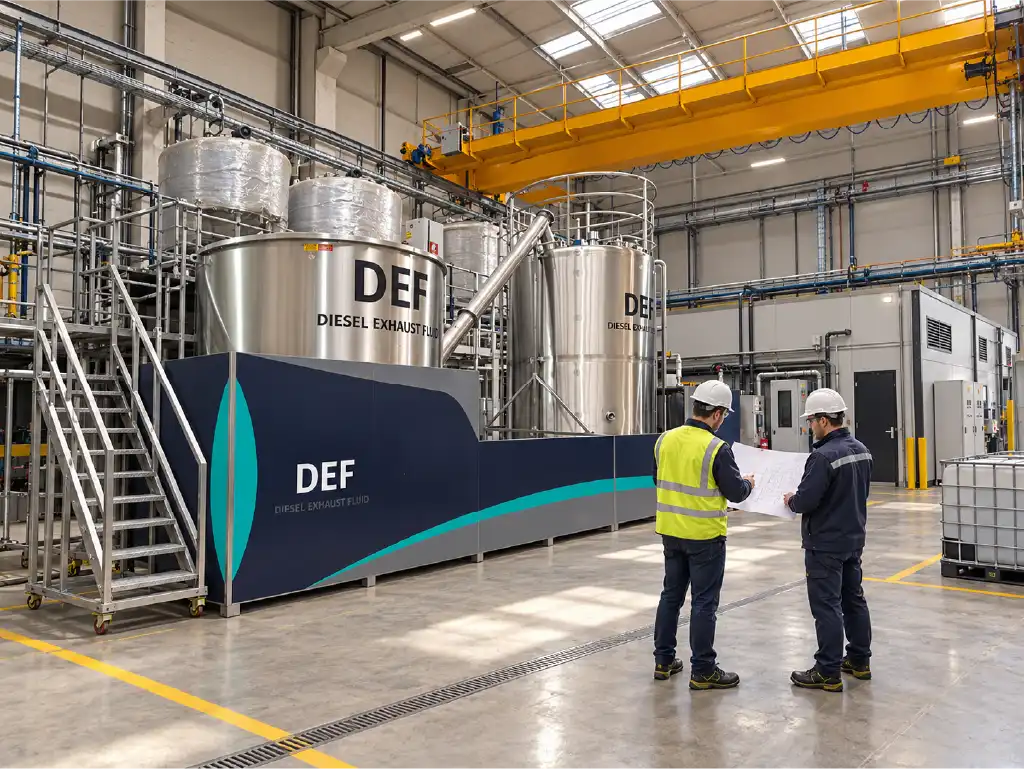
Expert note: A General Motors service bulletin hosted by NHTSA recommends compatible tanks, pumps, valves and fittings, with dedicated DEF transfer equipment. Include these details in the installation budget using its DEF storage and transfer guidance, alongside the applicable handling standard.
Which Operating Costs Affect DEF Manufacturing Profitability?
OPEX should be calculated against saleable output, not theoretical capacity. Separate variable production costs, fixed operating overhead and delivery expenses. This makes an AdBlue factory comparison meaningful across different sales volumes and packaging strategies.
Urea, water, electricity and labor costs
AUS32 contains nominally 32.5% urea by mass. An ideal 1,000 kg batch therefore contains 325 kg urea and 675 kg purified water, before correcting for raw-material assay, process losses or inventory differences. This is a mass calculation, not a volume recipe. Use qualified urea for DEF production with documented suitability; agricultural-grade material is not an interchangeable purchasing shortcut.
For an AdBlue factory, delivered urea cost includes transport, handling and storage losses. Purified-water cost includes treatment and rejected water. Labor covers receiving, packaging, sampling, cleaning and maintenance support as well as machine operation. Connected electrical power should never be treated as measured energy consumption.
How should urea, water, electricity and labor costs be evaluated in practice?
Build a transparent calculation per tonne, using one currency and a consistent delivery basis. Consider this illustrative scenario, which uses assumed costs rather than current market quotations.
| Assumption | Cost per theoretical tonne |
|---|---|
| Urea: 0.325 tonnes at USD 500/tonne | USD 162.50 |
| Purified water: 0.675 tonnes at USD 4/tonne | USD 2.70 |
| Other variable conversion and packaging costs | USD 45.00 assumed |
| Total before yield adjustment | USD 210.20 |
At an assumed 98% saleable yield, variable cost becomes USD 210.20 divided by 0.98, or approximately USD 214.49 per saleable tonne. If monthly fixed operating costs are USD 12,000 and sales reach 200 tonnes, add USD 60 per tonne. The resulting USD 274.49 excludes outbound distribution, financing, taxes and profit. Replace every assumption with validated project data.
Measurement method, documentation and acceptance criteria
Measure electricity in kWh per saleable tonne and water as both source-water intake and purified-water consumption. Reconcile urea receipts, batch records and stock movements. Allocate paid labor hours across production and supporting tasks. For an AdBlue factory selling in liters, convert using density at the defined reference temperature rather than assuming one liter equals one kilogram.
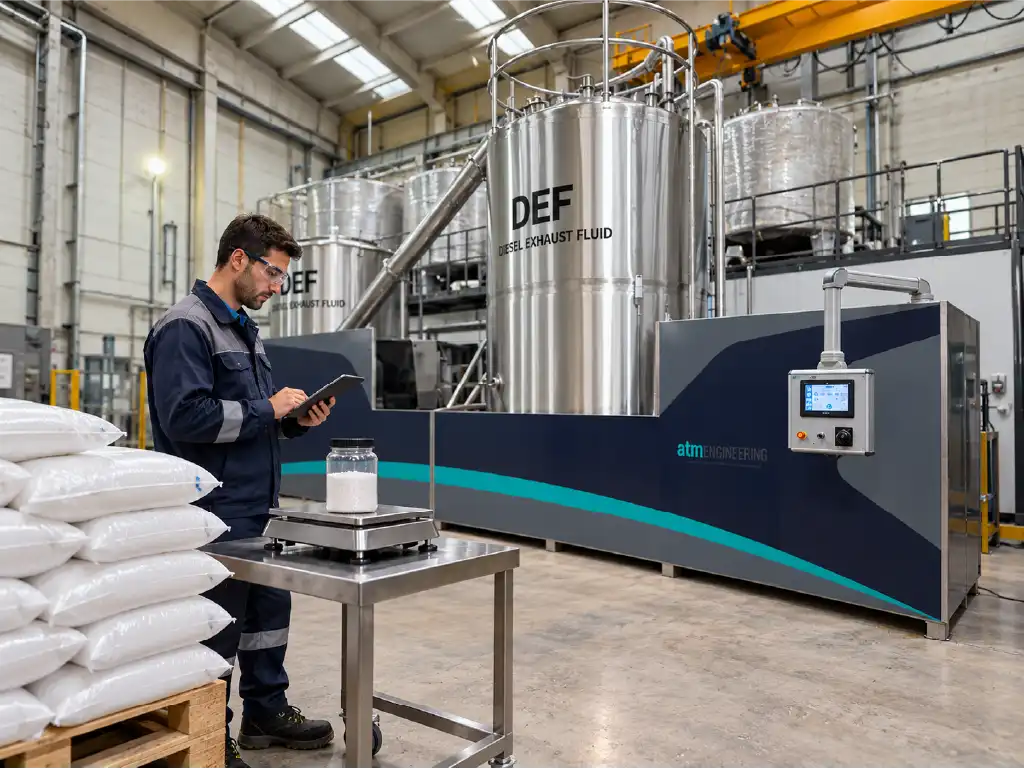
Set cost targets against approved operating conditions and compare actual results monthly. Investigate variance through purchase prices, yield, downtime and packaging mix. Test lower utilization and higher urea prices independently, then combine them in a downside scenario to expose cash-flow pressure.
At nominal composition, a USD 100 increase per tonne of purchased urea adds USD 32.50 per theoretical tonne of DEF before yield adjustment. Separately, halving monthly sales doubles the fixed-cost allocation per tonne when total fixed expenses remain unchanged. These sensitivities help an AdBlue factory prioritize procurement terms and realistic sales commitments.
Maintenance, packaging and quality-control expenses
Maintenance includes pump seals, valves, filters, calibration, water-treatment consumables and planned service labor. Budget critical spares according to failure consequences and delivery lead times. An AdBlue factory also carries the cost of maintenance access, production interruptions and restarting equipment after extended shutdowns.
Packaging can alter profitability more than expected. IBC ownership, inspection, cleaning, return logistics and losses differ from jerrycan, cap, label and pallet costs. Quality expenditure includes sampling supplies, retained samples, instrument checks and external testing. Quarantined stock also occupies tanks and delays dispatch, even when the batch is eventually accepted.
How should maintenance, packaging and quality-control expenses be evaluated in practice?
Prepare a maintenance calendar linked to operating hours and manufacturer recommendations. Obtain consumable prices and spare-part lead times before finalizing the purchase. Compare packaging alternatives using delivered cost per saleable unit, including transport utilization and customer requirements.
Separate technical conformity from permission to use the AdBlue® trademark. The VDA licensing information explains the trademark and production/distribution audit requirements. An AdBlue factory planning branded sales should confirm applicable licensing and audit costs directly; purchasing machinery does not automatically grant these rights.
Risk indicators, corrective actions and verification steps
Increasing filter differential pressure, declining water recovery, repeated concentration adjustments and unexplained filling losses warrant investigation. Check instruments, inspect raw-material handling and isolate suspect product. Verify corrective actions with documented measurements and the agreed release testing before dispatch.
Track complaints and traceability alongside cost indicators. Model the financial effect of a rejected batch, delayed urea delivery or unavailable filling line. Maintain a cash forecast covering inventory days, laboratory turnaround, supplier terms and customer payment periods. A profitable AdBlue factory can still experience a funding shortage when stock and receivables grow faster than collections.
Keep working capital separate from the contingency allowance: inventory and receivables require routine funding, while contingency addresses uncertainty. An AdBlue factory should update both as purchasing volumes and customer terms change. Confirm who owns returnable packaging and when deposits are refunded, because those cash movements can materially affect the funding cycle.
Frequently Asked Questions
How much does an AdBlue factory cost?
A reliable figure requires capacity, location, feedwater analysis, packaging and installation scope. Request itemized equipment and local infrastructure quotations, then add commissioning, risk allowances and working capital. A machine-only price cannot establish total project funding.
What is usually the largest variable cost in DEF manufacturing?
Urea is often a major contributor because it represents 32.5% of nominal product mass. However, small-container packaging, transport and low operating utilization can materially change the cost structure. Calculate the actual sales mix before ranking expenses.
Does every plant need RO and EDI?
No universal treatment configuration suits every source. Select pretreatment, RO passes and polishing through feedwater analysis and the required control strategy. Verify product quality through appropriate testing rather than assuming a particular equipment combination guarantees compliance.
How can I calculate the break-even production volume?
Divide fixed operating costs by contribution per saleable unit. Contribution is net selling revenue minus variable manufacturing and distribution costs. Use matching units and periods, then test whether sales demand and available production capacity support that break-even volume.
Which hidden costs should be checked before ordering?
Check utility upgrades, installation interfaces, freight, laboratory services, licensing, spare parts, startup losses and inventory financing. Also confirm who pays for commissioning consumables and repeat testing if site conditions differ from the agreed design basis.
Plan Your DEF Production Investment with Atmosphere Engineering
A credible AdBlue factory investment starts with a production requirement that equipment suppliers, site contractors and operating teams can evaluate consistently. Atmosphere Engineering brings together DEF production equipment, water-treatment options and filling solutions to support that assessment. Share your target monthly output, source-water analysis, intended packaging formats, site location and available utilities to establish a practical starting scope.
Through Atmosphere Engineering, discuss the equipment configuration and the information needed for a project-specific proposal. Request clear boundaries for supply, installation, commissioning, training and ongoing service, together with documented assumptions for capacity and utility demand. If your building or water analysis is still being finalized, identify those uncertainties early so they can be addressed during technical evaluation. To move from an indicative concept to a reviewable budget, contact the engineering team for a technical consultation and quotation.
Görseller temsilidir ve yapay zekâ kullanılarak oluşturulmuştur.
