
Selecting an AdBlue filling line requires more than comparing machine speed and price. The correct system must match the package sizes you sell, the number of orders you process, the accuracy required by your quality plan and the level of automation your team can operate reliably. A distributor serving retail stores may need fast changeovers between 5L, 10L and 20L canisters, while a fleet supplier may benefit more from drum or IBC filling with verified weighing and batch records.
The packaging stage protects the value created during water treatment, urea dissolution, filtration and laboratory control. Poor filling accuracy, incompatible product-contact materials, inconsistent capping or weak traceability can turn a compliant batch into a costly packaging problem. Line selection should therefore be evaluated as part of the complete DEF production process.
Atmosfer Makina develops integrated production and packaging solutions for small containers, drums and IBC tanks. Its filling, capping and labeling systems can be configured around filling volume, nozzle count, closure control, labeling and PLC operation.
Why Packaging Type Matters in AdBlue Production
Packaging influences customer type, warehouse layout, pallet efficiency, filling cycle time, labor demand and transport cost. An AdBlue filling line designed for 10L canisters is not automatically suitable for 1000L IBC tanks because flow rate, weighing method, container handling and operator workflow are fundamentally different.
Before comparing machines, map your sales mix. Define which formats generate the most volume, how often package sizes change, whether production is made to stock or order, and what traceability customers require. This creates a realistic specification and prevents investment based only on headline capacity.
Retail packaging vs bulk distribution
Retail packaging is designed for portability, shelf presentation and frequent handling. Five, ten and twenty-liter canisters are commonly supplied to automotive retailers, service stations, workshops, agricultural operators and small fleets. These formats require reliable container feeding, clean filling, consistent cap placement and accurate labeling. The AdBlue filling line must also tolerate normal variations in empty-container dimensions without creating jams or label misalignment.
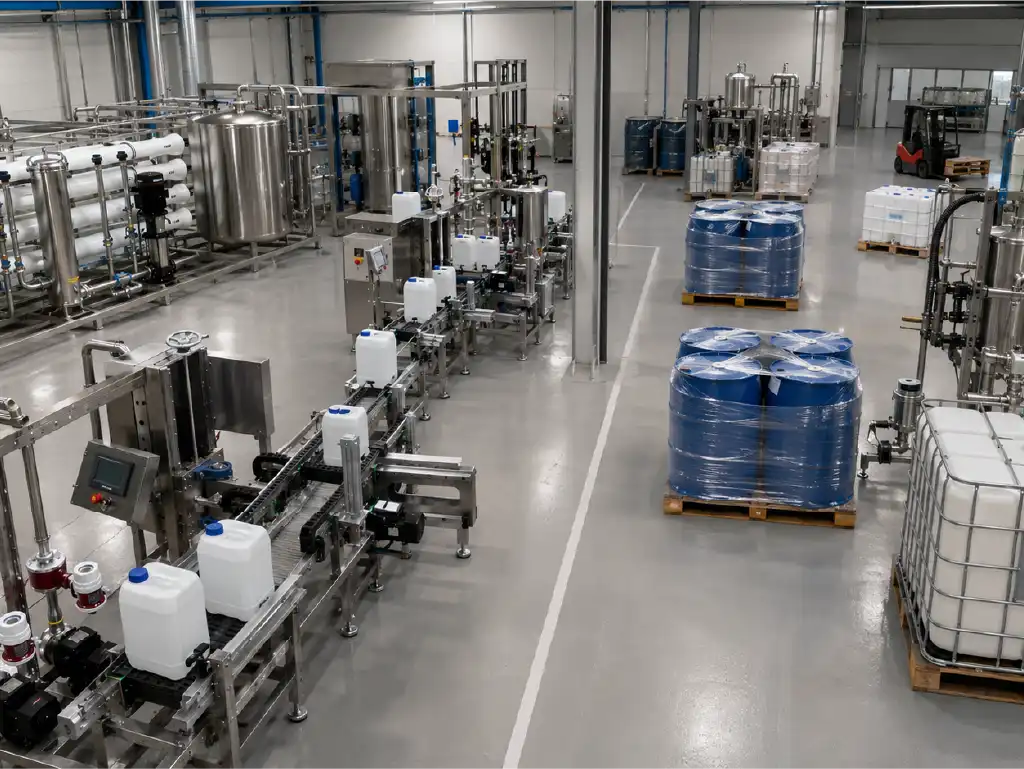
Bulk distribution serves customers that consume larger quantities and prefer fewer packaging operations. Drums may suit workshops and regional distributors, while IBC tanks are practical for fleet depots, fuel suppliers and customers with on-site dispensing equipment. The number of packages per batch is lower, so priorities shift toward high-flow transfer, weight verification, overfill prevention and safe connection management.
How filling volume affects line speed and accuracy
Nominal speed must always be read together with container size. A machine filling 5L canisters completes more units per hour than the same dosing principle filling 20L containers, even when total liters per hour are similar. Acceleration, nozzle movement, settling time, container spacing and downstream capping all influence actual output.
Accuracy should be evaluated in percentage and absolute volume. Repeated overfilling reduces margin, while underfilling creates commercial and compliance risk. A well-designed AdBlue filling line uses repeatable container positioning, controlled fast and slow filling stages, and a verification method suited to the package size.
Small canisters may use electromagnetic flow meters, mass dosing or volumetric systems. Drums and IBCs often benefit from load-cell weighing. Final settings should be tested with the actual container, hose arrangement and production temperature.
Choosing the Right AdBlue Filling System
Begin with a packaging matrix listing every container size, neck diameter, cap type, label dimension, pallet pattern and expected daily quantity. Then define which formats must run automatically, which can remain semi-automatic and how much changeover time is acceptable. This makes it easier to compare a dedicated DEF filling machine with a flexible packaging platform.
Atmosfer Makina’s AdBlue production line solutions include small-container, drum and IBC packaging options that can connect with finished-product storage. The company describes dedicated IBC stations, integrated weighing and labeling, drum and canister lines, emergency stops and spill-control features.
Small containers: 5L, 10L and 20L canisters
A small-container AdBlue filling line is usually selected for retail and distributor channels where presentation, consistency and unit throughput matter. The 5L format supports easy handling, 10L offers a practical retail volume, and 20L reduces packaging cost per liter but requires stronger conveyors and stable container guidance.
For an AdBlue 10L filling machine selection, buyers should test the intended canister. Handle shape, sidewall rigidity, neck position and cap thread can affect filling and closing. A flexible container may shift below the nozzle, an unsuitable cap feeder may misorient closures, and molded label panels may require precise applicator adjustment.
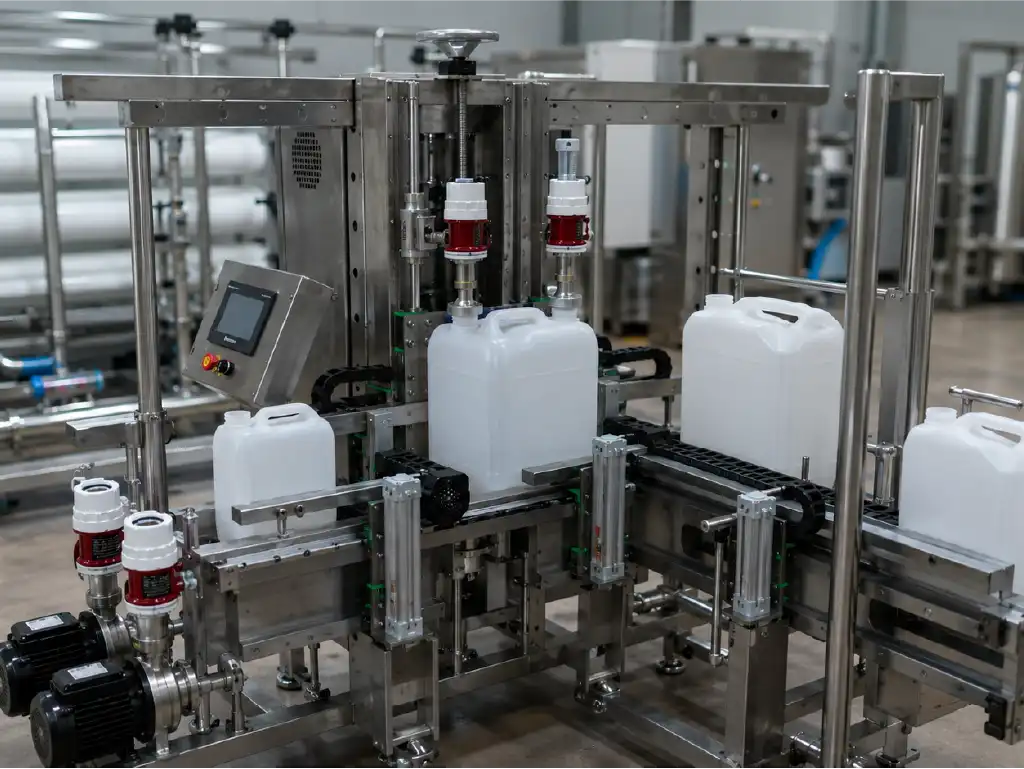
Automation should reflect order volume and labor economics. A semi-automatic machine can suit market entry, seasonal demand or frequent low-volume changes. A fully automatic AdBlue filling line becomes more attractive when production is repetitive and capping, labeling and material supply can maintain the same pace.
- Recipe selection for 5L, 10L and 20L formats
- Adjustable guides and rapid change parts
- No-container, no-fill logic and drip-control nozzles
- Automatic cap feeding with torque monitoring
- Label presence checks and batch coding
- Reject handling for filling, cap or label faults
Small-container equipment also needs a hygienic drainage and cleaning concept. Hoses, valves, tanks and nozzles should be compatible with DEF service and designed to reduce stagnant zones. The water quality requirements for AdBlue production remain relevant through packaging because contamination introduced after blending can affect the finished product.
Bulk packaging: drums and 1000L IBC tanks
A DEF drum filling line prioritizes controlled transfer, stable drum positioning and dependable weight confirmation. Drums may be filled individually on a scale through a top-fill lance, with an automatic or operator-confirmed stop. Configuration depends on drum size, closure design, pallet handling and whether sealing or serial labeling is required.
An AdBlue IBC filling and labeling line must manage a much larger liquid mass. The station should provide secure hose routing, accurate cut-off and overfill protection. A common method uses a fast-fill phase followed by a slower final-fill stage as target weight approaches. This improves cycle time while limiting overshoot.
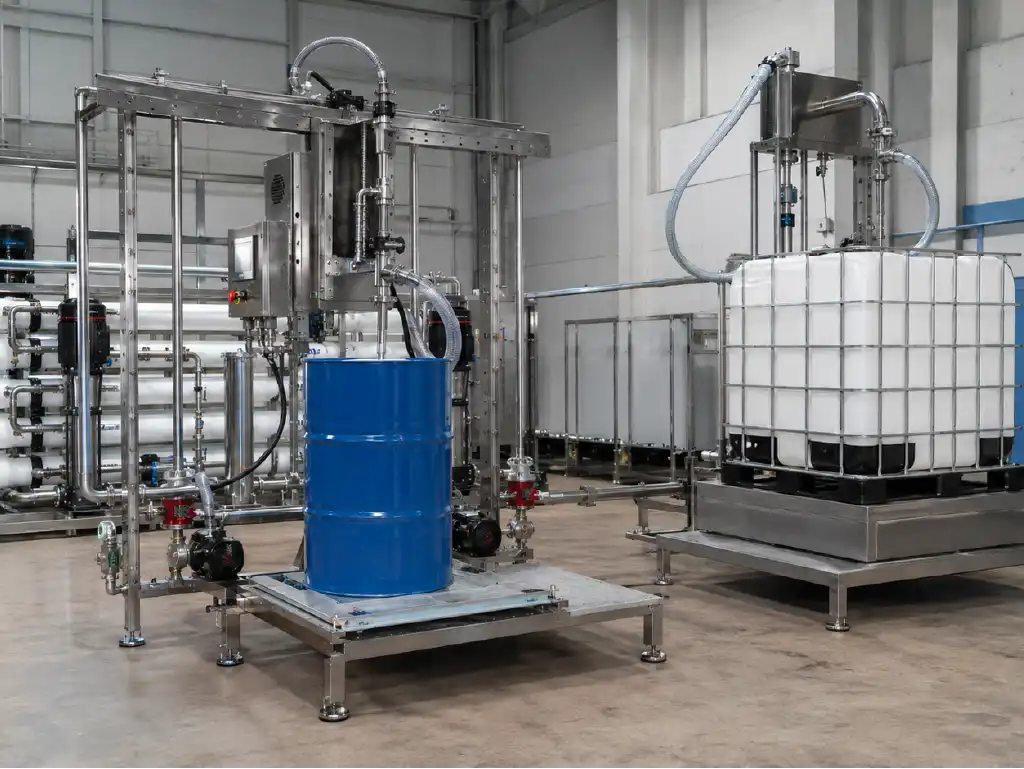
IBC filling also affects forklift routes, bunding, floor loading, filled-product storage and dispatch sequencing. Atmosfer Makina lists 1000L HDPE IBC tank options for liquid storage and transport. The final AdBlue filling line configuration should still be confirmed against the exact IBC valve, top opening, pallet type and local logistics requirements.
| Packaging format | Typical use | Preferred filling approach | Key priority |
|---|---|---|---|
| 5L canister | Retail and top-up use | Automatic multi-nozzle line | Unit speed and clean filling |
| 10L canister | Retail and workshops | Semi-automatic or automatic | Flexibility and capping control |
| 20L canister | Commercial users | Indexed conveyor filling | Stability and ergonomics |
| Drum | Industrial distribution | Scale-based filling station | Weight accuracy and handling |
| 1000L IBC | Fleet and bulk supply | Staged high-flow system | Overfill protection and records |
Key Technical Criteria Before Buying an AdBlue Filling Line
A sound purchasing process separates mandatory requirements from options. Core criteria include product-compatible materials, target accuracy, packaging formats, capacity, utilities, safety functions and documentation. Options may include cap sorting, vision inspection, remote support or future nozzle expansion.
Request a layout, operating sequence, changeover concept, utility list and acceptance-test plan. Quoted output should state container size, nozzle count, operator tasks and downstream assumptions. Without these conditions, two AdBlue filling line quotations may appear comparable while addressing different realities.
Filling accuracy, capping torque and labeling consistency
Filling accuracy should be verified across a meaningful sample rather than demonstrated with one container. Tests should include the lowest and highest planned volumes, repeated start-stop conditions and normal line speed. Empty-container tare variation must also be considered when weight-based checks are used, and measuring instruments need a documented calibration or verification plan.
Capping matters because an accurate fill can still be lost through leakage. Closure torque should follow the cap and container supplier’s recommendations and be confirmed under project conditions. Too little torque may allow leakage; too much can damage threads, deform the closure or make the package difficult to open. Recipe-based settings and periodic torque checks improve repeatability.
Labeling supports brand presentation and traceability. The AdBlue filling line labeler should apply the correct label at a stable position despite normal canister variation. Sensors can confirm label presence, while coding systems can add batch number, production date and other required data. Drum and IBC labels should also suit the storage environment and surface material.
Expert note: Do not approve an AdBlue filling line from water-only trials unless the project team confirms that the test represents the final process. Use representative containers, caps and labels during the factory acceptance test. Record fill results, torque values, label position, rejected units, changeover time and operator interventions. Confirm final settings again during site acceptance after connection to the actual storage, piping and utility system.
PLC control, traceability and production capacity
PLC control coordinates the filler, conveyor, capper, labeler, sensors and safety devices. The AdBlue filling line interface should allow authorized users to select recipes, view alarms and adjust permitted parameters without exposing critical settings. Atmosfer Makina’s published filling-line information describes centralized control of filling volume, capping torque, label placement and line speed, together with PLC control and configurable nozzle quantities.
Traceability should be defined before software development. A basic AdBlue packaging line may record batch number, package format, production date and total units. Advanced systems can connect an order to fill-weight data, alarm history, operator identification, label codes and rejected packages. ERP integration may be useful for high-volume plants, but it should support a clear operational need.
Production capacity means good, saleable output per shift. Breaks, format changes, cleaning, label-roll replacement, quality sampling and minor stops reduce theoretical output. Upstream production and storage must also supply the AdBlue filling line without interruption. Atmosfer Makina’s production guide identifies formats from 5L canisters to 200L drums and 1000L IBC tanks and notes that systems may be manual, semi-automatic or fully automatic.
Product handling remains connected to SCR performance. The U.S. Environmental Protection Agency states that verified SCR technology requires DEF to be produced, handled and transported in accordance with ISO 22241. Packaging equipment and records should therefore be treated as part of the quality system. See the U.S. EPA reference on DEF handling and ISO 22241.
How to Match the Line to Your Business Model
The best AdBlue filling line supports the current sales mix while leaving a path for growth. A new retail producer may begin with one or two nozzles and semi-automatic capping if the frame, controls and conveyor can be expanded. A mature distributor may justify a fully automatic canister line plus a separate drum and IBC station so bulk orders do not interrupt retail production.
Model current, growth and peak-season demand. Calculate liters, packages, labor, changeovers and storage per shift. Compare investment cost with labor savings, reduced giveaway, lower rejection risk and faster fulfillment. Project-based analysis is more reliable than selecting the highest advertised speed.
Supplier capability beyond the machine is also important. Integration with tanks, pumps, piping, water treatment and quality-control procedures influences plant performance. Atmosfer Makina evaluates the AdBlue filling line as part of a turnkey DEF production and packaging workflow, aligning upstream product quality with filling, closing, labeling and dispatch.
Frequently Asked Questions
Which AdBlue filling line is best for 5L, 10L and 20L containers?
The answer depends on package mix, speed, cap type and changeover frequency. Automatic systems suit stable high-volume production, while semi-automatic lines can be economical for lower volumes. Test actual canisters, caps and labels before approval.
Should I choose a flow-meter or load-cell filling system?
Flow meters can provide fast dosing for small and medium containers. Load cells are often preferred for drums and IBC tanks because they confirm weight directly. Selection should consider accuracy, package size, tare variation and flow rate.
Can one DEF filling machine handle canisters, drums and IBC tanks?
One system may support several formats, but covering every size can create slow changeovers. Many producers perform better with a dedicated small-container line and separate bulk station. Floor space, order frequency and growth should guide the decision.
What capacity should an AdBlue packaging line have?
Capacity should exceed required good output after cleaning, changeovers, checks and minor stops. Calculate demand in liters and packages, then balance the filler, capper and labeler.
What traceability features are useful for AdBlue packaging?
Useful records include order, batch number, package format, fill totals, operator, alarms and label-code verification. High-volume plants may also record individual weights or rejected packages.
Plan Your AdBlue Filling Line with Atmosfer Makina
Choosing an AdBlue filling line requires a clear understanding of package formats, target output, accuracy, closure control, labeling, traceability and future expansion. Atmosfer Makina can evaluate 5L, 10L, 20L, drum and IBC requirements as one integrated workflow rather than separate equipment purchases. Its project team can review container samples, daily demand, plant layout, utilities, storage tanks and automation expectations before proposing a suitable configuration.
This project-based approach helps reduce hidden bottlenecks, unnecessary manual handling and oversizing while keeping product quality at the center of the design. Whether you are building a new DEF facility, adding retail packaging or expanding into bulk distribution, visit Atmosfer Makina to request technical information, discuss a site-specific solution or receive a quotation. A properly matched system can support consistent filling, controlled packaging costs and scalable production as your customer network grows.
