
An AUS32 production plant needs a layout that protects product quality while keeping raw materials, operators and deliveries moving efficiently. Positioning a mixer inside an available building is only one decision. Water supply, urea handling, batch release, storage capacity and packaging must work together without creating contamination risks or blocked access.
Start with the required daily output, sales formats, delivery schedule and available utilities. Then build the layout around these operating conditions. A practical design makes routine activities straightforward: receiving urea, collecting samples, replacing filters, moving filled IBCs and loading a tanker without interrupting production.
Which Areas Are Required in an AUS32 Production Plant?
The essential areas cover receiving, protected raw material storage, water treatment, dissolution, finished product holding, quality control, filling and dispatch. Maintenance access, packaging storage and waste handling also need allocated space. An AUS32 production plant should distinguish material awaiting approval from material cleared for use, even when both occupy the same building.
For initial planning, use an area schedule linked to expected activity rather than assigning identical floor space to every function.
| Area | Main function | Layout priority |
|---|---|---|
| Urea receiving and storage | Receipt, inspection and protected holding | Separation from clean transfers |
| Water treatment | Purified water generation and supply | Sampling and service access |
| Production | Dosing, dissolution and transfer | Loading clearance and maintainability |
| Product holding | Batch identification and storage | Controlled release and tank access |
| Laboratory | Sampling, testing and records | Protected sample handling |
| Filling and dispatch | Packaging and outbound loading | Clean connections and clear routes |
Urea storage, water treatment and production zones
Locate urea receiving where deliveries can be inspected without carrying external dirt through production. Store approved automotive grade urea in intact packaging, protected from moisture and unrelated chemicals. Provide identifiable positions for incoming, approved and rejected stock. Design the bag handling area around actual lifting equipment and loading height.
Water treatment belongs near its supply and utility connections, with room to service filters, membranes and pumps. An AUS32 production plant may require RO and additional polishing, depending on feedwater analysis and the approved quality specification. Review Atmosphere Engineering’s water treatment systems alongside the production requirement, rather than selecting purification equipment solely by nominal flow.
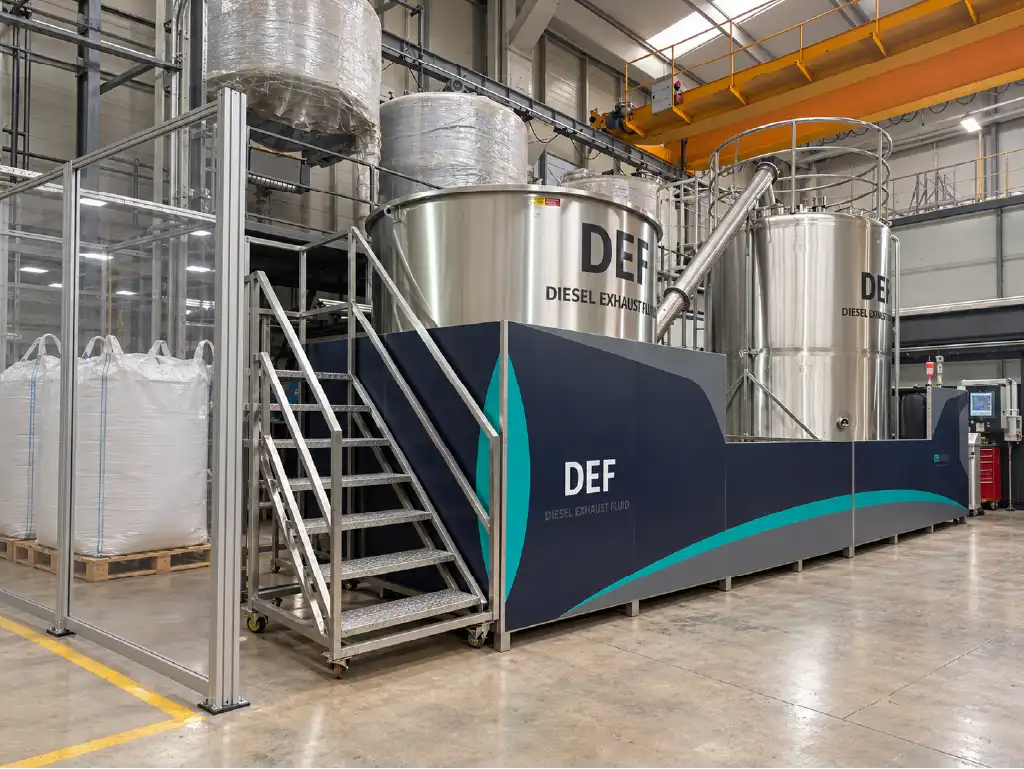
How should urea storage, water treatment and production zones be evaluated in practice?
Walk through a complete operating shift on the proposed drawing. Check where bags arrive, how operators load them and whether maintenance remains possible during normal stockholding. Include lifting height, structural capacity, door openings, electrical access and equipment removal routes.
For the AUS32 production plant, calculate peak water demand during batching rather than relying on a daily average. Check buffer recovery between batches and include documented allowances for treatment downtime and approved cleaning activities.
Measurement method, documentation and acceptance criteria
Prepare a measured building survey, equipment footprint register and utility schedule. Record clearances with access doors open and components positioned for servicing. Link the process flow diagram to the piping and instrumentation diagram, identifying sampling points and isolation boundaries.
Approve the AUS32 production plant against agreed output, water quality, access and handling criteria. Confirm flow with calibrated instruments and verify water quality using the specified laboratory methods. Conductivity can support monitoring, but it does not establish every impurity parameter. Retain commissioning records and resolve deviations before routine operation.
Finished product storage, laboratory and filling areas
Size product storage around sales demand, laboratory turnaround and dispatch frequency. Product awaiting release must remain controlled, whether held in a separate tank or managed through validated identification and isolation arrangements. An AUS32 production plant also needs a defined destination for nonconforming material so that a rejected batch does not occupy the only available production vessel.
Position the laboratory away from bag opening, vehicle exhaust and maintenance dust. Provide clean sample handling and secure records. Connect storage to filling through a dedicated, verified product path. The company’s filling, capping and labeling systems can be considered against the intended packaging mix and required integration.
Assess seasonal temperatures and direct sunlight when positioning storage. Select insulation, shading or temperature control from the expected exposure, residence time and applicable handling requirements. Include access for inspecting vents and connections, and ensure any heating arrangement is suitable for the product and vessel design.
How should finished product storage, laboratory and filling areas be evaluated in practice?
Model a busy dispatch day with realistic tank levels and delayed quality results. In an AUS32 production plant, usable storage differs from nominal vessel volume because operating limits, segregation and inventory commitments reduce available capacity.
Check that sample valves are reachable without crossing vehicle routes. Assess container supply, filling, closure, verification, pallet staging and rejected package handling as one sequence. For a DEF manufacturing plant, a fast filler offers little benefit if empty containers or outbound pallets repeatedly block its access.
Risk indicators, corrective actions and verification steps
Investigate missing batch identity, unprotected hose ends, damaged closures, unexplained inventory differences and product dispatched before release. Hold potentially affected stock, establish the exposure boundary and document the investigation. Corrective action may involve replacing a connection, revising valve permissions or relocating a staging position.
Restart the affected AUS32 production plant section only after appropriate checks. Depending on the deviation, these may include cleaning verification, representative product analysis, filling checks and a successful traceability exercise. Refractive index or density alone cannot demonstrate complete product conformity.
How Should Material Flow Be Planned Inside an AdBlue Factory?
Plan a forward sequence from receipt to production, controlled holding, filling and dispatch. Actual routes may bend around building constraints, but repeated backtracking and unnecessary crossings should be challenged. An effective AUS32 production plant coordinates liquid transfer with packaging movements, operator access and maintenance tasks.
Test the DEF plant layout against concurrent activities, not isolated operations. A delivery, laboratory sampling and IBC changeover may all occur within the same hour.
Reducing cross-contamination through plant zoning
Use boundaries that reflect contamination exposure. Bag opening, vehicle movement and workshop activity should be separated from protected sampling, open filling connections and clean packaging. Depending on the assessment, separation may involve distance, partitions, dedicated rooms or controlled procedures. Floor markings support the arrangement but cannot contain airborne dust.
The AUS32 production plant should have a documented product contact boundary covering tanks, pumps, valves, hoses and filling components. Specify materials and cleanliness requirements for each assembly. Review AUS32 material compatibility considerations when selecting wetted parts, including seals and temporary transfer equipment.
ISO 22241 addresses product quality and associated handling requirements. ISO 22241-3 specifically covers handling, transportation and storage. Apply the relevant current requirements to the project; a visually tidy AdBlue factory layout is not evidence of conformity.
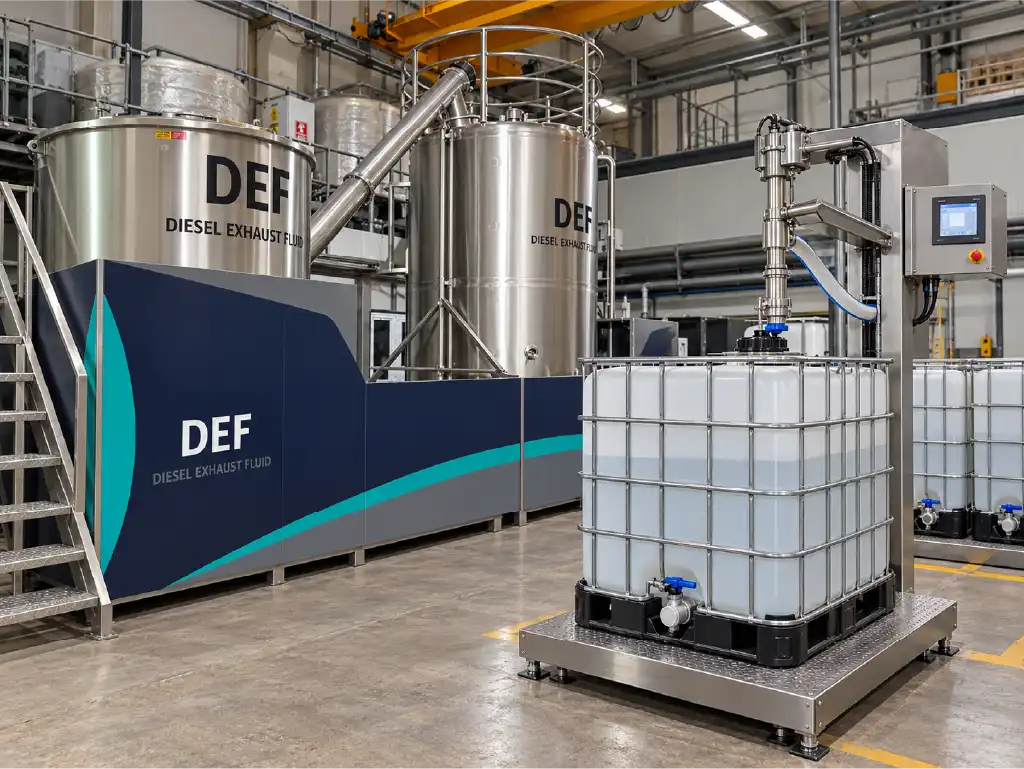
How should reducing cross-contamination through plant zoning be evaluated in practice?
Map possible contamination entry points and follow their routes to the product. Include dust carried on pallets, maintenance debris, cleaning chemicals, unsuitable replacement parts and hoses connected to the wrong destination. In an AUS32 production plant, shared staff or shared floor space requires deliberate controls at the boundary.
Review normal operation and unusual events, including filter replacement, spill recovery and temporary equipment installation. Confirm where clean tools are stored and how maintenance work is cleared before production resumes.
Measurement method, documentation and acceptance criteria
Create a zoning drawing, product contact register and inspection checklist. Establish representative sampling locations before and after critical transfers. Record component identity, cleaning status, operator, batch number and applicable analytical methods.
Evaluate the AUS32 production plant against approved specifications and a risk based verification plan. Visual inspections can identify obvious deficiencies; suitable laboratory analysis is needed for relevant chemical impurities. Define who can release equipment after maintenance, how deviations are handled and when increased sampling is required. Periodic review should check whether observed working practices still match the approved zoning design.
Expert note: Reserve space for the tasks that drawings often overlook: removing a pump, changing a filter, storing a capped hose and holding a rejected pallet. These small allowances can prevent improvised workarounds that weaken contamination control.
Planning forklift, IBC and tanker movement
Develop vehicle routes using the selected forklift, actual IBC dimensions and loaded handling conditions. Include approach space, turning envelopes, visibility, floor capacity and safe positions for setting down containers. Wherever practicable, separate pedestrians from vehicle traffic and protect vulnerable equipment.
The U.S. OSHA guidance on forklift travel and maneuvering recommends separating forklift and pedestrian traffic as much as possible. Use this as a planning reference alongside applicable local requirements and the site risk assessment.
An AUS32 production plant serving tankers needs an assessed vehicle approach, parking position and protected loading connection. Allow for hose handling, isolation access and spill response without placing hoses across routine walkways. Locate forklift charging or refueling activities in a separately assessed area.
How should planning forklift, IBC and tanker movement be evaluated in practice?
Run a swept path assessment using the actual vehicle specification. For the proposed AUS32 production plant, simulate incoming empties, outgoing full IBCs, retained batches and a tanker occupying its loading position simultaneously. Verify that escape routes and access to controls remain available.
Where the building already exists, confirm the model with controlled site trials before finalizing barriers and staging positions. Assess the complete AdBlue production facility, including yard queues, loading appointments and weather exposure at external connections.
For illustration, dispatching 20 cubic metres in 1,000 litre IBCs means 20 filled containers, plus the corresponding empty container supply. Count additional moves for staging and inspection rather than assuming one forklift trip per container. Use your actual package fill, order mix and handling method to establish the traffic forecast.
Risk indicators, corrective actions and verification steps
Repeated reversing, damaged barriers, pallets in walkways, stretched hoses and drivers waiting inside active production areas indicate layout problems. Record near misses and observe peak activity to identify whether scheduling, space allocation or physical separation needs adjustment.
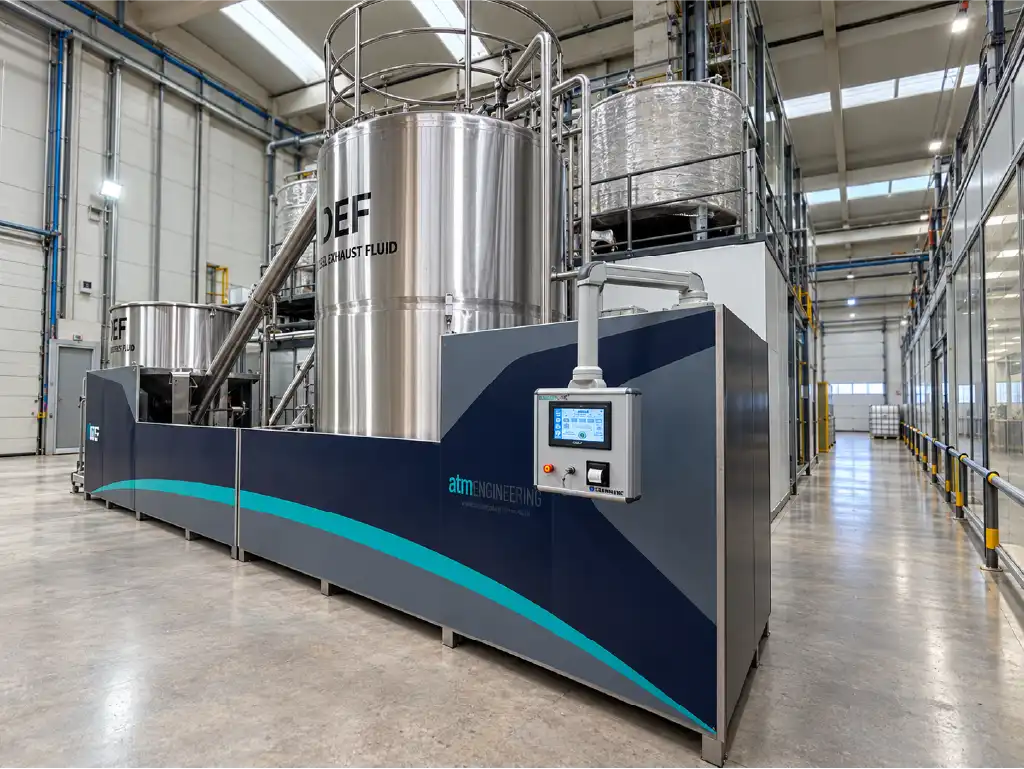
After changes, repeat the movement trial under representative conditions. Check visibility, crossing behavior, unobstructed isolation points and container stability. Record the revised drawing, operating rules and training. An AUS32 production plant layout should be reassessed whenever packaging formats, vehicle types, storage arrangements or production volumes materially change.
Frequently Asked Questions
How much space does an AUS32 production plant need?
There is no universal floor area. Equipment dimensions, storage days, quality holding time, packaging formats and traffic routes determine the requirement. Request a project specific arrangement that includes access and logistics, rather than treating the production skid footprint as the complete factory area.
Can urea storage and filling share one hall?
They may share a building if an assessed zoning strategy adequately protects exposed product and clean connections. Evaluate dust movement, distance, partitions, packaging handling and cleaning practices. A shared hall requires stronger scrutiny where bag opening occurs near filling.
Does every factory need a fully equipped laboratory?
The testing arrangement should match the quality plan. Routine checks may be performed on site, while specialist analysis can be assigned to a competent external laboratory. Provide suitable sampling, records and controlled product holding while results are pending.
How should finished product storage capacity be calculated?
Combine expected dispatch volume, delivery intervals, batch size, quality release time and an agreed operating buffer. Account for usable tank capacity and segregation. Test delayed dispatch and rejected batch scenarios before selecting the tank arrangement.
Can the layout support future production expansion?
Yes, if expansion space and utility interfaces are planned early. Reserve suitable access for additional vessels and evaluate whether water treatment, filling, storage and dispatch can support the higher output. AUS32 plant design should consider the entire operating chain.
Build a Layout That Supports Reliable Operation
A successful AUS32 production plant connects quality protection with practical daily work. Approve the design through measurable capacity checks, representative movement trials and documented release arrangements. Revisit those assumptions as demand changes so that growth does not create hidden storage or handling constraints.
Discuss Your Project with Atmosphere Engineering
Planning an AUS32 production plant starts with a clear operating brief. Share your target output, building dimensions, raw water analysis, urea supply method and intended sales formats with Atmosphere Engineering. Include expected storage days, laboratory arrangements and vehicle types so that the discussion covers the complete production environment.
Explore the company’s DEF production facility solutions and discuss how production, water treatment and packaging could fit your site. A technical enquiry can establish the information needed for a preliminary layout, identify interfaces requiring further assessment and clarify the scope of a tailored quotation.
Visit Atmosphere Engineering to begin the conversation, or request a project consultation with your drawings and capacity objectives. Agreeing on the design basis early helps turn a machinery enquiry into a facility plan that can be evaluated against actual site conditions.
The images are for illustrative purposes and were created using artificial intelligence.
