
Choosing an automatic filling machine for diesel exhaust fluid (DEF) is a measurement decision before it is a speed decision. An electromagnetic flow meter measures liquid passing through a pipe; a load cell measures the increase in container mass. Both can deliver consistent fills, yet neither can compensate for unsuitable piping, unstable containers, poorly timed valves or weak verification. The choice must meet package quantity, production and quality targets in operation.
How Do Automatic DEF Filling Systems Measure Product Quantity?
An automatic filling machine controls a valve or pump against a target. The sensor supplies a quantity signal, but final package content also depends on liquid left between the shutoff point and nozzle, residual drips, container positioning and the time allowed for a reading to settle. Specify whether the commercial declaration is in liters or kilograms before selecting the measuring principle. If the customer buys a declared volume and the filler measures mass, the conversion requires a documented density basis and product temperature.
When evaluating an automatic filling machine for DEF, separate the instrument’s data-sheet accuracy from the accuracy of a complete filled package. The latter is what should be demonstrated during factory and site acceptance with production containers, DEF and the intended operating range.
Electromagnetic flow meter filling
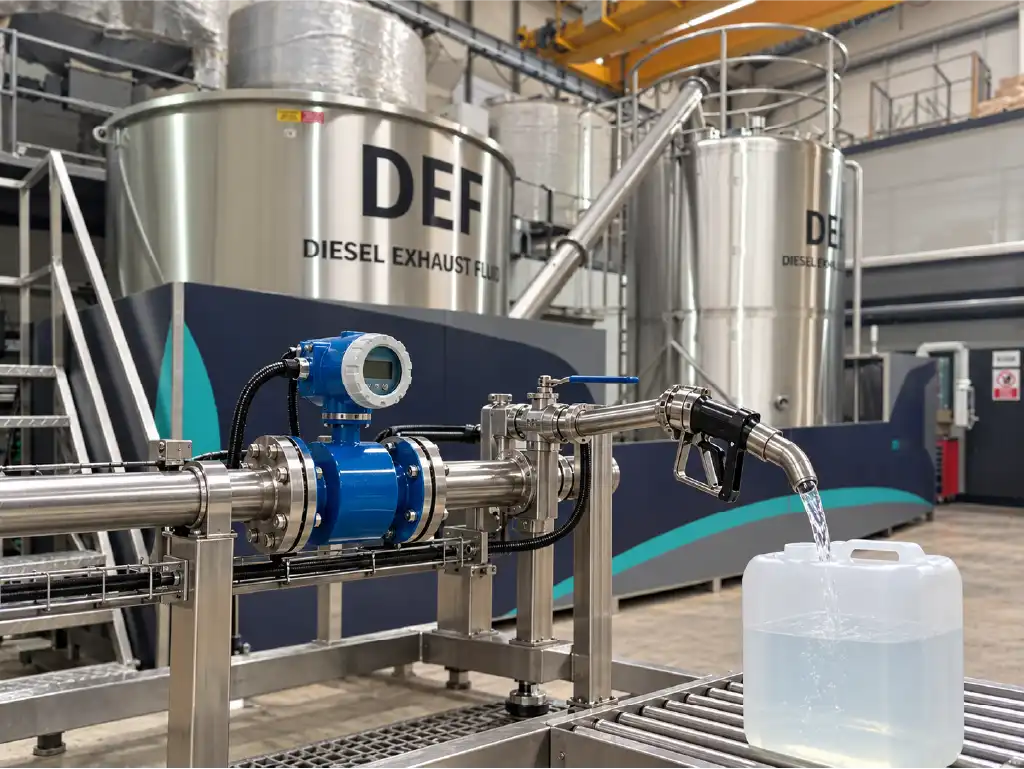
In an automatic filling machine, an electromagnetic meter measures the volumetric flow of a conductive liquid without a moving measuring element in the bore. AUS32 can suit this principle if the chosen lining, electrodes, seals and other wetted components are compatible and the meter operates within its specified range. The controller integrates flow until the recipe target is reached, usually with fast filling followed by a slower finishing stage.
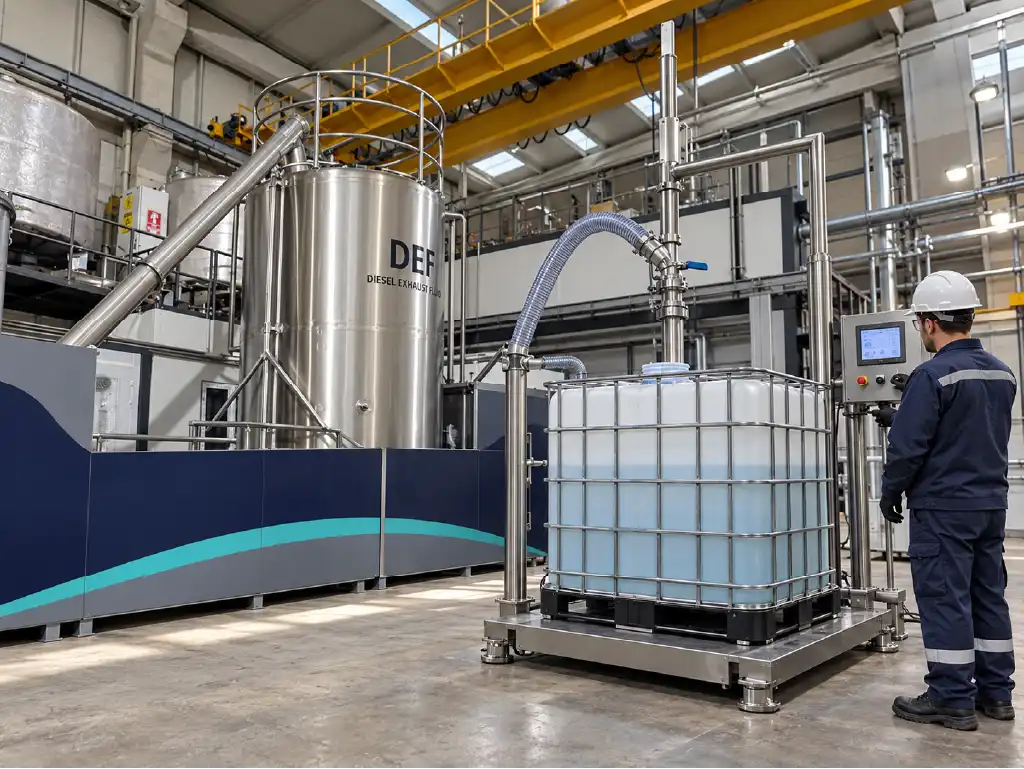
An automatic filling machine with a flow meter can be attractive for repetitive small-container runs because measuring occurs in the line while packages travel through a conveyor. It does not measure what remains in the container after spills or a dripping nozzle. Air entrainment, partially filled pipework, unsuitable electrical grounding, pump pulsation and abrupt cutoff can all affect the delivered quantity. The manufacturer’s installation requirements remain part of the engineering specification, not optional accessories.
How should electromagnetic flow meter filling be evaluated in practice?
For an automatic filling machine using this method, map the liquid path from finished-product tank to nozzle. Locate high points where air may collect, verify the meter stays full, review the pump’s minimum and maximum flow, and identify every source of recirculation or pressure fluctuation. Check how far the shutoff valve sits from the discharge point and whether the nozzle prevents after-drip. Then run low, nominal and high-speed trials across the planned container sizes. A stable reading at one setting proves little about the full production envelope.
Measurement method, documentation and acceptance criteria
Agree on a test matrix before purchase: product batch, container size, target quantity, flow stage, operating temperature, sample count and permitted error. Collect individual delivered quantities using a calibrated reference method. Report average error, maximum error and repeatability separately; an average on target can conceal alternating overfills and underfills. Include start-up, restart and end-of-run packages, plus a challenge test after a format change.
Retain meter calibration records, configuration versions, pipe drawings, wetted-material declarations and signed FAT/SAT results. Where commercial measurement rules apply, confirm local legal requirements rather than treating a supplier tolerance as a regulatory approval. The U.S. NIST Handbook 44 reference provides relevant sections on liquid-measuring devices and weighing equipment, subject to the rules that govern the installation’s market.
Weight-based load cell filling
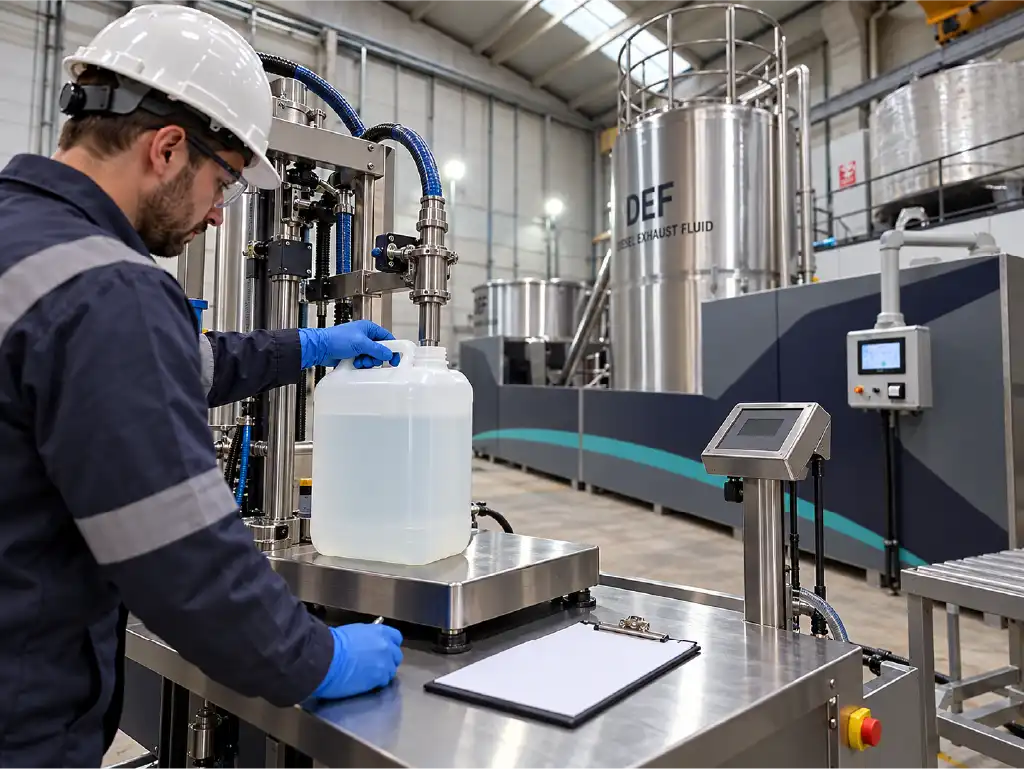
An automatic filling machine with load cells places the container on a weighing platform, records its tare and measures the net mass added. It directly addresses variation in the empty weights of drums and intermediate bulk containers. The process normally starts with a rapid dose and slows as the net-weight setpoint approaches; the controller then closes the valve and waits for the reading to stabilize.
Mass measurement avoids a temperature-based volume conversion when the contractual fill quantity is mass. If the label declares liters, however, mass still has to be related to DEF density under a documented method. Scales can also be disturbed by vibration, uneven platform loading, a rigid pipe touching the container, or a filling hose pulling on it. A good scale cannot overcome poor mechanical isolation.
How should weight-based load cell filling be evaluated in practice?
Before approving an automatic filling machine with weighing, begin with empty packages, not only a nominal drawing. Compare the tare spread for jerrycans, drums or IBCs, and confirm that each package sits fully on the active platform. Observe the weight trace while the pump and nearby conveyor run. Flexible hoses need support so changing hose tension does not become a false mass signal. Position the nozzle so it neither leans on the package nor transfers weight to the platform.
Risk indicators, corrective actions and verification steps
On a weight-based automatic filling machine, watch for a drifting zero, inconsistent tare, readings that jump when a hose moves, and fills that change with nearby machinery. Investigate the physical cause before changing a software correction factor. Re-level the platform, isolate vibration, restore hose support and check the weighing module against reference weights. Repeat fill trials with several empty-container types after the correction.
Which Filling Technology Is More Suitable for AUS32?
No measurement principle makes an automatic filling machine the universal winner. For a consistent stream of smaller packages, electromagnetic dosing may support high line speed; for drums and IBCs with varying tare, gravimetric filling offers direct net-mass control. A mixed plant may use separate filling stations or flow-controlled filling with independent checkweighing. The choice depends on the declared unit, package mix, accuracy target, production rhythm and installation constraints.
AUS32 product integrity matters as much as dose control. Wetted parts, cleaning practices and dedicated transfer equipment should be reviewed against the applicable DEF quality requirements. The U.S. EPA describes DEF’s role in selective catalytic reduction, while the product specification and local rules should govern how the filling operation is qualified. See the EPA’s DEF overview.
| Decision factor | Flow meter | Load cell |
|---|---|---|
| Direct result | Delivered liquid volume | Net filled mass |
| Useful fit | Repetitive, faster small-package dosing | Variable-tare drums and IBCs |
| Main sensitivity | Air, pipe fill, cutoff and dripping | Vibration, hose force and settling |
| Essential check | Package output across flow range | Zero, span and finished net weight |
Accuracy, speed and calibration requirements
For any automatic filling machine, published sensor precision should never be copied directly into a finished-package guarantee. The full error budget includes instrument uncertainty, control resolution, valve response, residual liquid, temperature or density conversion, reference method and package behavior. State an allowed package error in the purchase specification, then decide how many consecutive fills must pass and how exceptions will be handled.
Compare good packages per hour rather than a theoretical nozzle rate. Include indexing, tare, filling, settling, capping, labeling, routine checks and rejected units. An automatic liquid filling machine only achieves the promised production rate if downstream equipment and product supply can sustain it. Atmosfer’s filling, capping and labeling line describes electromagnetic, volumetric and load-cell configurations that can be assessed within the wider packaging workflow.
How should accuracy, speed and calibration requirements be evaluated in practice?
Require each proposed automatic filling machine to be demonstrated using real AUS32 and the smallest and largest planned packages. Measure a consecutive production run at target speed; do not allow operators to pause between every fill solely to improve results. Repeat at the expected temperature extremes if they can materially affect measurement. Independently verify contents after filling, and keep all rejected packages in the data set rather than silently excluding them.
Measurement method, documentation and acceptance criteria
When accepting an automatic filling machine, use a documented reference scale or volume standard for the target package. Define its uncertainty, the test conditions and the decision rule before FAT. Log setpoint, measured fill, error, cycle duration, temperature, batch, package identity and operator. Compare both the individual-package limit and the target for average giveaway. Inspect for leaks, dripping, missed containers and unstable readings while the line runs normally.
Expert note: A trial that passes only with an unusually slow final fill may fail the production-capacity requirement. Accept accuracy and throughput together at the same recipe, not in separate demonstrations.
Container size, production capacity and product giveaway
An automatic filling machine has different cycle costs on a 10 L jerrycan line and at a 1,000 L IBC station. For small packages, frequent positioning, capping and labeling can dominate the cycle; for large packages, bulk flow, safe access and stable weighing become more important. Build a package matrix with target size, annual mix, peak demand, empty-weight variation, cap type and changeover frequency. Atmosfer’s AdBlue filling line selection guide discusses the practical range from 5 L jerrycans through drums and IBCs.
How should container size, production capacity and product giveaway be evaluated in practice?
When sizing an automatic filling machine, calculate required good units per shift for every size, including a realistic allowance for cleaning, stoppages, format changes and quality checks. Compare a single convertible line with a dedicated small-container filler plus a bulk station. Factor in space, operator travel, forklift movements, finished-product tank capacity and the order pattern. A bottleneck at capping or labeling can make a faster DEF filling machine a poor investment.
Risk indicators, corrective actions and verification steps
For an automatic filling machine, frequent changeover errors, growing positive fill bias, IBCs requiring repeated top-ups and queues ahead of the capper all suggest a mismatch between machine design and real demand. Revisit nozzle sizing, cutoff control, recipe protection or station separation as appropriate. After modification, repeat the same acceptance matrix and calculate good output and giveaway again, using the baseline for comparison.
How to Specify an Automatic Filling Machine for DEF
Give prospective suppliers a measurable duty rather than only an hourly liters figure. The request should include DEF quality requirements, declared quantity and unit, package drawings and samples, actual package mix, operating temperature, available utilities, floor layout, desired traceability and integration points. Ask for a process diagram identifying where quantity is measured, where flow stops and how each filled package can be independently checked.
Commissioning should cover product-contact compatibility, cleaning, changeover, alarms, recipe access, operator training and documented FAT/SAT. If the plant already makes AUS32, integrate the packaging plan with its storage and transfer system; Atmosfer’s AUS32 production line overview connects manufacturing with drum, small-container and IBC packaging. A qualified line delivers defensible package quantities without compromising the fluid upstream.
Frequently Asked Questions
Is a flow meter or a load cell more accurate for DEF filling?
Neither is inherently more accurate in every installation. Compare verified finished-package errors across your product temperature, fill rate and formats. The meter’s catalog accuracy does not cover nozzle dripping or air in the line; scale specifications do not cover vibration and hose force. Choose against an agreed acceptance limit and production trials.
Can an electromagnetic meter measure AUS32?
Yes, a properly selected electromagnetic meter can measure conductive AUS32. Confirm the selected model’s conductivity range, wetted-material compatibility, full-pipe conditions and installation instructions. Prove package quantity at low and high operating flow, including valve cutoff and any conversion used for verification.
How often should a DEF filling system be checked?
Set the interval using the equipment manufacturer’s guidance, operating conditions, your quality plan and local legal requirements. Add checks after a sensor change, relocation, abnormal drift, valve service or software adjustment. Record routine package checks between formal calibrations so a developing error can be found before a long run is released.
Can one machine fill jerrycans, drums and IBCs?
It is possible to engineer a multi-format system, but throughput and changeover penalties may justify separate stations. Give the supplier package samples and the forecast sales mix. Verify the smallest and largest fill, downstream handling and good output per shift before committing to one configuration.
Discuss Your DEF Filling Requirements
The right automatic filling machine is the one that meets your package specification at a sustainable production rate with a clear verification record. Atmosfer Engineering can review whether electromagnetic dosing, load-cell control or a combination fits your AUS32 operation. Share sample containers, target quantities, hourly demand, packaging mix and the available plant layout; these details make a technical assessment more useful than a generic machine quotation.
For a new facility, the discussion can also cover clean product transfer, storage, filling, capping, labeling and the checks needed before release. For an existing line, measured error and downtime data can help identify whether the issue is the sensor, valve, container handling or downstream bottleneck. Explore the solutions at Atmosfer Makina and contact the engineering team to request information, a site-specific consultation or a configuration-based offer. An agreed test plan lets you compare options against measurable outcomes.
Görseller temsilidir ve yapay zekâ kullanılarak oluşturulmuştur.
