
An off-spec AdBlue® batch should be isolated as soon as a release test, in-process reading or visual inspection indicates a deviation. The objective is not merely to obtain a passing retest. It is to determine whether the result reflects a sampling or instrument error, an incorrect urea-to-water ratio, contaminated raw material, a water-treatment problem or contamination introduced by process contact surfaces. A disciplined response protects the SCR system, preserves traceability and prevents a local production issue from becoming a distribution-wide complaint.
AdBlue®, also known as diesel exhaust fluid or DEF, is nominally a 32.5% high-purity urea solution in 67.5% deionized water. The narrow formulation window is only one part of conformity. An off-spec AdBlue® batch may show an acceptable concentration and still fail because of biuret, aldehydes, insoluble matter, phosphate or trace metals. Troubleshooting should combine representative sampling, calibrated measurements, batch records and laboratory confirmation against the applicable ISO 22241 edition and the producer’s quality plan.
How to Identify an Off-Spec AdBlue® Batch
The first response to a suspected off-spec AdBlue® batch is containment. Stop transfer and filling, identify every connected tank and package, place the material under quarantine and preserve a sealed retention sample. Record the batch number, time, tank level, water lot, urea lot, operator, instrument identity, process temperature and all alarms. If any portion has already been filled or dispatched, the affected quantity should be mapped before further decisions are made.
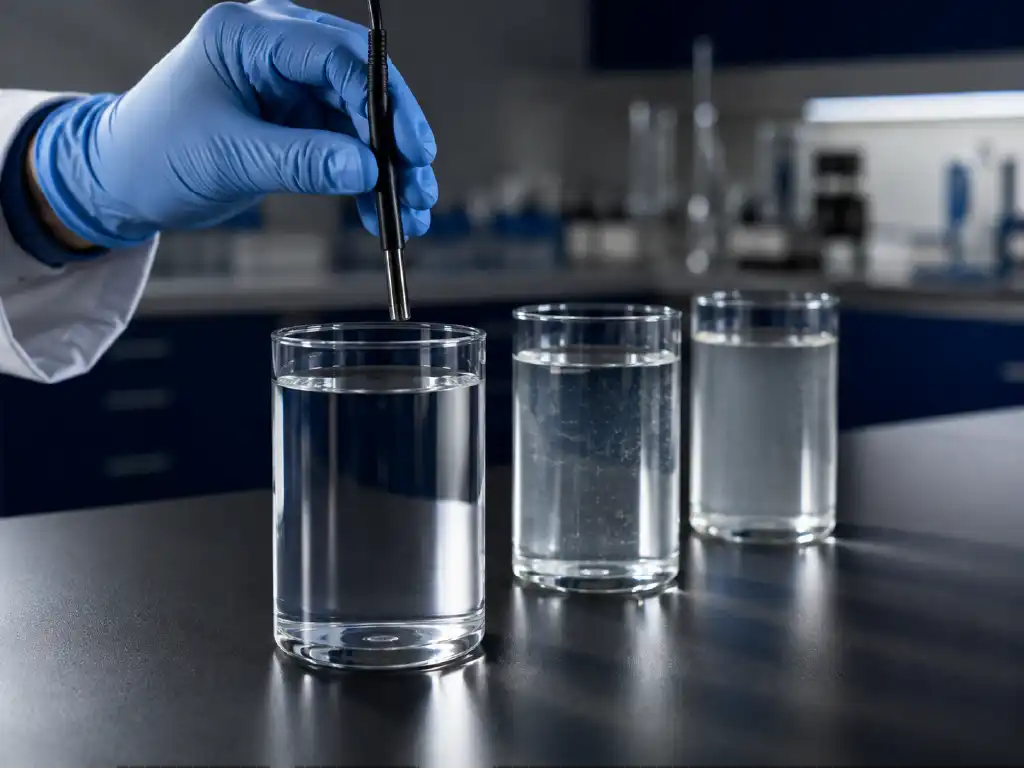
Next, confirm that the result is real. Take a new representative sample through the approved sampling point after the required mixing or recirculation period. Use a clean, compatible container and avoid sampling from a stagnant hose, an unflushed valve or the liquid surface alone. Verify instrument calibration, temperature compensation, cleanliness and reference standards. Replicate testing should follow a written procedure; repeated measurements must not become an informal search for a convenient pass.
The UK government’s bus retrofit performance report notes that ISO 22241-1 specifies a 32.5% aqueous urea solution and also highlights the role of filters in removing particles, dirt and crystallised urea from SCR-related systems. This illustrates why both chemical composition and physical cleanliness matter when evaluating a DEF batch failure.
Urea concentration and refractive index deviations
Urea concentration is commonly screened through refractive index, density or a validated inline measurement. For ISO 22241 quality, the typical urea content target is 32.5% by mass with an allowable range of 31.8% to 33.2%. The corresponding refractive index at 20°C is generally 1.3814 to 1.3843. These limits and related impurity values are also presented on Atmosfer Engineering’s AdBlue production facility page. The laboratory method, sample temperature and instrument correction must match the approved standard before a failure is assigned.
A low result can indicate too much water, insufficient urea dosing, retained rinse water, load-cell or flow-meter bias, an incorrect recipe, incomplete transfer, or sampling before the mixture became homogeneous. A high result can arise from excess urea, insufficient water, evaporation, a wrong raw-material weight, or a calculation error caused by using volume where the recipe requires mass. Temperature can also distort uncompensated refractive index and density readings.
An AdBlue concentration problem should be checked against independent evidence. Compare the refractometer result with density at controlled temperature, review water and urea totals, reconcile inventory and inspect the trend. If the inline sensor and laboratory result disagree, check both with traceable standards. If only one sample fails, investigate sampling integrity and tank stratification before deciding that it represents an off-spec AdBlue® batch.
Expert note: refractive index is primarily a concentration indicator. It does not prove that the urea is automotive grade or that metal, phosphate, aldehyde and insoluble-matter limits are acceptable. A corrected concentration cannot convert contaminated AdBlue production into conforming product without full analytical verification.
High conductivity, visible particles and contamination indicators
Conductivity is highly valuable for monitoring purified water and detecting process change, but it should not be treated as a universal standalone release limit for finished AdBlue®. The final solution’s conductivity depends on urea chemistry, temperature and the measurement method. A suspiciously high reading should be compared at the same temperature with a qualified-batch baseline, the incoming deionized-water result and the site’s validated alert limits. It should then trigger targeted chemical analysis rather than an automatic conclusion about the contaminant.
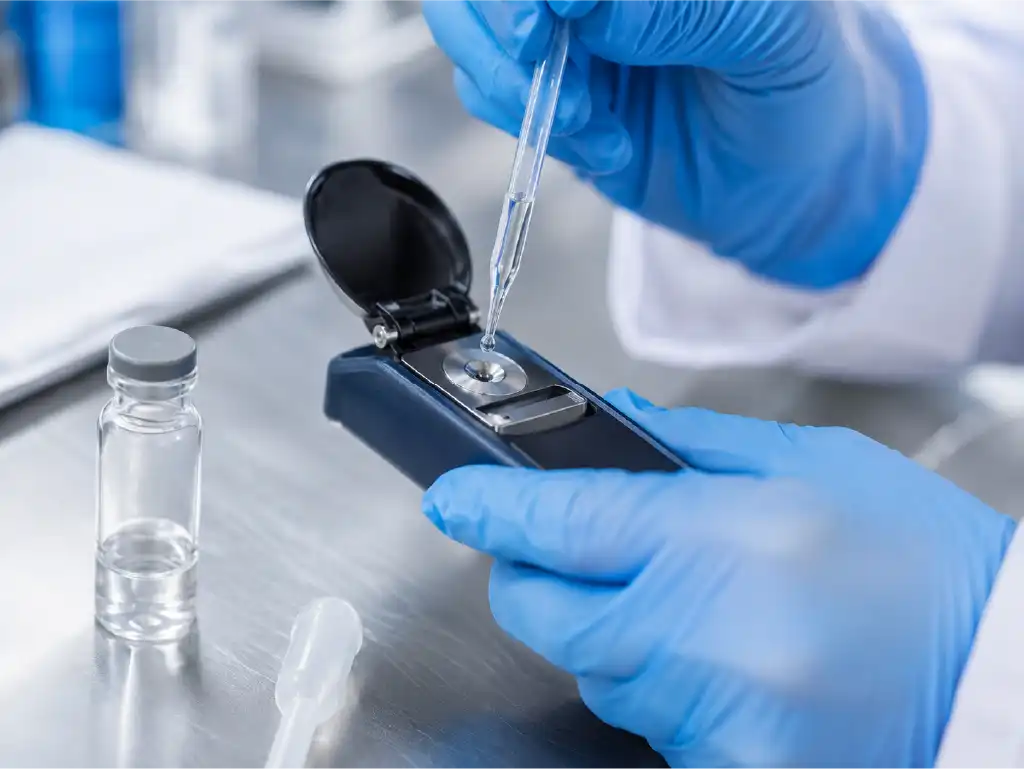
Potential causes include ionic breakthrough from water treatment, exhausted polishing media, membrane damage, cleaning-chemical carryover, corrosion products, salts in raw urea or an unsuitable container. Conductivity that rises across several batches often points toward water treatment or contact-surface deterioration. A sudden jump in an off-spec AdBlue® batch more strongly suggests dosing error, cleaning residue, foreign-liquid ingress or a sampling problem.
AdBlue® should be clear, colourless and free from visible contamination. Haze, sediment, fibres, dark specks, oil film, unusual colour or abnormal odour are quarantine signals. White crystals around a sample closure may be dried product, but solids suspended inside an off-spec AdBlue® batch still require investigation. Do not simply filter and release it: filtration may remove particles while leaving dissolved metals, minerals or incompatible chemicals behind.
A contamination investigation should include insoluble matter and, where relevant, calcium, iron, copper, zinc, chromium, nickel, aluminium, magnesium, sodium, potassium, phosphate, biuret, aldehydes and alkalinity. The analytical scope should reflect the observed symptom and the suspected route of entry. For example, copper or zinc may implicate incompatible fittings, while sodium and calcium can indicate water-quality failure. Hydrocarbon or detergent contact requires a different method than a trace-metal investigation.
| Observed signal | Likely checks | Immediate control |
|---|---|---|
| Low refractive index | Water overcharge, wet line, incomplete mixing, temperature correction | Quarantine and verify concentration independently |
| High refractive index | Urea overcharge, water shortage, evaporation, recipe or weighing error | Hold transfer and reconcile mass balance |
| Conductivity above baseline | Purified-water trend, cleaning residue, salts, sensor calibration | Retest at controlled temperature and analyse ions |
| Particles or haze | Filters, raw urea, tank cleanliness, packaging, corrosion | Stop filling and preserve representative samples |
| Oil film, colour or unusual odour | Wrong chemical, lubricant, detergent or reused container | Isolate connected equipment and reject unless safety review proves otherwise |
Root Cause Analysis and Corrective Actions
Root cause analysis begins only after the off-spec AdBlue® batch is physically and digitally controlled. Build a time-ordered record from raw-material receipt through water production, batching, filtration, storage and filling. Compare the off-spec AdBlue® batch with the last conforming batch and the next clean verification. Useful evidence includes certificates of analysis, water trends, dosing totals, tank history, calibration records, maintenance work, cleaning logs, filter differential pressure and operator interventions.
Do not change several process variables at once. Confirm the failure mechanism, define the correction, and then verify effectiveness through a controlled batch or documented test. The investigation should distinguish the root cause from contributing conditions. A dosing valve may have stuck, for example, but overdue calibration, weak alarm logic and the absence of an independent mass-balance check may explain why the fault was not detected sooner.
Raw material, water treatment and dosing-related causes
Raw urea should be approved for AUS 32 production, supported by lot-specific documentation and protected from moisture, dust and unsuitable materials. Agricultural-grade urea can introduce unacceptable biuret, aldehydes, minerals or insoluble matter. If an off-spec AdBlue® batch follows a new supplier or lot, compare certificates with incoming verification and test a retained raw-material sample. Supplier documentation does not replace risk-based incoming control.
Water quality must be reviewed as a trend, not a single number. Examine feed-water change, RO permeate conductivity, rejection performance, polishing-stage condition, storage-tank hygiene and microbial or organic controls specified by the site. Look for regeneration carryover, membrane breach, exhausted resin, stagnant storage, an open vent or a bypass valve left in the wrong position. Atmosfer Engineering’s guide to water quality for AdBlue production explains how purification, dosing, mixing, filtration and filling operate as one connected quality chain.
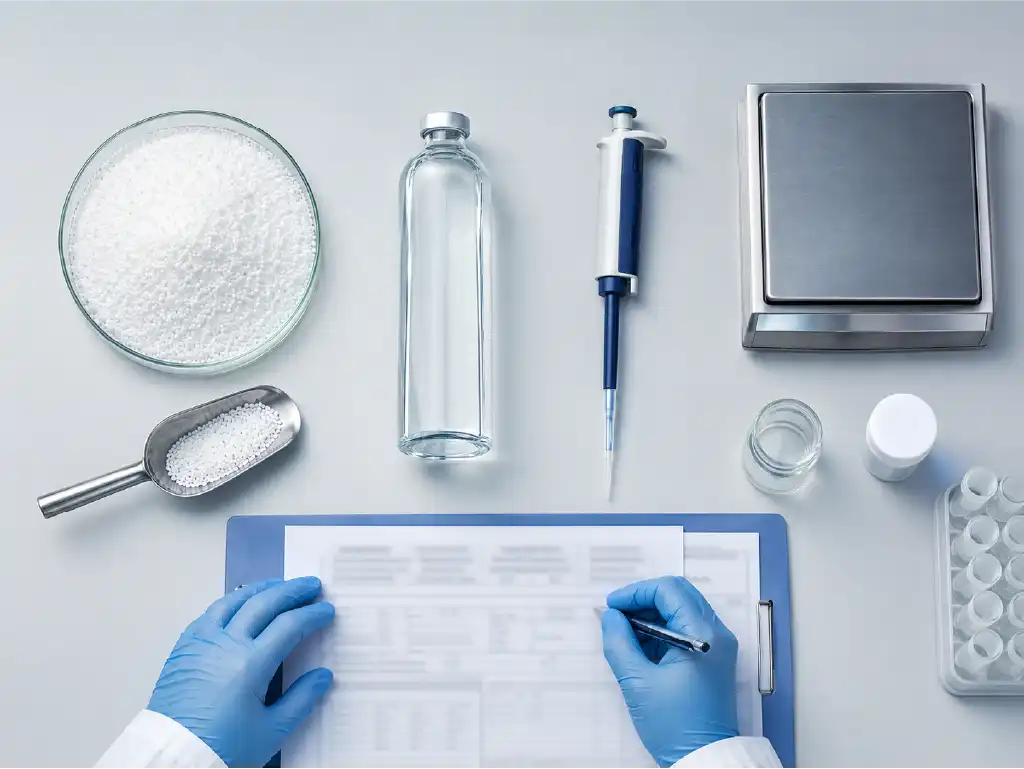
Dosing investigations should reconcile commanded quantities with actual mass. Review load-cell zeroing, flow-meter factors, valve response, feeder performance, recipe version, manual additions and interrupted cycles. Check whether the off-spec AdBlue® batch was made by mass or volume and whether density correction was applied. Confirm adequate mixing for dissolution and homogeneity, while verifying that excessive heat or residence time did not degrade quality.
Contact surfaces are another frequent source of contaminated AdBlue production. Inspect tanks, pipework, pumps, seals, hoses, sampling tools and filling heads for compatibility, wear, corrosion and shared use. Copper alloys, galvanized surfaces and dirty transfer equipment can introduce harmful contaminants. Cleaning agents and rinse water must be controlled through validated procedures. The engineering principles behind compatible materials, closed handling and monitored blending are discussed in Atmosfer Engineering’s guide to designing an efficient AdBlue/DEF plant.
- Correct the failed component, calibration, recipe or operating procedure.
- Assess every batch produced since the last verified good condition.
- Document containment, investigation, disposition and approval responsibilities.
- Train affected personnel and verify that the revised control is understood.
- Confirm effectiveness through subsequent batch trends, not one passing result.
When a batch can be reworked, quarantined or rejected
Quarantine is the default status for any off-spec AdBlue® batch until an authorised quality decision is recorded. Rework may be technically possible when the only demonstrated deviation is a homogeneous concentration error, all raw materials are conforming and traceable, contamination has been excluded, and an approved calculation and procedure exist. High concentration may be corrected with a calculated quantity of qualified deionized water; low concentration may require a validated urea addition or controlled blending strategy. Either route requires complete remixing, representative resampling and full release testing.
Rework is not justified when the contaminant is unknown, the off-spec AdBlue® batch has contacted fuel, lubricant or an incompatible chemical, trace metals exceed limits, the wrong urea grade was used, traceability is lost, or packaging contamination affects an uncertain quantity. Dilution cannot conceal contamination. Particle filtration alone is insufficient unless investigation proves that particles are the sole failure mode and the approved requalification plan permits recovery.
An off-spec AdBlue® batch should remain quarantined when testing is incomplete, results conflict, the affected volume is uncertain or the root cause could extend to adjacent batches. Reject it when conformity cannot be demonstrated or safe, controlled rework is unavailable. Rejected material must be segregated and managed under applicable environmental and waste requirements; it should never be released by commercial pressure or discharged without an authorised disposal route.
The disposition record should state the evidence reviewed, risk assessment, calculations, rework instructions, test results and final approval. Retain samples from the original and reworked material where the quality system requires them. A successful rework closes the material decision, but the corrective action remains open until the cause has been removed and later production demonstrates stable control.
Frequently Asked Questions
What urea concentration should AdBlue® contain?
AdBlue® is formulated at 32.5% high-purity urea by mass in deionized water. The commonly applied ISO 22241 acceptance range is 31.8% to 33.2%, but release must consider the complete specification, validated method and applicable standard edition, not concentration alone.
Can conductivity alone confirm an off-spec AdBlue® batch?
No. Conductivity is an effective trend and screening tool, especially for purified water, but the finished product result is temperature- and method-dependent. Compare it with a qualified baseline and use targeted laboratory analysis to identify ionic or chemical contamination.
Can an AdBlue concentration problem be corrected?
Sometimes. A homogeneous concentration-only deviation may be reworked under an approved procedure after contamination is excluded. The reworked off-spec AdBlue® batch must be mixed, resampled and retested against every required release parameter before use or sale.
Are visible particles removable by filtration?
Filtration may remove solids, but it does not establish conformity because dissolved metals or chemicals may remain. Identify the particles and their source first. Release is appropriate only when the recovery method is validated and full testing confirms compliance.
What records are most useful during a DEF batch failure?
Batch dosing data, raw-material certificates, water-quality trends, calibration records, cleaning and maintenance logs, alarms, operator actions, sampling details and retention samples create the clearest path from symptom to root cause.
How can repeat off-spec batches be prevented?
Use qualified urea, consistently purified water, compatible contact materials, automated and independently verified dosing, controlled sampling, calibrated instruments, validated cleaning and batch traceability. Trend review and periodic technical audits help detect drift before specifications are exceeded.
Protect Batch Quality with the Right Production Controls
An off-spec AdBlue® batch is best managed through evidence: immediate containment, representative sampling, reliable laboratory methods, traceable process data and a documented disposition decision. Atmosfer Engineering designs AdBlue/DEF production solutions around precise dosing, purified-water control, compatible process materials, filtration, automation and batch monitoring. If you are investigating recurring concentration drift, conductivity change or contamination, the team can review your raw-water conditions, planned capacity, process flow and quality-control points on a project-specific basis. Visit Atmosfer Engineering to request technical information, discuss a new facility or evaluate improvements for an existing production concept. A structured engineering assessment can help reduce batch variability, strengthen traceability and build a more reliable route from raw-material acceptance to final release without turning quality control into a reactive exercise.
