
Urea storage for DEF production is not a routine warehouse task. It is a quality-control step that directly affects dissolution, batch consistency, laboratory results and the long-term reliability of the finished Diesel Exhaust Fluid. Even when a plant uses accurate dosing, purified water and automated mixing, unsuitable storage or careless transfer can introduce moisture, dust, metals, oil, fertilizer residues or packaging debris before production begins.
DEF, also marketed as AdBlue® in many regions, is a sensitive aqueous urea solution used in selective catalytic reduction systems. Vehicle emission systems monitor DEF level and quality, so raw-material and process control have operational consequences. The U.S. Environmental Protection Agency describes DEF within regulated SCR emission-control systems. Review the EPA’s DEF information for regulatory context.
For plant owners, production managers and quality teams, the practical question is simple: how can urea be kept dry, clean, traceable and ready for controlled processing? The answer begins with selecting the correct grade, then protecting it through warehouse design, packaging discipline, closed transfer and documented incoming inspection.
Why Urea Quality Is Critical for DEF Production
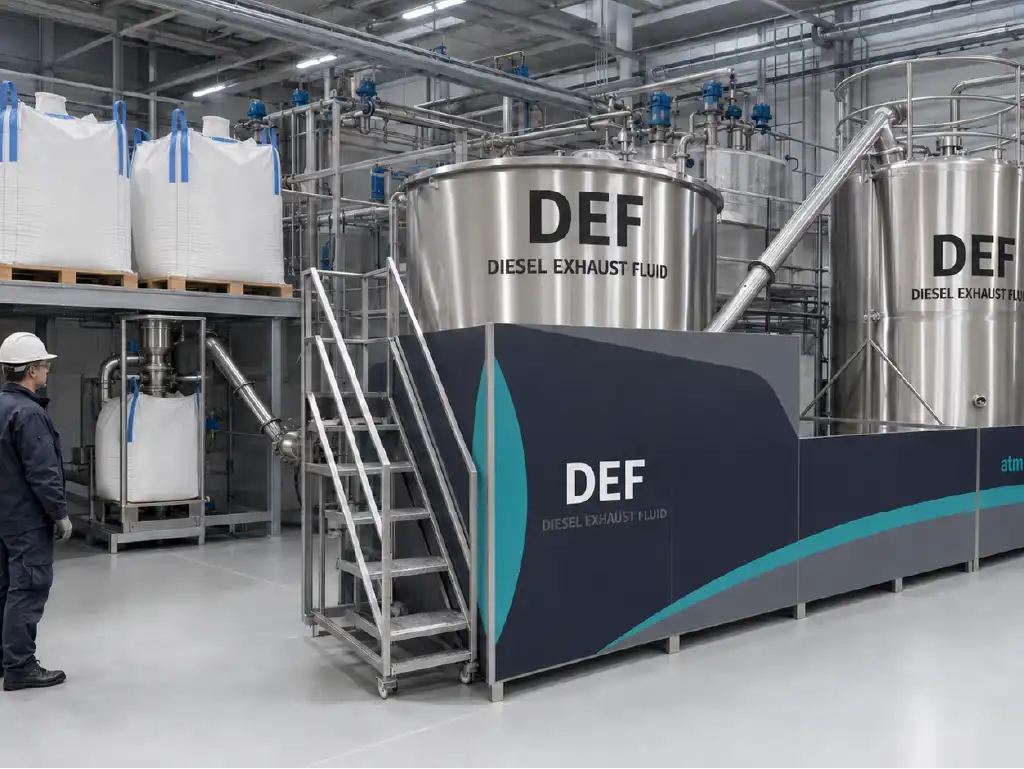
Urea is the principal raw material in DEF production, but not every commercial grade is suitable for automotive use. A batch may look white and uniform while containing substances unacceptable for SCR applications. Quality cannot be judged by appearance alone; supplier approval, certificates of analysis, impurity limits, particle condition and lot traceability should be reviewed before release.
Professional DEF manufacturing depends on high-purity urea, demineralized water, compatible process materials and verified final-product analysis. Atmosfer Engineering stresses that DEF urea must be manufactured and documented for the application, not treated as a generic fertilizer input. Read why urea quality matters in AdBlue production.
Difference between automotive-grade and agricultural-grade urea
Automotive-grade urea is produced and controlled for DEF or AdBlue manufacturing. Beyond nitrogen content, it must maintain very low levels of substances that could remain in solution, form deposits or affect SCR components. Controls commonly address biuret, aldehydes, phosphate, insoluble matter, moisture and trace metals. Acceptance limits should follow the applicable specification, supplier documents and the plant quality plan.
Agricultural-grade urea is designed to deliver nitrogen to crops. It may include anti-caking agents, conditioners, coatings or impurity profiles acceptable for fertilizer use but unsuitable for DEF. Different particle distribution, dust and dissolution behavior may also create process variability. A lower purchase price becomes irrelevant if the DEF fails analysis or the batch must be rejected.
Prilled urea storage is important because prills can support controlled dissolution, yet they remain vulnerable to abrasion, moisture and contamination. The material must be automotive-grade, suitably uncoated, documented by lot and protected from transport through dosing.
How impurities affect AdBlue quality
Impurities can enter from the urea, warehouse, transfer equipment or operator practices. Dust, rust, unsuitable metal surfaces, lubricants, detergents, dirty scoops and reused hoses may compromise a batch. Once contamination dissolves or disperses, removal may be impractical; prevention is usually more reliable than correction.
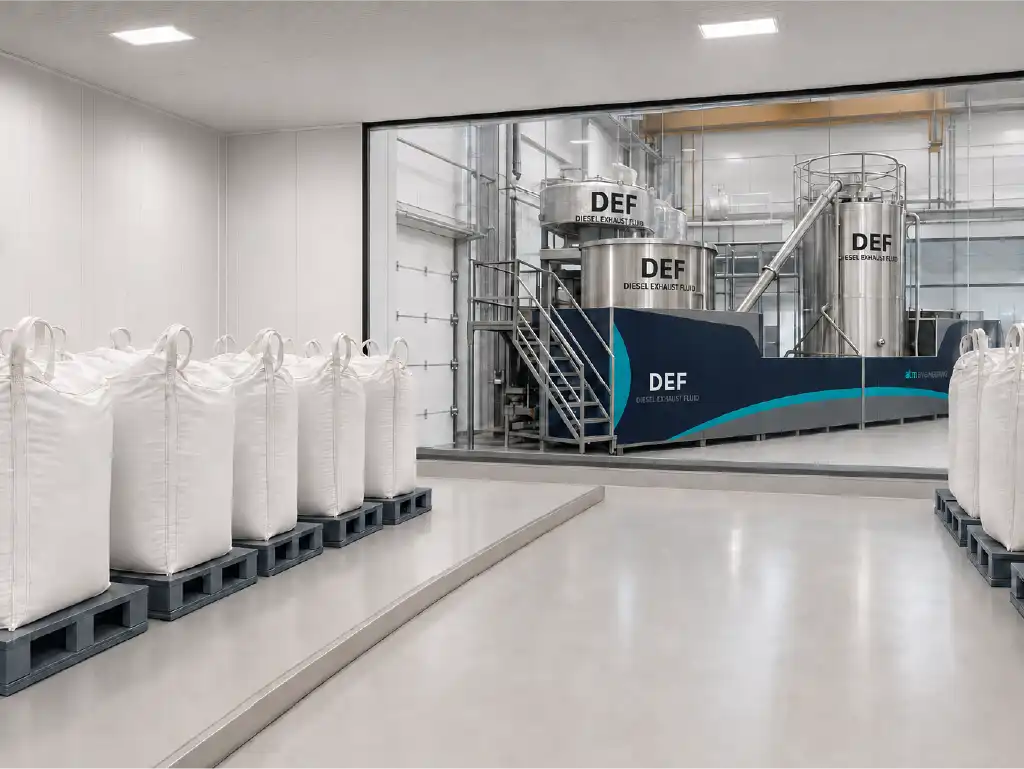
Contamination may appear as abnormal conductivity, insoluble matter, unexpected metals or inconsistent laboratory results. It can also contribute to deposits in dosing systems or undesirable catalyst interaction. Therefore, urea contamination in AdBlue production must be managed as a process hazard, not only a housekeeping issue.
| Risk source | Possible quality impact | Recommended control |
|---|---|---|
| Moisture entering bags | Caking, poor flow and uncertain feed consistency | Dry warehouse, sealed packaging and humidity monitoring |
| Dust or mixed-product residues | Higher insoluble matter and batch contamination | Dedicated storage zone and closed transfer |
| Unsuitable tools or metal surfaces | Trace-metal contamination | Compatible, identified and dedicated equipment |
| Torn big bags or damaged liners | Foreign matter, moisture ingress and loss of traceability | Quarantine, inspection and documented disposition |
| Unapproved urea grade | Nonconforming impurity profile | Supplier approval and certificate verification |
Expert note: A production plant should never release urea based only on supplier reputation or visual appearance. Incoming acceptance should combine documentation review, packaging inspection, lot identification and risk-based testing. The exact control plan should be defined through project-based evaluation, expected production volume, supplier history and laboratory capability.
How to Store Urea Before Production: Urea Storage for DEF Production
Anyone researching how to store urea for AdBlue production should start with three objectives: keep the material dry, prevent contact with incompatible substances and preserve lot traceability. Warehouse conditions should support these objectives every day, including during unloading, internal transport, temporary staging and maintenance activities.
The storage area should be enclosed, clean, dry and protected from weather. Floors should be intact and easy to clean without standing water. Roof leaks, rain at loading bays and condensation on building surfaces are quality risks. Keep urea away from fuels, lubricants, cleaners, pesticides and dusty agricultural products.
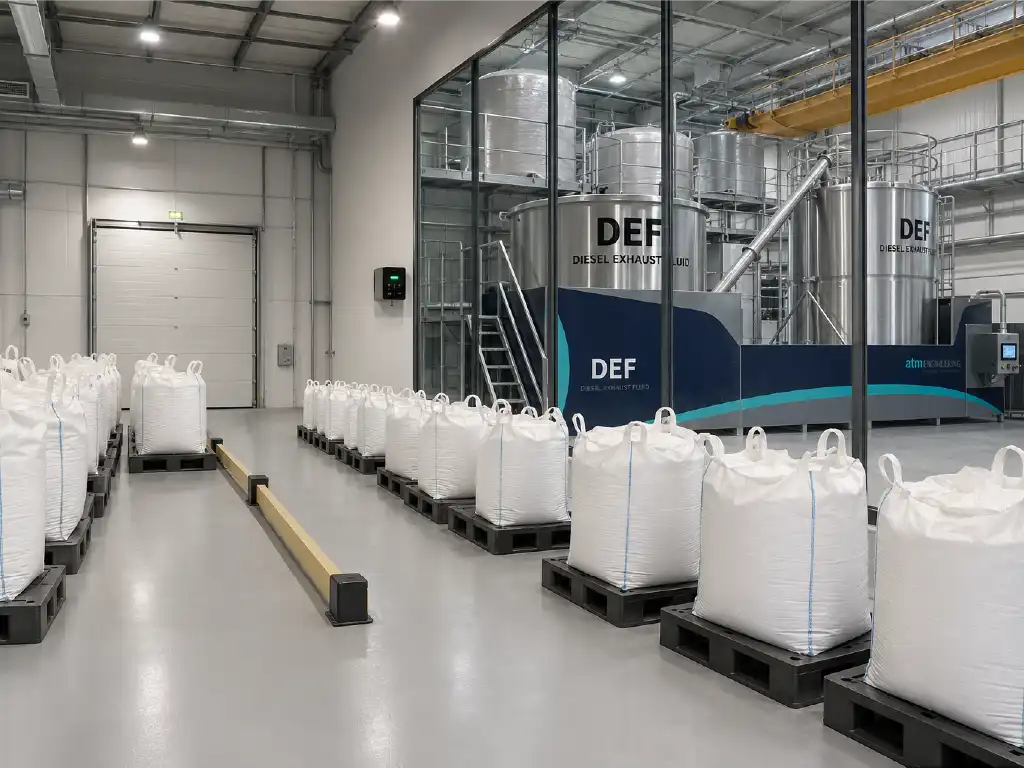
Humidity, caking and dust control
DEF urea humidity control is essential because moisture changes material flow. Humid air or liquid water can soften contact points between particles and form lumps. Caking restricts big-bag discharge, increases manual intervention and generates more abrasion. It may also tempt operators to use unsuitable tools, adding contamination risk.
Humidity limits should reflect local climate, seasonal temperature changes, door-opening frequency, insulation and storage duration. Use calibrated temperature and relative-humidity monitoring, review trends and establish site action limits through technical analysis. Dehumidification, controlled ventilation or improved sealing may be needed.
Dust can accumulate around torn bags, discharge stations and transfer points, then settle on clean equipment or migrate to adjacent operations. Use dedicated cleaning methods, avoid contaminated sweeping tools and keep wash water away from stored urea. Enclosed discharge and dust extraction reduce contamination and material loss.
- Keep bags closed until the planned production run.
- Record warehouse humidity and investigate unusual peaks.
- Repair roof, wall and loading-bay leaks promptly.
- Use dedicated spill-cleaning equipment identified for DEF raw materials.
- Do not return collected floor material to an approved bag or production hopper.
Big bag storage and warehouse conditions
Big bags should arrive with intact fabric, lifting loops, seams, labels and liners where specified. Identify each unit by supplier, grade, lot number, net weight and receipt date. Labels must remain readable; a bag with lost identity should not be approved merely because it resembles other stock.
Place bags on clean, dry pallets or an engineered system that prevents floor contact. Follow supplier stacking instructions and the certified bag design. Poor stacking may damage lower bags, stress seams and obstruct stock rotation. Maintain inspection access and protect bags from forklift punctures.
Separate material awaiting inspection, approved stock, quarantined stock and rejected material. Clear physical status control prevents accidental loading of an unapproved lot. Use first-in, first-out rotation while also considering supplier shelf-life guidance, packaging condition and inspection results.
Cleaning, pest control and maintenance must not introduce chemicals, grinding dust, paint mist or metal particles. Isolate such work from raw-material storage, then inspect and release the area before exposing urea.
Handling Practices That Protect Product Quality
DEF urea handling begins at receiving and ends when material enters the mixer. Every touchpoint should reduce open exposure and manual contact. Repeated opening, movement, sampling or partial use increases the opportunity for moisture pickup, mix-ups and foreign-material entry.
Atmosfer Engineering’s automated DEF concept transfers urea from a hopper, calculates water quantity, monitors mixing and sends finished product to storage. Controlled processing reduces manual handling, but warehouse discipline remains essential. Explore the automated DEF production facility.
Closed transfer and contamination prevention
Closed transfer is one of the strongest controls in AdBlue raw-material processing. A big-bag station can use a covered connection, controlled opening, dust extraction and an enclosed route to the hopper or mixer. This limits contact with warehouse air, tools and surrounding surfaces while improving material flow.
Product-contact hoppers, chutes, piping, seals and fasteners should not release metals, oils or coatings into the urea. Knives, sample tools, containers and cleaning equipment should be dedicated, clean and stored in a protected location.
For partial bags, reseal the liner with an approved method, record the remaining quantity and return the bag to controlled storage. Do not leave open bags beside the hopper between shifts. Frequent partial use may justify reviewing batch size, hopper capacity or bag size.
Maintenance can introduce grease, welding debris, polishing compounds or dirty parts. Permits should include cleanliness requirements, and product-contact equipment should receive documented inspection before release. Any cleaning method or agent requires technical assessment and residue verification.
Raw material inspection before production
Raw material inspection should take place at receipt and again before use. The receiving check confirms that the shipment matches the purchase specification. The pre-production check confirms that the correct approved lot is being loaded and that its condition has not changed during storage. Both stages should be recorded.
- Verify identity: Compare the supplier, product description, lot number and purchase order.
- Review documentation: Confirm the certificate of analysis, declared grade and relevant impurity data.
- Inspect packaging: Look for tears, moisture marks, damaged liners, contamination and unreadable labels.
- Assess physical condition: Check for unusual caking, discoloration, odor or excessive dust without relying on appearance as the sole acceptance criterion.
- Apply the sampling plan: Take representative samples with clean, dedicated equipment when required by the quality system.
- Release or quarantine: Only authorized personnel should change material status after reviewing evidence.
Risk-based checks may include moisture, particle condition, biuret, aldehydes, insoluble matter and selected metals. The program should follow applicable standards, contracts and plant validation. Atmosfer Engineering describes ISO 22241 compliance as a system of raw-material control, suitable materials, analysis, documentation and traceability. See the ISO 22241 compliance overview.
Quarantine and investigate nonconforming material. Do not blend questionable urea with approved stock to dilute a problem. Determine whether the cause was the supplier, transport, humidity, packaging or internal handling, then apply corrective action such as supplier feedback, warehouse improvement or additional testing.
Frequently Asked Questions
Can agricultural urea be used to produce DEF or AdBlue?
Agricultural urea should not be assumed suitable. It may contain additives, coatings or impurity levels acceptable for fertilizer use but inappropriate for SCR systems. Use automotive-grade urea supported by relevant technical documentation and a verified certificate of analysis.
What is the main risk during prilled urea storage?
The main risks are moisture pickup, caking, dust generation, packaging damage, cross-contamination and loss of traceability. A dry dedicated warehouse, sealed bags, controlled handling and routine inspection address these risks.
How should a damaged big bag be handled?
Move it to a designated quarantine area, protect the spill, record the lot and damage, and evaluate the material under the site’s nonconformance procedure. Do not transfer it into approved stock without documented quality authorization.
How often should warehouse humidity be checked?
Monitoring frequency should reflect climate, building design, storage duration and risk. Continuous data logging is useful in variable environments, while documented routine checks may be adequate in stable conditions. Internal limits should be established through site-specific technical evaluation.
Why is closed transfer recommended for DEF urea?
Closed transfer reduces exposure to humid air, dust, tools, floor debris and unrelated process materials. It also improves housekeeping, limits material loss and supports repeatable feeding into the production system.
Is a certificate of analysis enough to approve a urea shipment?
No. The certificate is important, but approval should also consider supplier status, packaging integrity, lot identity, transport condition, physical inspection and risk-based verification testing. Quality decisions should follow a documented acceptance procedure.
Build a Cleaner and More Reliable DEF Production Process
Reliable urea storage for DEF production depends on more than warehouse space. It requires coordinated decisions about approved raw materials, humidity control, big-bag handling, compatible equipment, closed transfer, inspection, testing and traceability. When these controls are planned together, producers can reduce contamination risk, avoid preventable batch losses and create a stronger foundation for consistent AdBlue quality.
Atmosfer Engineering supports companies planning new DEF facilities or improving existing operations with project-based engineering, automated production systems, purified-water solutions and practical process guidance. The team can evaluate site conditions, expected capacity, raw-material logistics, quality-control needs and future expansion before recommending a suitable configuration. For technical information, plant planning, consultation or a quotation, visit Atmosfer Engineering’s official website and discuss your production objectives with an expert team. A well-designed storage and handling strategy protects the material before mixing begins and helps the complete facility operate with greater confidence, traceability and commercial reliability.
