
AdBlue® CIP cleaning is not complete simply because a tank looks clean or the return water appears clear. A defensible cleaning program must show, with repeatable operating parameters and suitable verification, that urea residue, foreign matter and cleaning-agent carryover have been reduced to predetermined limits throughout the product-contact circuit. For DEF producers, this matters because small amounts of mineral, metal, detergent, lubricant or previously concentrated solution can affect a later batch and ultimately place the SCR system at risk.
A validated AdBlue® CIP cleaning procedure links equipment design, purified-water quality, circulation conditions, sampling and records. Validation proves that the defined method can work consistently; routine verification confirms that operators executed it for a specific event. This framework applies across tanks, mixers, pumps, valves, transfer lines and filling circuits.
Why Cleaning Validation Matters in DEF Production
AdBlue® is an aqueous urea solution manufactured to demanding purity expectations. Its simple formulation can create a false sense that cleaning is simple as well. Urea is water-soluble, but it can concentrate in films, crystallize as retained liquid dries, or remain trapped where flow and drainage are weak. At the same time, an unsuitable cleaning chemical or low-quality rinse water can introduce more contamination than the cleaning step removes.
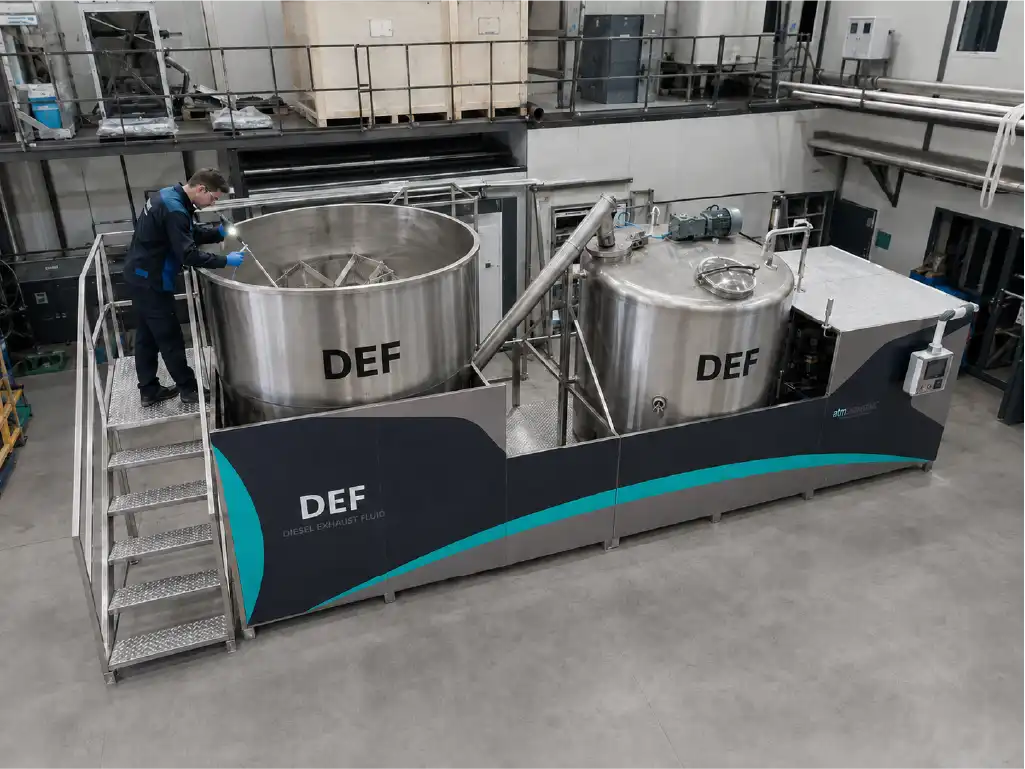
A sound AdBlue® CIP cleaning strategy therefore starts with a defined hygienic boundary. It should identify every surface that contacts purified water, urea solution or finished DEF, including recirculation loops, sample valves, probes, seals, pump housings and filling manifolds. Connections opened during maintenance or transfer also require risk-based review because they can admit dust, incompatible metals or environmental contamination.
Residual urea, stagnant zones and contamination risks
Residual urea is most likely to remain at low points, behind instruments, inside valve cavities, around mixer shafts, at pump seals and in branches with insufficient velocity. These stagnant zones are often called dead legs. Their significance depends on geometry, drainability, surface condition and actual AdBlue® CIP cleaning flow. A line may show acceptable return flow while a short branch receives little exchange.
When retained solution loses water, the local urea concentration increases and crystals may form. Those crystals can later dissolve into the next batch, shift its concentration or release particles intermittently. A visual inspection of accessible tank walls is valuable, but it cannot represent an entire closed circuit. AdBlue® tank cleaning must therefore account for inaccessible piping and worst-case locations as well as the main vessel.
Contamination is not limited to old product. Rinse water can contribute sodium, calcium, magnesium, iron or other ions if purification is not performing correctly. Unsuitable copper, brass, galvanized surfaces or non-compatible elastomers can also introduce unwanted material. Atmosfer Engineering’s guide to water quality for AdBlue® production explains why RO, EDI, conductivity trending and laboratory verification must operate as one controlled system.
Other risks include maintenance grease, fibers from wipes, fragments from seals, dust entering an open manway and residues from detergents. Because every cleaning agent becomes a potential contaminant, purified water is often the preferred medium where it can demonstrably remove the urea residue. If a chemical cleaner is necessary, its compatibility, concentration, removal method and analytical detectability should be justified during CIP validation.
How poor cleaning affects subsequent production batches
Carryover does not always cause an obvious failure at the mixer. Its effect can appear later as an abnormal refractive index, conductivity trend, insoluble matter result, metal content, alkalinity or appearance. A concentrated heel from the previous run may distort the water-to-urea balance. A residual detergent may change surface behavior or interfere with analysis. Contaminated rinse water can introduce ions even when the urea and process dosing are correct.
The risk is especially important after maintenance, an extended shutdown, an interrupted batch or an AdBlue® CIP cleaning cycle that missed a branch. First product may collect residue from a discharge valve or filling manifold, while a later composite sample dilutes the evidence. Sampling position and timing should follow a process-risk assessment.
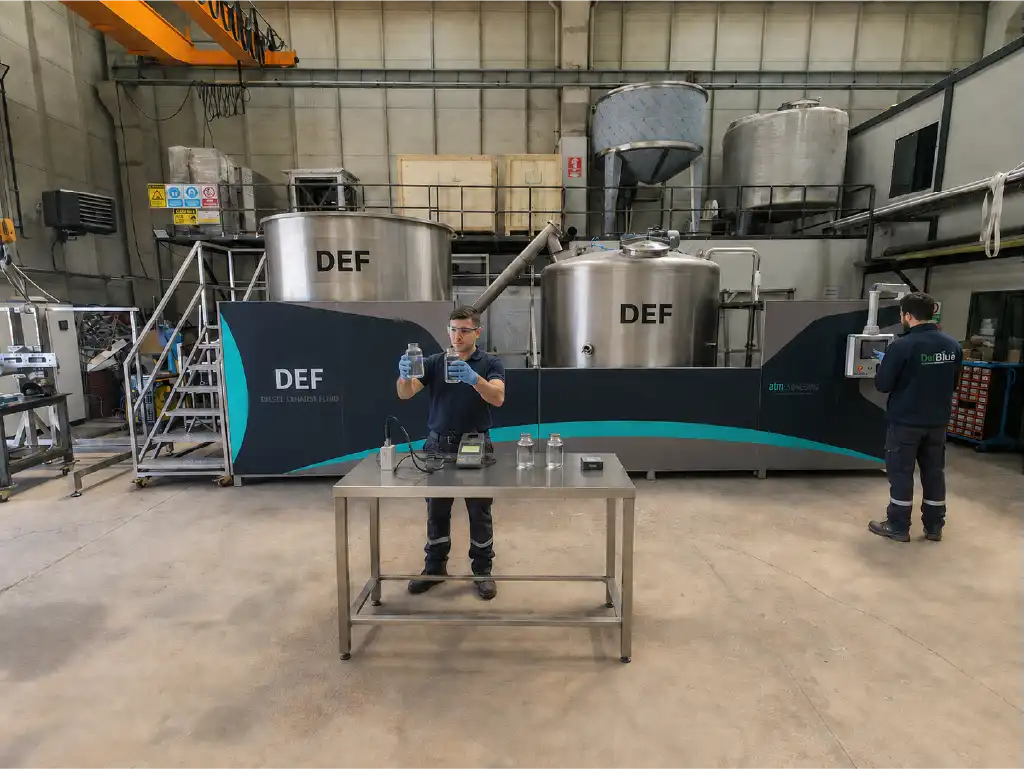
Poor AdBlue® CIP cleaning and inadequate DEF production line cleaning can lead to extra testing, quarantined stock, disposal costs and delayed deliveries. If an unsuitable batch reaches the market, complaints and investigations may involve containers, transfer equipment and transport. Linking cleaning and batch records helps locate whether a deviation began in raw materials, water preparation, production, cleaning, filling or downstream handling.
Atmosfer Engineering’s overview of ISO 22241-conscious AdBlue® machinery design highlights compatible contact materials, smooth surfaces, self-draining concepts and CIP capability. These design choices do not replace validation, but they make a stable AdBlue® CIP cleaning process easier to establish and repeat.
How to Build a Validated AdBlue® CIP Cleaning Procedure
A validated procedure should be built from the actual line, not copied from a generic checklist. Engineers should map the product path, identify the hardest-to-clean locations, confirm available flow and pressure, review spray-device coverage, and check whether the system drains without retained pockets. The design review should include tanks, transfer pumps, return headers, bypasses, instruments, hoses and the filling section.
The protocol defines critical AdBlue® CIP cleaning parameters, sampling methods, acceptance criteria and responsibilities before qualification begins. Trials should represent credible worst cases, such as the longest dirty hold time, concentrated residue, minimum circulation performance and challenging valve configurations. The number of successful runs should be justified by risk, variability and the quality system, not an arbitrary universal rule.
Cleaning sequence, circulation time and rinse water monitoring
The AdBlue® CIP cleaning sequence must cover batch completion through equipment release. Operators should know valve positions, open circuits, required water quality, return routing and sampling time. Where routes differ, a verified valve matrix or automated recipe reduces the chance that a branch is excluded.
| Stage | Primary control | Evidence to record |
|---|---|---|
| Product removal and drain | Defined end point, low-point drainage and correct valve route | Start time, drain status and abnormal observations |
| Initial rinse | Approved purified-water quality and complete circuit wetting | Water source, volume or time, temperature and return appearance |
| Recirculation | Validated flow, pressure, temperature and contact time | Actual readings, alarms and confirmed branch positions |
| Final rinse | Fresh qualified water and representative sampling | Conductivity, temperature and residue-specific result where required |
| Drain and protection | Complete drainage, closed hygienic boundary and defined clean hold time | Completion time, inspection and release status |
AdBlue® CIP cleaning circulation time must be established with hydraulic conditions. Time alone is not proof: a long cycle at inadequate velocity may leave films and dead zones untouched, while excessive flow or pressure can stress equipment without improving coverage. The validated window should specify values that the installed pump, spray device and pipework can reliably deliver.
Temperature can improve dissolution, but it must remain compatible with seals, instruments and system materials. The chosen range should also be realistic at the point most difficult to heat, not only at the supply tank. If the procedure relies on temperature, the protocol should define sensor location, stabilization requirement and action when the minimum is not achieved.
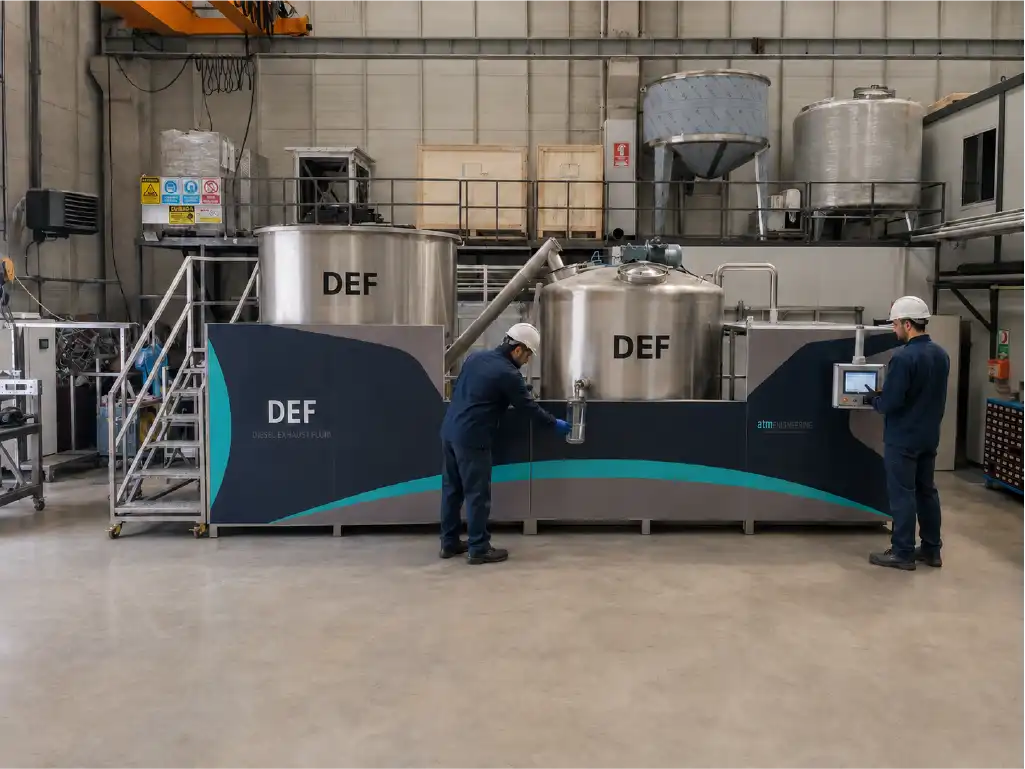
For AdBlue® CIP cleaning rinse monitoring, compare final return with a representative purified-water sample. Conductivity helps detect ionic differences and trend the endpoint, but is not automatically a complete urea-residue test. A urea-specific method, refractive index, TOC or another approach may be selected according to residue profile, required sensitivity and validated capability. Water and container background must be understood.
The FDA guide on validation of cleaning processes, although written for regulated pharmaceutical manufacturing rather than DEF production, provides a useful general principle: rinse sampling covers large and inaccessible areas, but direct surface sampling is valuable where residue may be physically retained, and indirect measures such as conductivity should be correlated with equipment condition before routine use. An AdBlue® CIP cleaning protocol can adapt that logic without treating the FDA document as an AdBlue® specification.
Acceptance criteria, documentation and operator responsibilities
AdBlue® CIP cleaning acceptance criteria must be defined before validation and connected to product risk. “Clear rinse” or “no visible residue” alone is insufficient. Criteria may include satisfactory visual inspection, no crystals at worst-case points, final-rinse conductivity within an established relationship to the water blank, residue below a justified limit, cleaning chemical below its limit, complete drainage, and no unresolved alarms or leaks.
The laboratory method needs an appropriate range, detection capability and recovery assessment for the selected surface or rinse matrix. Sample points should represent both the bulk circuit and known hard-to-clean locations. Where swabbing is feasible, the defined area, swab material, extraction solvent and technique should be controlled. Where only rinse sampling is practical, the volume, contact conditions, collection point and sample handling should be consistent.
Expert note: Do not set an acceptance limit only because an instrument can measure it. Begin with the residue and contamination risk to the next DEF batch, establish a technically justified limit, and then confirm that the sampling and analytical method can reliably detect that limit under site conditions.
A complete AdBlue® CIP cleaning record should identify equipment, previous batch, operator, recipe version, water source, times, actual flow, pressure and temperature, rinse results, deviations, corrective actions and release authorization. Automated capture does not remove the need for controlled manual checks and review. Atmosfer Engineering’s guide to DEF batch traceability shows how production, laboratory, retained-sample and operator records work together during a quality investigation.
Operators are responsible for following the approved sequence, confirming valve positions, observing abnormal conditions and stopping the cycle when a critical parameter falls outside its range. Quality personnel approve the protocol, review results and authorize release. Engineering maintains the hygienic design, instruments, pumps and automation. The laboratory controls sampling and testing. Clear ownership prevents a failed cycle from being informally accepted because each department assumed another had reviewed it.
Routine verification should confirm that each AdBlue® CIP cleaning cycle remained within its validated window. Periodic review should evaluate trends such as rising final-rinse conductivity, longer endpoint time, repeated low-flow alarms or residue at the same location. Revalidation or documented assessment may be required after tank or piping modification, software changes, new cleaning chemistry, altered water quality, major maintenance, a longer dirty hold time, or an unexplained batch contamination event.
Finally, AdBlue® CIP cleaning must address clean hold time. A released line can be re-exposed through open vents, unprotected hoses or maintenance. The procedure should define how equipment is closed and protected, how long it may remain idle, and what check or abbreviated rinse is required before production resumes.
Frequently Asked Questions About AdBlue® CIP Cleaning
Is purified water enough for AdBlue® tank cleaning?
Purified water may be sufficient because urea is highly water-soluble, but AdBlue® CIP cleaning adequacy must be demonstrated for the actual tank, residue and circuit. Long dirty hold times, crystals, poor spray coverage or maintenance contamination may require a revised method. Any chemical introduces compatibility and carryover controls.
Can conductivity alone validate a CIP cycle?
Not automatically. Conductivity can be a strong routine trend indicator, particularly when final rinse is compared with qualified source water. During CIP validation, the site should demonstrate that the selected endpoint correlates with acceptable residue removal. A residue-specific test or direct surface sample may also be needed.
Where should final-rinse samples be taken?
Sampling should cover the return stream and risk-based worst-case points such as low drains, remote branches, valve cavities or the filling manifold. The exact plan depends on line geometry, flow path and accessibility. Sampling only the easiest outlet can miss locally retained residue.
How often should CIP validation be repeated?
There is no single interval suitable for every DEF plant. The quality system should define periodic review and revalidation triggers based on risk, performance trends, equipment changes, maintenance, deviations and cleaning-process changes. Stable routine records help justify the chosen frequency.
What happens if one cleaning parameter is outside its validated range?
The equipment should not be released automatically. The deviation must be documented and assessed, and the cycle may need to be repeated with additional sampling or investigation. The response should be defined in the SOP so operators do not make improvised release decisions under production pressure.
Build Cleaning Control into Your DEF Production Project
A reliable production line should make cleanliness measurable, repeatable and easy to document. Atmosfer Engineering supports new plant investments and upgrades with project-based evaluation of tank geometry, compatible product-contact materials, purified-water preparation, recirculation routes, instrumentation, automation and quality-control sampling points. The objective is not merely to add a CIP button; it is to create an AdBlue® CIP cleaning process that operators can execute consistently and that quality teams can verify with meaningful evidence.
If you are planning a turnkey DEF facility, expanding capacity or investigating recurring residue and contamination risk, visit Atmosfer Engineering to review production solutions and request technical consultation. An expert team can assess your raw-water conditions, batch schedule, equipment layout, required documentation and site constraints before proposing the appropriate cleaning and monitoring concept. This project-specific approach helps reduce avoidable downtime while protecting batch consistency and long-term plant reliability.
The images are for illustrative purposes only and were generated using artificial intelligence.
