
An AdBlue plant FAT SAT program gives a buyer objective evidence that a production system was built as specified, performs under agreed conditions and can operate safely at the final site. FAT, or Factory Acceptance Test, is completed before shipment at the manufacturer’s facility. SAT, or Site Acceptance Test, is performed after installation and connection to the buyer’s utilities. Treating them as two controlled stages reduces the risk of accepting a machine on appearance alone.
The purchase specification should define test boundaries, instruments, representative raw materials, capacity, tolerances, witness points, documents and retest rules. This guide shows how to structure an AdBlue factory acceptance test and DEF plant commissioning plan around verifiable results.
AdBlue Plant FAT SAT: Defining Acceptance Before Testing
A practical AdBlue plant FAT SAT protocol converts the quotation, process description and approved drawings into measurable pass criteria. “Machine runs correctly” is not sufficient. A useful criterion identifies the operating condition, measurement method, sample size, permissible deviation and evidence. Unmeasurable requirements should be clarified before testing.
The AdBlue plant FAT SAT protocol should also identify exclusions. A skid may use temporary tanks, test water or a simulated downstream connection at the factory. That limitation is acceptable when documented and scheduled for SAT confirmation. Atmosfer Makina’s turnkey DEF production systems connect water preparation, dosing, mixing, monitoring and transfer, so interface boundaries deserve attention. Before witnesses arrive, approve the protocol, test schedule, latest drawings, instrument list and signatory authority.
What Should Be Tested During the Factory Acceptance Test?
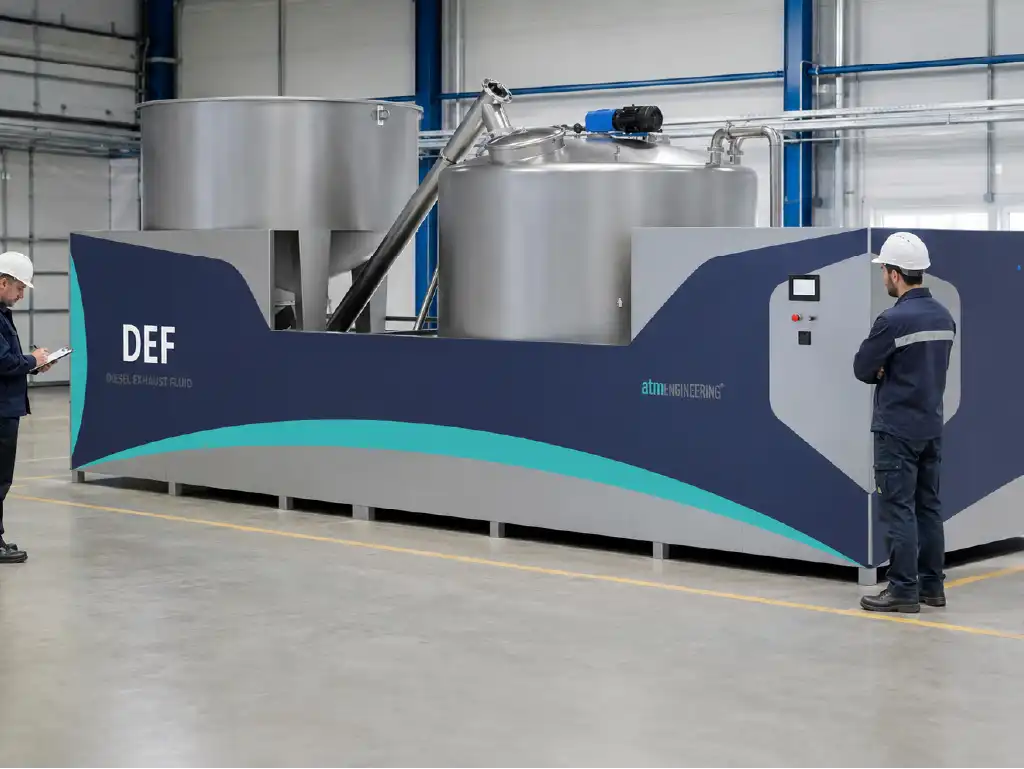
The factory stage of AdBlue plant FAT SAT confirms that equipment matches the approved design before shipment. It should include visual inspection, document review, static checks and dynamic operation. The supplier should complete internal pretesting first. An effective production line acceptance test records values, instrument identities, observations and punch-list items.
Mechanical, electrical and automation inspections
Mechanical inspection begins with the approved layout and piping and instrumentation diagram. Verify skid dimensions, tank orientation, pump and valve locations, maintenance access, guards, lifting points, anchors and drainage. Product-contact materials, gaskets, hoses and seals should match the specification. Examine accessible welds and sanitary connections, confirm flow direction and check pipe supports.
For an AdBlue plant FAT SAT, cleanability and contamination control are functional requirements. Inspect possible stagnation points, verify drainage and remove temporary workshop materials. Check pump rotation, agitator direction, valve actuation, leakage and vibration during operation. Passivation, flushing or cleaning requirements need documented acceptance.
Electrical inspection compares the panel and field devices with approved schematics. Qualified personnel should verify protective earthing, terminals, cable routing, motor protection, phase sequence, cabinet ventilation and safety circuits. Perform insulation or continuity testing when applicable. Demonstrate emergency stops, door interlocks and reset behavior.
Automation testing follows the I/O list and functional specification. Check each critical sensor, motor and valve from field device to PLC and HMI. Verify modes, permissions, recipes, setpoint limits, interlocks, trends, alarm history, batch records and time synchronization. If remote access is included, define authorization, security, backups and permitted intervention.
- Confirm that manual mode cannot bypass critical safety or quality interlocks without controlled authorization.
- Check the machine response after power interruption, communication loss and controlled restart.
- Verify PLC, HMI and parameter backups, including the approved software version.
- Record calibration status and serial numbers for critical process instruments.
Dosing accuracy, alarm simulation and batch performance tests
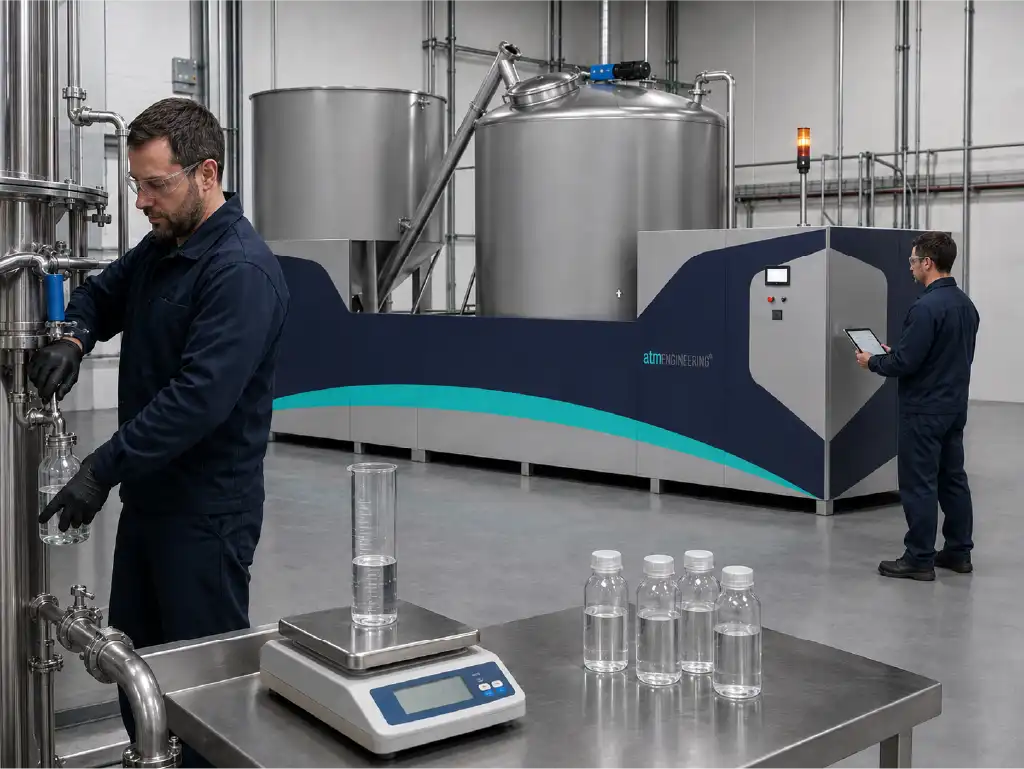
Dosing tests verify water and urea quantities because final concentration depends on their controlled relationship. Use calibrated load cells, flow meters, reference weights or combined measurements. Acceptance instruments need valid calibration evidence and suitable resolution. Test multiple cycles; one successful value cannot demonstrate repeatability.
A robust AdBlue factory acceptance test within the AdBlue plant FAT SAT plan challenges normal and boundary conditions. Confirm dosing stages, automatic cut-off, residual handling, mixing time, transfer logic and prevention of double dosing. If the test medium differs from actual urea and demineralized water, document which product checks will be repeated during DEF plant commissioning.
Alarm simulation proves machine behavior under abnormal conditions. Simulate relevant low and high levels, no flow, motor overload, high pressure, sensor failure, communication loss, unsuitable water-quality signal and emergency stop. Confirm detection, time stamp, safe state and reset logic. The AdBlue plant FAT SAT record should distinguish a screen alarm from an interlock that stops the affected operation.
Measure complete cycle time from approved start condition to finished-product transfer, not only mixer time. Record dosing, dissolution, mixing, verification, filtration and transfer. Compare gross batch volume with usable output. For contractual energy or water targets, define the measurement boundary beforehand.
Finished DEF quality requires verification beyond online readings. Use compatible clean sample containers and link every sample to its batch. Concentration, refractive index, density or project-defined parameters may be checked on site, while a qualified laboratory may be needed for the wider impurity profile. A U.S. EPA verified SCR technology reference specifies DEF meeting API certification of ISO 22241-1 quality requirements, including appropriate purity and 32.5% urea concentration. Acceptance must follow the applicable contract, standard edition and market requirements.
| Test area | Typical verification | Objective evidence | Pass basis |
|---|---|---|---|
| Mechanical | Materials, piping, pumps, valves and drainage | Drawings, certificates, inspection record | Approved design and project specification |
| Electrical | Panel, earthing, protection and safety circuits | Test values and signed checklist | Approved schematics and applicable rules |
| Automation | I/O, recipes, interlocks and data logging | Functional test sheets and backups | Functional design specification |
| Dosing | Water and urea quantity repeatability | Calibrated measurement results | Contractual tolerance and sample plan |
| Performance | Batch time, output and transfer | Batch report and time-stamped trends | Defined operating conditions |
| Safety | Emergency stops and failure response | Alarm matrix and simulation record | Risk assessment and approved logic |
Expert note: Do not let the acceptance meeting become an improvised demonstration. Freeze the software version, drawings and test protocol before FAT. Log every deviation with an owner, due date, severity and retest requirement. This creates a defensible bridge between factory testing, shipment and site acceptance.
What Should Be Verified During Site Acceptance Testing?
The SAT stage of AdBlue plant FAT SAT confirms that the delivered system survived transport, was installed correctly and performs with real utilities, materials and downstream equipment. Inspect shipping condition, record damage before repair, verify leveling and anchoring, and close installation checks before energizing.
Utility connections, water quality and production capacity
Verify every interface against the utility schedule: voltage, frequency, phase, power, protective earth, compressed air if used, feed-water pressure and flow, drainage, ventilation and ambient conditions. Check pipe size, material, flushing and flow direction. Permanent connections may reveal pressure loss or control behavior hidden during FAT.
Water quality is especially important in an AdBlue plant FAT SAT because changes in feed water can alter treatment performance and final product risk. Test representative incoming water and verify pre-treatment, reverse osmosis and EDI or polishing performance under site conditions. Conductivity is valuable for online monitoring, but it does not replace the complete analysis required by the project quality plan. Atmosfer Makina’s guide to water quality requirements for AdBlue production explains why feed-water analysis, RO performance, polishing and laboratory confirmation should be assessed as one system.
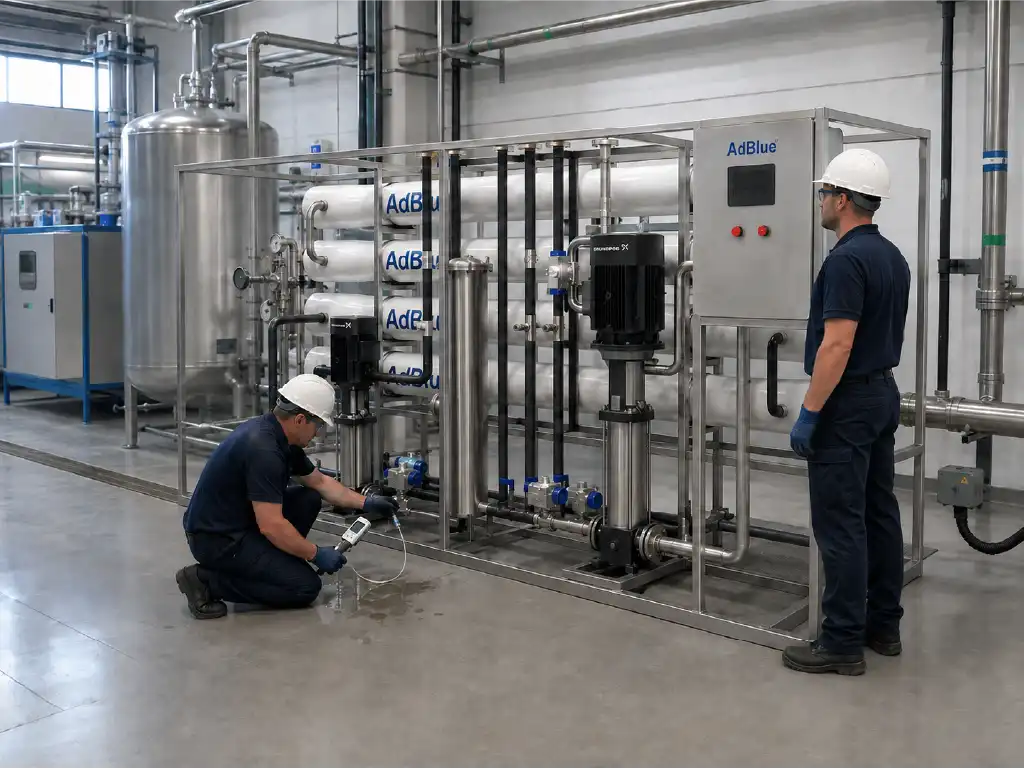
Commission water treatment to stable conditions rather than accepting the first low reading. Record flow, pressure, recovery, conductivity, temperature and relevant differential pressure. Sample after flushing from a defined point. Because SAT cannot reproduce every seasonal variation, handover documents should define operating limits and actions for off-spec water.
Production capacity should be verified at the contractual boundary. State whether capacity means batch volume, cubic meters per hour, saleable output per shift or daily production under a defined schedule. Include normal dosing, dissolution, quality checks, filtration and transfer. Downstream storage or a filling line can restrict output even when the mixer performs correctly, so the AdBlue plant FAT SAT report should separate equipment capability from site bottlenecks and identify the action needed for each.
Repeat enough cycles to demonstrate stable operation with representative urea and treated water. Compare concentration, cycle time, yield, alarms and operator intervention with approved criteria. If packaging is included, test representative containers, caps and labels through the filling, capping and labeling system. Trace accepted batches from raw material to storage or packaging.
Training, documentation and final handover criteria
Training should be role based. Operators need start-up, shutdown, sampling, alarm response and cleaning instruction. Maintenance staff need isolation, preventive tasks, instrument checks and backup restoration. Quality staff should understand sampling, instrument limits, batch release and deviations. Supervised operation provides stronger evidence than attendance alone.
Documentation must match the installed system. Typical items include as-built layout and P&ID, electrical drawings, utility and instrument lists, material and calibration certificates, manuals, spares, FAT and SAT reports, training records, software backups and warranty information. PLC or HMI source access, passwords and remote-support tools should follow the contract and cybersecurity policy.
Batch traceability remains important after acceptance. Define batch numbering, raw-material lot links, sample identification, process values, alarm history, operator records and release status. The Atmosfer Makina resource on DEF production traceability and batch records provides a useful framework for connecting process data with quality decisions.
Final AdBlue plant FAT SAT handover should use a signed status list. Close critical safety, quality and operation items before acceptance. Minor items may remain only with an owner, due date and agreed impact. The certificate should state warranty start, open obligations, retest results, limitations and the change-control baseline.
Turning AdBlue Plant FAT SAT Results into a Defensible Handover
A successful AdBlue plant FAT SAT process confirms that the line is mechanically complete, electrically safe, logically controlled, capable of repeatable dosing and supported by reliable documentation. FAT removes avoidable problems before shipment; SAT proves the installed process under site conditions.
Buyers gain the strongest protection when acceptance criteria are agreed early, measurements are traceable and deviations lead to documented corrective action. Supplier expertise also matters: water treatment, dosing, automation, storage and filling must operate as a connected quality chain. Project-specific technical analysis is therefore more dependable than a generic checklist used without reference to site conditions and contractual scope.
Frequently Asked Questions
What is the difference between FAT and SAT for an AdBlue production plant?
FAT verifies design, assembly and performance at the manufacturer’s facility before shipment. SAT verifies installation, utility integration and performance with real site conditions after delivery. The two stages share some tests, but SAT closes the risks that cannot be reproduced at the factory.
How long does an AdBlue factory acceptance test take?
Duration depends on plant capacity, automation, test scope and the number of witnessed batches. A compact skid may require a focused test period, while an integrated water-treatment, production, storage and filling line needs more time. The schedule should be based on protocol steps rather than a fixed generic duration.
Can SAT be skipped for a preassembled production skid?
Skipping SAT creates avoidable risk because transport, installation, utilities, feed-water quality and site piping can affect operation. A preassembled skid can reduce commissioning work, but key safety, quality, interface and performance tests should still be confirmed at site.
Which instruments should be calibrated for the production line acceptance test?
The AdBlue plant FAT SAT instrument list commonly includes load cells, flow meters, conductivity sensors, pressure transmitters, temperature sensors and laboratory instruments used to approve results. Calibration intervals and traceability levels should be defined in the quality plan and contract.
Who should sign the final FAT and SAT acceptance certificate?
Authorized representatives identified in the contract should sign. This often includes the supplier and buyer’s engineering or project representative, with operations, quality or an independent inspector participating when required. Signatures should reference the approved protocol, results, deviations and remaining obligations.
Plan Your Acceptance Process with Atmosfer Makina
If you are comparing production systems, preparing a procurement specification or approaching commissioning, Atmosfer Makina can help align equipment design with a practical AdBlue plant FAT SAT plan. The evaluation can cover water-treatment interfaces, urea dosing, mixing, filtration, automation, storage transfer, filling integration, capacity targets and the records needed for handover.
Because feed-water analysis, site utilities, packaging formats and operating expectations differ between projects, the most useful checklist is one adapted to your real conditions. Visit Atmosfer Makina to discuss your intended capacity, factory layout, utility data and quality-control expectations. The engineering team can review the project scope, clarify acceptance boundaries and prepare a solution that supports efficient testing, operator readiness and documented final delivery without turning the process into an overly aggressive sales exercise.
The images are for illustrative purposes and feature artificial intelligence capabilities.
