
Liquid cooling in data centers is becoming more common as AI and high-performance computing put more heat into each server rack. If you are planning a new facility or adding GPU racks to an existing one, start with the servers you intend to deploy. Their cooling requirements will shape the choice between direct-to-chip and immersion cooling and determine what the facility must provide. IEA, Energy and AI
Direct-to-chip or immersion cooling?
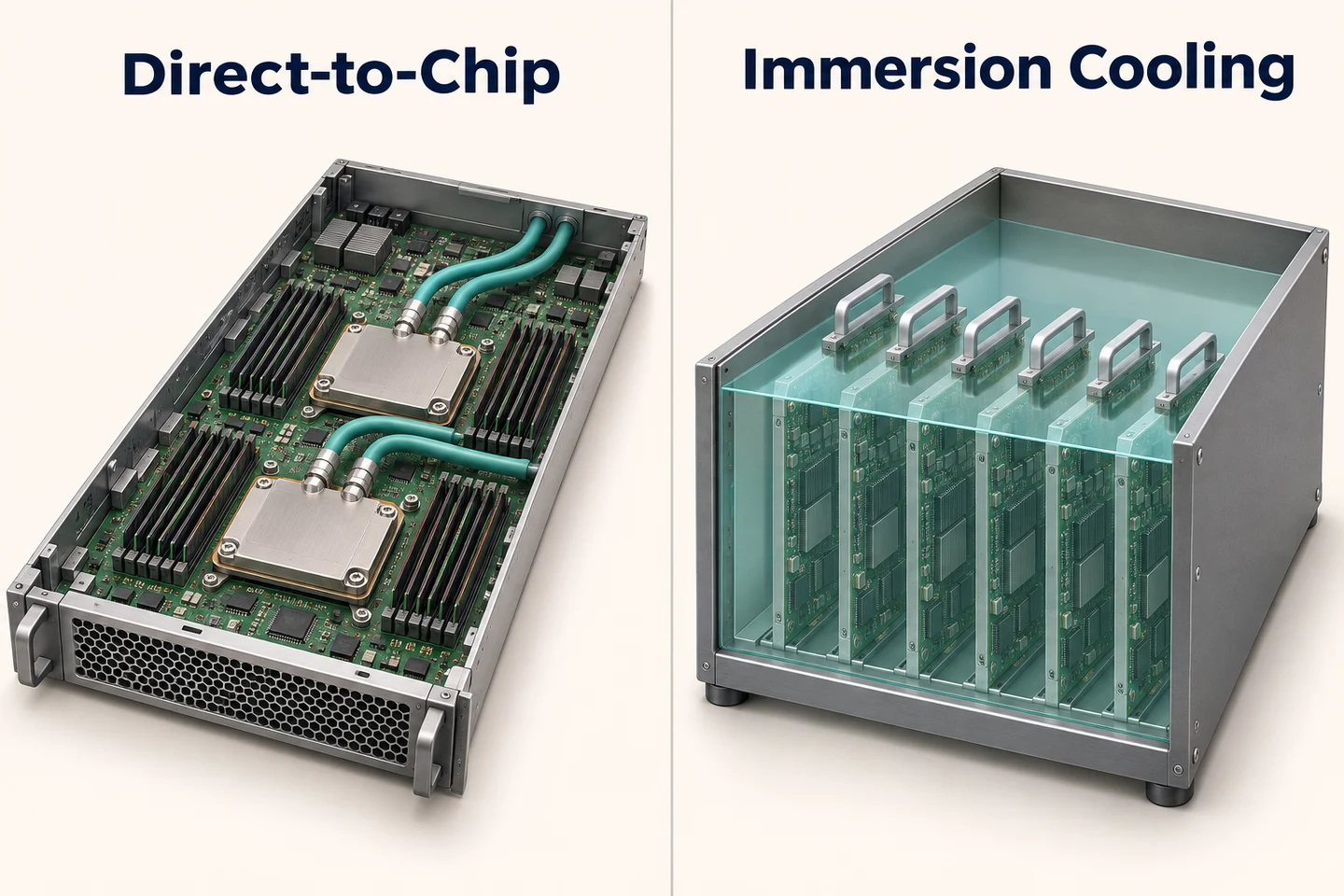
With direct-to-chip cooling (DTC), cold plates mounted on CPUs and GPUs transfer heat to a circulating coolant. Memory, power supplies, and other components may still need airflow. This approach can suit a phased retrofit when the selected servers support cold plates and the facility can retain enough air cooling for the remaining heat load. Open Compute Project, Cold Plate
With immersion cooling, compatible servers sit in a tank of electrically insulating fluid. In a single-phase system, the fluid stays liquid and carries heat to a heat exchanger. In a two-phase system, the fluid boils at hot surfaces and the vapor condenses inside the tank. Both designs require compatible server hardware, space for the tanks, and procedures for removing and servicing submerged equipment. Open Compute Project, Immersion Requirements
| Selection criterion | Direct-to-chip | Immersion cooling |
|---|---|---|
| Heat pickup | Cold plates on processors | Direct contact between dielectric fluid and submerged electronics |
| Server compatibility | Servers designed for cold plates and liquid connections | Servers and materials approved for the immersion fluid |
| Facility requirements | Liquid distribution and any remaining air cooling | Tanks, heat exchangers, and space to service equipment |
| Design checks | Coolant quality, flow, and pressure drop | Fluid compatibility, tank layout, and maintenance access |
Water-cooled cold plates were the most commonly reported option among direct liquid cooling users in the Uptime Institute’s 2024 survey. For your project, the choice depends on which hardware you can deploy and how you plan to maintain it. Uptime Institute’s 2024 Cooling Systems Survey
Why is the CDU important?
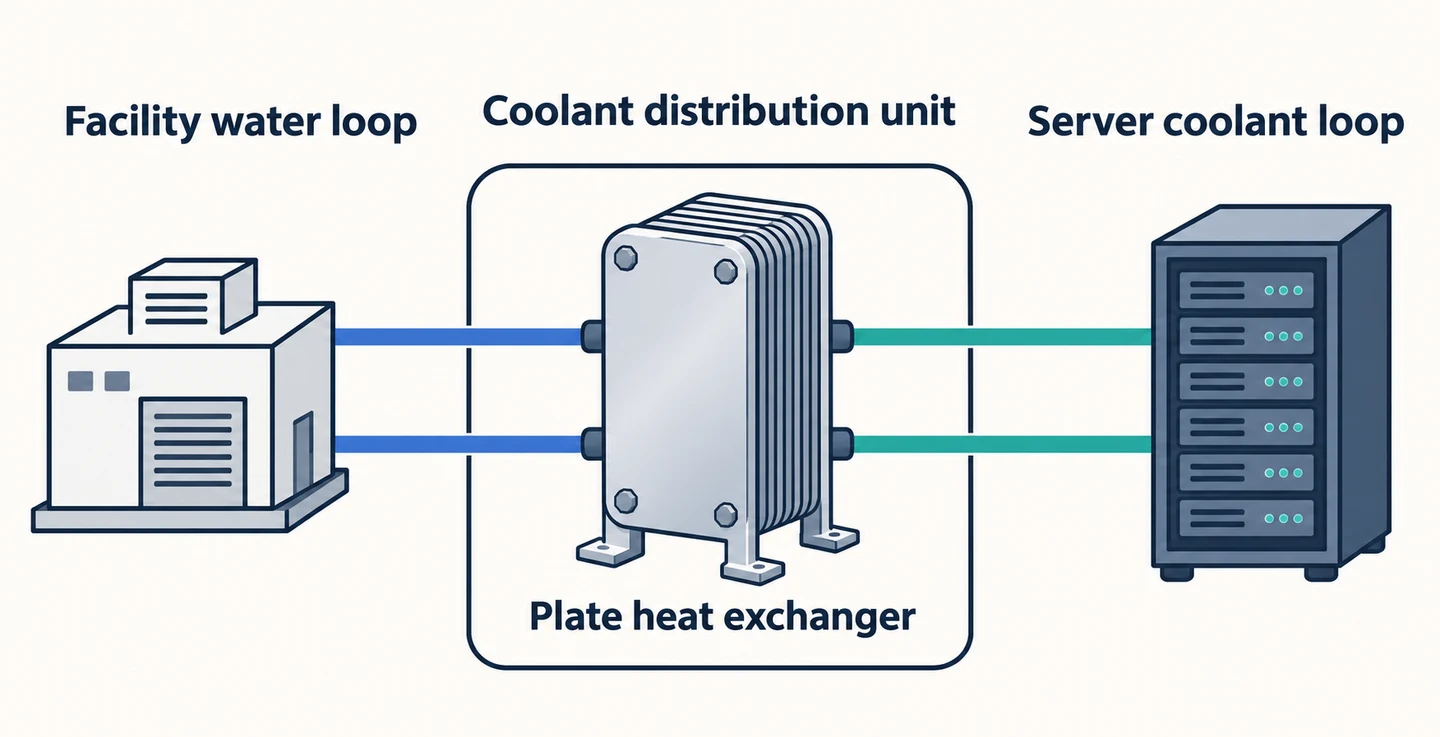
A coolant distribution unit (CDU) links the server coolant loop to the facility’s cooling infrastructure. In a liquid-to-liquid CDU, a plate heat exchanger transfers heat from the server coolant to the facility water while keeping the two fluids separate. Pumps and controls help maintain the flow and temperature required by the server loop. Open Compute Project, Liquid-to-Liquid CDU Design Guidance
Check three things when selecting a CDU.
- Cooling capacity. Check the expected IT heat load and the CDU’s rated capacity at the facility water temperature and flow you can provide.
- Hydraulic performance. Verify that the CDU can deliver the required flow to the racks at the designed pressure drop.
- Coolant quality. Follow the equipment manufacturer’s requirements for coolant chemistry, filtration, and material compatibility. Corrosion and deposits can reduce cold-plate performance and restrict flow. Chinthaparthy et al., ASHRAE Journal
Can liquid cooling reduce energy costs?
When the equipment can operate with warmer facility water, a dry cooler may be able to reject heat to the outdoor air for more hours of the year. That can reduce chiller runtime. ASHRAE’s liquid cooling classes specify maximum facility supply temperatures for compatible equipment. To estimate savings for your site, use local weather data, the expected heat load, and the electricity demand of the pumps, fans, and chillers. ASHRAE Handbook · Open Compute Project, Reference Design Guidance
Heat recovery is worth evaluating when a nearby process can use the heat at the temperature you can supply. In a 2026 modeling study, Yang, Konstantinou, and Hou used data center waste heat to preheat seawater for reverse osmosis desalination. The authors attributed approximately 17% cost savings to heat reuse in that specific modeled case. Yang et al., Applied Energy
How to choose a system for your data center
For a retrofit, confirm which racks can accept liquid-cooled servers, how much air cooling you will still need, and what your existing facility loop can support. For a new build, define the expected rack density, total heat load, and room for expansion before sizing the facility loop and heat rejection equipment.
Specify water quality for the facility loop and coolant quality for the server loop separately. A water analysis can help determine whether filtration, pretreatment, or reverse osmosis is appropriate for the relevant water stream. Use the equipment manufacturer’s specifications to set the requirements for the server coolant. Atmosfer Makina’s industrial reverse osmosis systems · Data center seawater desalination systems
Atmosfer Makina can help assess water treatment and filtration requirements for your cooling project. For an initial review, share your water analysis, required cooling capacity, design flow rate, and the equipment manufacturer’s coolant specifications. Contact Atmosfer Makina
